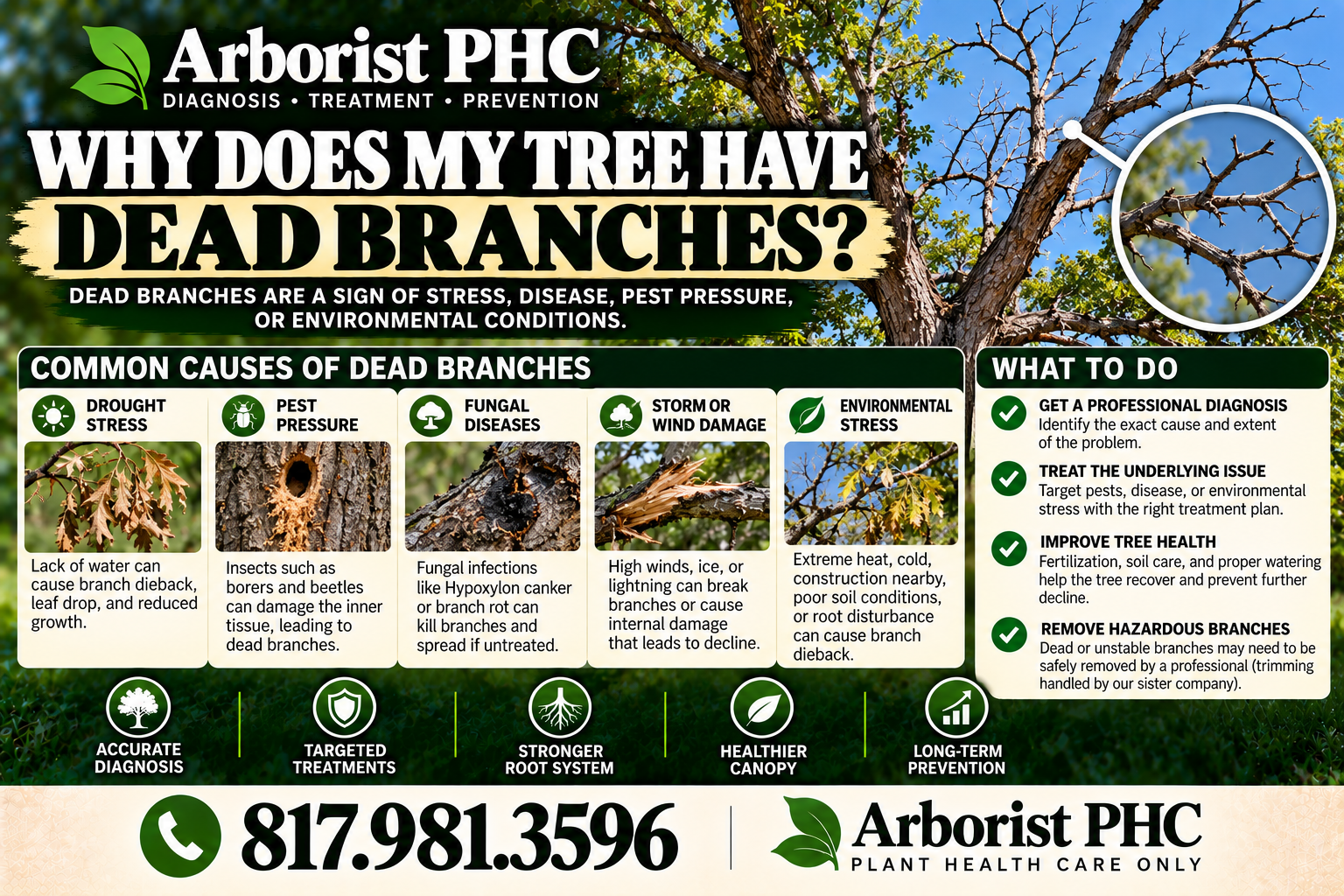
Why Does My Tree Have Dead Branches? | Causes, Diagnosis & Treatment | Arborist PHC
Why Are Branches Dying on My Tree?
If you’ve noticed dead branches throughout your tree—or even a single large limb that has suddenly died—you may be wondering what’s causing the problem.
Dead branches are one of the most common warning signs that a tree is experiencing stress, disease, insect activity, or root problems. While a few dead twigs can be part of a tree’s natural aging process, significant branch dieback is usually a sign that something more serious is affecting the tree.
At Arborist PHC, we specialize exclusively in Plant Health Care (PHC) and help homeowners identify the underlying cause of branch dieback before it progresses into severe canopy decline or tree loss.
What Causes Dead Branches?
Dead branches don’t occur without a reason.
When a tree is unable to transport enough water and nutrients to part of its canopy, it begins shutting down those limbs to conserve energy.
Several different problems can cause this response.
Common Causes of Dead Branches
Extended periods of extreme heat and drought place tremendous stress on trees.
As moisture becomes limited, trees often sacrifice smaller limbs and branch tips to conserve water.
Common symptoms include:
🍂 Dead branch tips
🍂 Brown leaves
🍂 Thin canopy
🍂 Premature leaf drop
🍂 Slow growth
🍄 Fungal Diseases
Several diseases cause branch dieback throughout Texas.
Common examples include:
Tubakia Leaf Spot
These diseases interfere with the movement of water and nutrients, causing branches to decline over time.
🐛 Insect Activity
Many insects attack weakened trees and contribute to branch dieback.
Common pests include:
🐛 Carpenter Ants
🐛 Scale Insects
🐛 Bagworms
Secondary insect infestations are often a sign that the tree is already under stress.
🌱 Nutrient Deficiencies
Trees lacking essential nutrients may develop:
🍂 Sparse foliage
🍂 Yellow leaves
🍂 Slow growth
🍂 Branch dieback
Iron Chlorosis is one of the most common nutrient-related problems affecting trees in Texas.
Excavation, trenching, soil compaction, heavy equipment, and utility installation can severely damage root systems.
When roots are compromised, portions of the canopy may no longer receive enough water and nutrients, leading to:
🍂 Dead branches
🍂 Wilting
🍂 Thin canopy
🍂 Progressive decline
🌧 Root Rot & Poor Drainage
Roots require oxygen to survive.
When soils remain saturated for extended periods, roots begin to decline, reducing their ability to support the canopy.
Symptoms include:
🍂 Dead limbs
🍂 Yellow leaves
🍂 Wilting
🍂 Sparse canopy
🍂 Slow decline
Trees Commonly Affected
We frequently diagnose branch dieback on:
🌳 Red Oaks
🌳 Bur Oaks
🌳 Savannah Post Oaks
🌳 Bradford Pears
🌳 Desert Willows
🌳 Maple Trees
🌳 Italian Cypress
🌳 Leyland Cypress
Why Accurate Diagnosis Matters
Dead branches are a symptom—not the diagnosis.
Many different issues produce similar symptoms.
Our Certified Arborists evaluate:
✔️ Tree species
✔️ Branch structure
✔️ Canopy density
✔️ Root health
✔️ Soil conditions
✔️ Disease symptoms
✔️ Insect activity
✔️ Irrigation practices
✔️ Environmental stress
✔️ Construction damage
Determining the underlying cause allows us to recommend the most effective treatment program.
Our Plant Health Care Solutions
Every treatment recommendation is customized to the specific needs of your tree.
🌱 Deep Root Inoculation
Our Deep Root Inoculation program helps:
✔️ Stimulate healthy root development
✔️ Improve nutrient uptake
✔️ Increase drought tolerance
✔️ Reduce environmental stress
✔️ Strengthen overall tree health
🌳 BBT (Broad Brush Treatment) Program
Our signature BBT (Broad Brush Treatment) combines several Plant Health Care techniques into one comprehensive treatment.
The program may include:
✔️ Deep Root Inoculation
✔️ Basal Drench Applications
✔️ Nutrient Management
✔️ Micronutrient Support
✔️ Disease Management
✔️ Insect Management
✔️ Environmental Stress Reduction
Our goal is to restore tree vigor while helping prevent future decline.
💧 Basal Drench Applications
Basal Drench treatments improve systemic uptake through the root flare while promoting healthier roots and improved nutrient movement throughout the tree.
Can a Tree Recover from Branch Dieback?
In many cases, yes.
If the underlying problem is identified early, many trees can recover and produce healthy new growth over time.
However, ignoring dead branches often allows the problem to worsen, increasing the risk of additional canopy loss and structural decline.
Early diagnosis provides the best opportunity for recovery.
Schedule a Tree Health Assessment
If your tree has dead branches, don’t assume it’s simply getting old.
Branch dieback is often an early warning sign that your tree needs professional attention.
📞 Call or Text Arborist PHC
📸 Send Photos for a Preliminary Evaluation
Our Certified Arborists will identify the underlying cause of decline and develop a customized Plant Health Care program designed to restore and protect your trees.
Frequently Asked Questions
-
Dead branches are commonly caused by drought stress, fungal diseases, insect activity, nutrient deficiencies, root damage, poor drainage, or environmental stress.
-
Not always. Many trees recover when the underlying cause is identified and treated early.
-
Dead branches can become hazardous and are often removed for safety. However, it’s important to identify why they died before assuming pruning alone will solve the problem.
-
Yes. Heat and drought stress are among the leading causes of dead branches throughout Texas.
-
No. Arborist PHC specializes exclusively in Plant Health Care, diagnosis, treatment, and preventive care.