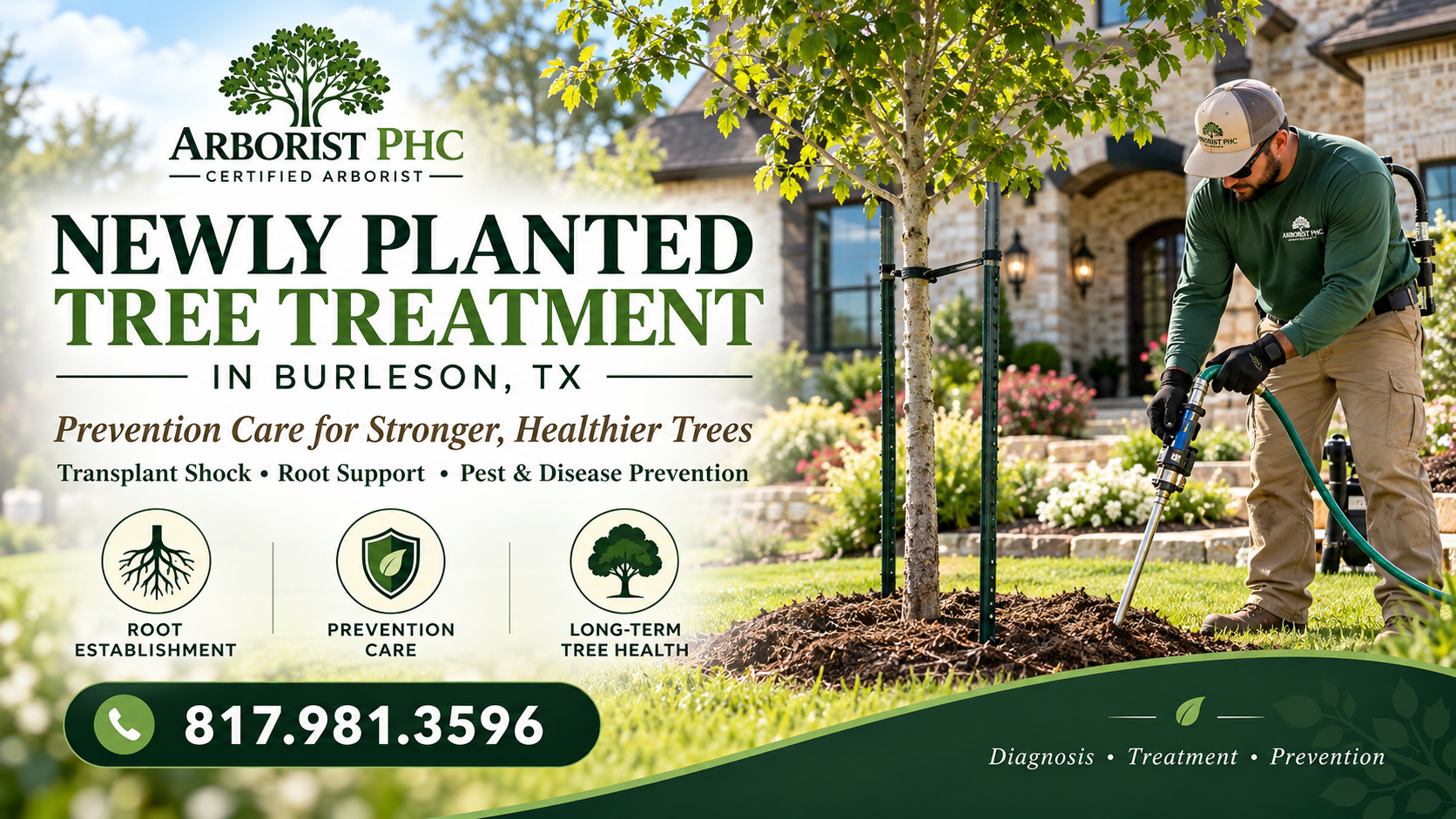
Newly Planted Tree Treatment in Burleson, TX | Preventative Tree Care
Planting a new tree is an investment in your property, but the first several years after planting are often the most important for long-term tree health. Newly planted trees in Burleson, TX can experience transplant stress, limited root development, heat stress, drought, pest pressure, nutrient deficiencies, and fungal problems while they are becoming established.
At Arborist PHC, our approach is centered around Diagnosis • Treatment • Prevention. Preventative plant health care can help a newly planted tree establish a stronger root system, adapt to North Texas conditions, and reduce the risk of problems becoming more serious later.
Why Newly Planted Trees Are More Vulnerable
When a tree is transplanted, much of its original root system may be disturbed or reduced. Even when the tree appears healthy above ground, the root system is still working to become established in its new environment.
During this establishment period, the tree can be more sensitive to:
Heat and drought stress
Improper watering
Poor drainage or oversaturated soil
Root damage or restricted root growth
Nutrient deficiencies
Pest activity
Fungal diseases
Planting depth problems
Soil compaction
Environmental stress
Burleson summers can be especially difficult on young trees because high temperatures increase moisture loss while the developing root system may not yet be able to supply the canopy efficiently.
Preventative Treatment Can Help Support Root Establishment
One of the most important goals after planting is encouraging the development of a healthy, functional root system.
Depending on the condition of the tree and surrounding soil, a preventative Plant Health Care program may include treatments designed to support:
Root Development
Healthy roots allow the tree to absorb water, nutrients, and oxygen more efficiently. Supporting the root zone during the establishment period can help improve long-term vigor.
Nutrient Availability
Newly planted trees may struggle to access nutrients if the surrounding soil is compacted, depleted, poorly drained, or significantly different from the soil in the original root ball.
A targeted nutritional program can help provide support while the tree becomes established.
Pest Prevention
Stressed trees are often more vulnerable to insects. Certain pests may take advantage of trees already weakened by transplant shock, drought, or root stress.
Preventative monitoring and treatment can help reduce pest pressure before significant damage develops.
Fungal Disease Prevention
New trees can also experience fungal problems, particularly when moisture remains around the root system for extended periods.
Proper diagnosis is important because a tree suffering from drought stress can sometimes display symptoms similar to a tree suffering from excessive moisture or root disease.
Transplant Shock Is Common in Newly Planted Trees
A newly planted tree may experience transplant shock while adjusting to its new environment.
Common symptoms may include:
Wilting leaves
Leaf curl
Yellowing foliage
Brown or scorched leaf edges
Early leaf drop
Reduced growth
Thin canopy development
Small leaves
Branch tip dieback
Some temporary stress after planting can be normal. However, severe or continuing decline should be evaluated before the tree loses additional vigor.
Preventative Care Is Often Easier Than Correcting Severe Decline
Many tree problems develop slowly beneath the soil before obvious canopy symptoms appear.
By the time a newly planted tree develops major branch dieback or significant canopy thinning, the root system may already have been under stress for months.
Preventative tree care focuses on identifying problems early and supporting the tree before the condition becomes severe.
Our Newly Planted Tree Care Approach
At Arborist PHC, treatment recommendations are based on the tree's condition, species, soil environment, planting depth, moisture levels, and visible signs of stress.
Depending on what we find, recommendations may include:
BBT Application
Our Broad Brush Treatment programs may be used to address multiple plant health concerns, including pest pressure, fungal issues, micronutrient support, and environmental stress.
Deep Root Inoculation
Root-zone applications can be used to deliver targeted nutrients and soil-supporting materials into the area where developing roots are actively growing.
Basal Drench Applications
Certain systemic products may be applied around the root flare and surrounding root zone when pest or disease prevention is appropriate.
Nutritional & Soil Support
Macro and micronutrients, iron, soil conditioners, and other supportive products may be recommended depending on the tree's needs.
Seasonal Monitoring
New trees should be monitored as they establish. Changes in canopy density, leaf size, color, growth, and branch development can provide important clues about how well the tree is adapting.
Proper Watering Is Just as Important as Treatment
Preventative treatment works best when proper watering practices are also followed.
Newly planted trees generally need consistent moisture while establishing, but the soil should not remain continuously saturated. Both underwatering and overwatering can damage developing roots.
Water should be directed toward the root ball and surrounding soil rather than only spraying the trunk.
The exact watering schedule should depend on:
Tree species
Tree size
Soil type
Drainage
Temperature
Rainfall
Sun exposure
During extremely hot North Texas weather, watering needs may increase.
Make Sure the Tree Was Planted at the Correct Depth
One of the most common problems we encounter with younger trees is improper planting depth.
The root flare should normally be visible near the soil surface. When a tree is planted too deeply, soil and moisture can remain against the trunk, potentially contributing to root decline, bark problems, poor oxygen availability, and long-term structural issues.
Mulch should also be kept away from direct contact with the trunk.
Newly Planted Tree Prevention Care in Burleson, TX
A tree does not have to look unhealthy before receiving Plant Health Care.
Preventative care can be especially valuable for:
Newly installed Live Oaks
Red Oaks
Bur Oaks
Cedar Elms
Chinese Pistache
Maples
Pecans
Magnolias
Other ornamental and shade trees
The goal is to help the tree establish properly, reduce environmental stress, support root development, and identify problems early.
Schedule a Newly Planted Tree Health Assessment in Burleson
If you recently planted a tree in Burleson, TX, having it evaluated early can help determine whether the tree is establishing properly and whether preventative care would be beneficial.
Arborist PHC specializes in Plant Health Care, including diagnosis, treatment, root-zone care, pest and disease management, nutritional support, and preventative tree programs.
Diagnosis • Treatment • Prevention
Call or Text: 817.981.3596