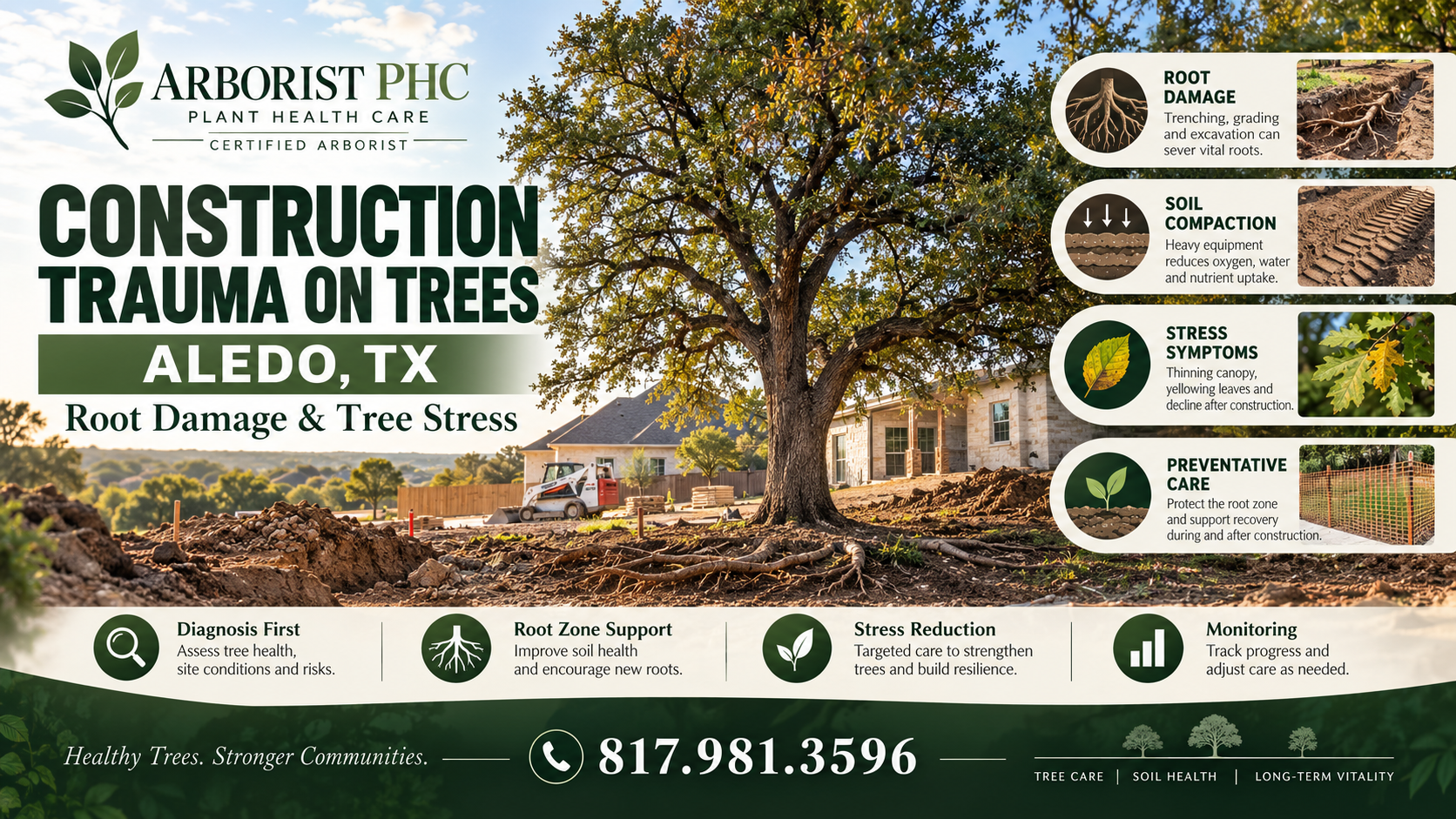
Construction Trauma on Trees in Aledo, TX | Root Damage & Tree Stress | Arborist PHC
Certified Arborist | Serving Aledo & North Texas
Construction Trauma on Trees in Aledo, TX
How Construction Damage Affects Tree Health
Construction-related damage is one of the leading causes of long-term tree decline throughout Aledo and surrounding North Texas communities.
At Arborist PHC, we specialize in evaluating environmental stress and root-related decline caused by:
Excavation
Grade changes
Soil compaction
Heavy equipment traffic
Root disturbance
Our approach follows:
ISA arboriculture principles
ANSI A300 standards
Science-based plant health care strategies
Many trees decline slowly over time after construction damage occurs below the surface.
Why Construction Is Harmful to Trees
Most tree roots exist within the upper portion of the soil profile.
During construction, roots are commonly damaged by:
Trenching
Excavation equipment
Soil removal
Driveway or sidewalk installation
Compaction from vehicles and machinery
Even if damage is not immediately visible, root injury can significantly affect long-term tree health.
Signs of Construction Trauma on Trees
Common symptoms include:
Thinning canopy growth
Sparse foliage
Premature leaf drop
Dead branch tips
Reduced vigor
Bark splitting or peeling
Delayed decline months or years after construction
Symptoms often appear gradually because root systems are stressed below ground long before canopy decline becomes noticeable.
Why Trees in Aledo Are Vulnerable
Trees throughout Aledo commonly experience:
Soil compaction from development
Root zone disturbance
Heat and drought stress
Heavy clay soil limitations
When construction injury combines with environmental stress, trees become more vulnerable to:
✔️ Pest pressure
✔️ Disease activity
✔️ Long-term decline
The Connection Between Root Damage & Decline
Roots are responsible for:
Water absorption
Nutrient uptake
Oxygen exchange
Structural stability
When root systems are damaged, trees may struggle to:
Transport nutrients efficiently
Manage drought stress
Defend against pests and disease
Construction injury often weakens a tree’s natural defense system.
Common Construction-Related Problems We See
At Arborist PHC, we frequently evaluate:
Soil compaction issues
Root loss from trenching
Grade changes around root flares
Heat stress after root disturbance
Secondary pest and fungal activity
Construction trauma is often an underlying contributor to larger tree health issues later on.
Our Plant Health Care Approach (Watch Our Process)
Our goal is to reduce stress and improve recovery potential for affected trees.
Deep Root Feeding (Soil Injection)
Delivers nutrients directly into the root zone
Supports root recovery and soil biology
Improves drought tolerance and overall vigor
Root Zone Support
Helps reduce compaction-related stress
Improves oxygen and water movement within the soil
Broad-Spectrum Plant Health Care (BBT)
Addresses multiple stress factors simultaneously
Includes nutrients, micronutrients, and systemic support
Monitoring & Reassessment
Tracks tree response over time
Identifies developing decline patterns early
Adjusts treatment recommendations when necessary
Why Early Intervention Matters
Trees affected by construction damage may continue declining for years if stress is not addressed.
Early plant health care support can help:
Reduce environmental stress
Improve root function
Increase drought tolerance
Slow decline progression
The sooner damage is identified, the better the long-term recovery potential.
Preventative Tree Protection During Construction
Protecting root systems before construction begins is one of the best ways to reduce future decline.
Important considerations include:
Avoiding trenching near root zones
Limiting heavy equipment traffic
Reducing soil compaction
Maintaining proper grade around trees
Healthy root systems are essential for long-term tree stability and health.
Our Diagnosis-First Philosophy
Not all declining trees are suffering from disease alone.
We evaluate:
Root conditions
Soil compaction
Construction history
Environmental stress factors
Pest and fungal activity
This allows us to develop:
✔️ Accurate diagnoses
✔️ Targeted treatment strategies
✔️ Long-term management recommendations
Service Areas Near Aledo
We proudly serve:
Hudson Oaks
Willow Park
Surrounding Parker County communities
Request a Tree Health Assessment in Aledo, TX (Click Here To Submit A Form)
If your trees are showing signs of stress following nearby construction or excavation work, early evaluation is important.
📞 Call or Text to Schedule
📸 Send photos for a preliminary review
We’re here to help you identify underlying stress factors and implement science-based solutions for long-term tree health.
Frequently Asked Questions
-
Yes—severe root damage and soil compaction can lead to long-term decline and structural stress.
-
In many cases, symptoms may appear months or even years after construction activity occurs.
-
Some trees can improve with proper stress reduction and plant health care support, depending on severity.
-
Compacted soils restrict oxygen, water movement, and root growth—all critical for healthy tree function.
-
No—Arborist PHC specializes strictly in plant health care, diagnosis, and treatment programs.