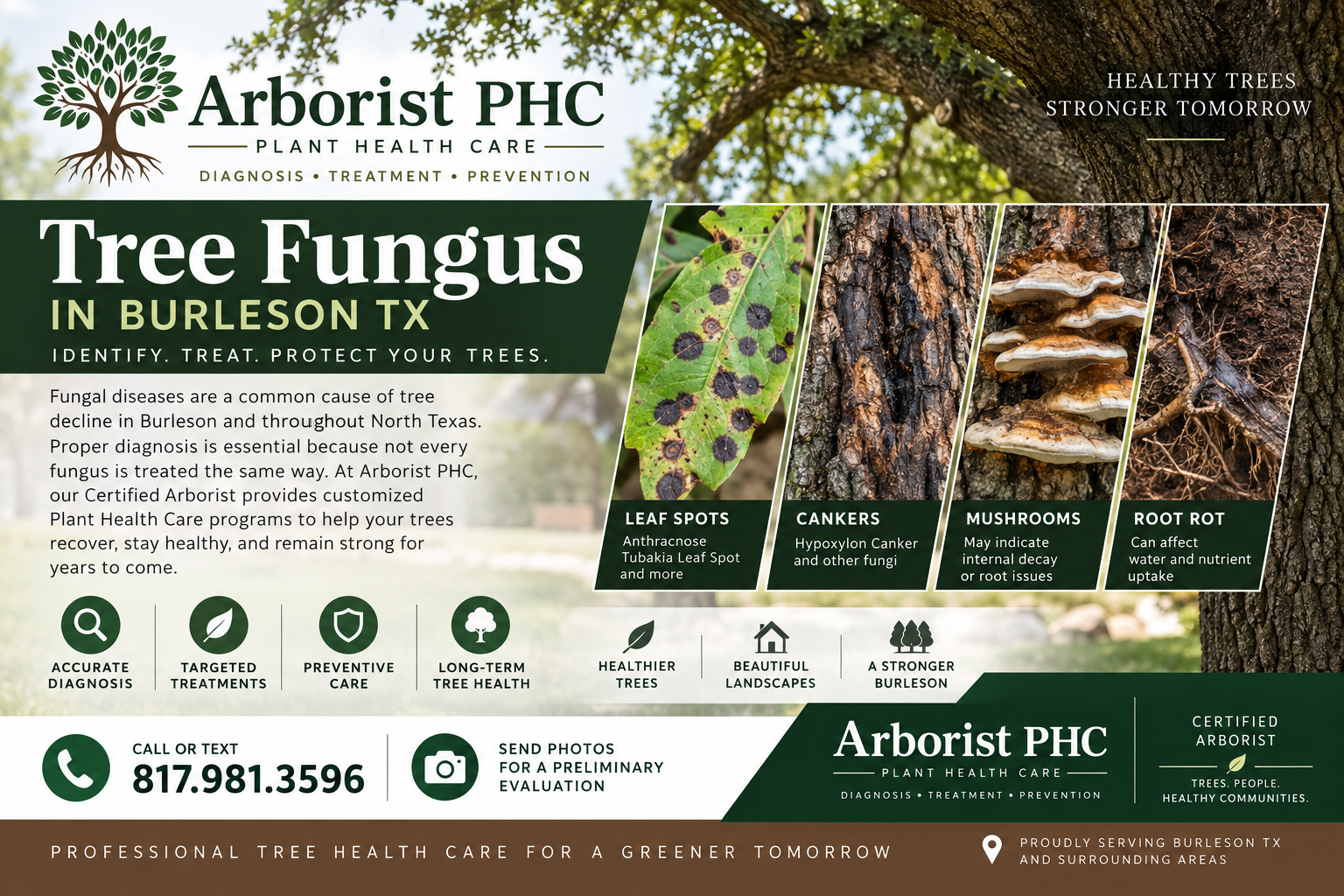
Tree Fungus in Burleson TX | Tree Disease Diagnosis & Treatment | Arborist PHC
Tree Fungus in Burleson TX
Is Fungus Affecting Your Trees in Burleson?
Fungal problems are some of the most common causes of tree decline throughout Burleson and North Texas.
Depending on the pathogen, tree fungus can affect the leaves, branches, bark, trunk, roots, or vascular system. Some fungal issues are mostly cosmetic, while others can cause severe canopy decline, root damage, branch dieback, or even tree death.
At Arborist PHC, we specialize exclusively in Plant Health Care (PHC) and help homeowners identify the specific cause of fungal symptoms before recommending treatment.
The most important step is proper diagnosis because not every fungus is treated the same way.
What Causes Tree Fungus?
Fungal diseases often become more active when environmental conditions favor infection.
Common contributing factors include:
🌧 Prolonged rainfall and high humidity
💧 Poor drainage or overwatering
🌳 Dense canopies with limited airflow
☀️ Heat and drought stress
🚧 Root damage from construction
🪨 Soil compaction
🍂 Infected fallen leaves or plant debris
🌱 Weak or stressed root systems
❄️ Freeze-related tissue damage
Trees weakened by environmental stress are often more vulnerable to secondary fungal problems.
Common Signs of Tree Fungus
Fungal disease symptoms vary depending on the tree and pathogen, but common warning signs include:
🍂 Black or brown leaf spots
🍂 Yellowing foliage
🍂 Premature leaf drop
🍂 Curling or distorted leaves
🍂 Branch-tip dieback
🍂 Thin or sparse canopy
🍄 Mushrooms or fungal growth near the base
🍄 Fungal structures growing from the trunk
🌳 Bark discoloration or decay
💧 Dark or water-soaked lesions
🍂 Progressive canopy decline
If your tree is showing these symptoms, an inspection can help determine whether fungus is truly the cause or if another issue is creating similar symptoms.
Common Tree Fungal Diseases in Burleson
Hypoxylon Canker is commonly associated with Oaks weakened by drought, root injury, construction stress, or other environmental problems.
It often becomes visible after the tree has already experienced significant stress.
Symptoms may include:
Bark sloughing
Gray, brown, or black fungal tissue beneath the bark
Branch dieback
Canopy thinning
Progressive decline
The best defense against Hypoxylon is maintaining strong overall tree health and reducing environmental stress.
Anthracnose affects many shade trees and commonly causes:
Brown or black leaf lesions
Leaf distortion
Premature leaf drop
Twig dieback
Thin canopy
The disease is often more active during wet or humid periods.
🍄 Tubakia Leaf Spot
Tubakia Leaf Spot is commonly seen on Oaks.
Symptoms often include:
Dark brown or black leaf spots
Circular lesions
Premature defoliation
Browning foliage
Reduced canopy density
Repeated infections may contribute to long-term stress.
Several fungal and fungus-like pathogens can damage tree roots.
Root diseases may develop when soils remain overly wet or poorly drained.
Common symptoms include:
Wilting despite moist soil
Yellow leaves
Canopy thinning
Dead branches
Poor annual growth
Fungal growth near the root flare
Root problems can become serious because they affect the tree’s ability to absorb both water and nutrients.
🍄 Phytophthora Root Rot
Phytophthora is technically a water mold rather than a true fungus, but homeowners often recognize it as a root-rot disease.
It thrives in saturated soil and may cause:
Root decay
Wilting
Yellow foliage
Premature leaf drop
Branch dieback
Rapid decline during hot weather
Correcting drainage and root-zone conditions is often an important part of management.
🍄 Sooty Mold
Sooty mold appears as a black coating on leaves and branches.
The mold itself often grows on honeydew produced by sap-feeding insects such as aphids or scale.
That means the underlying insect problem usually needs to be addressed rather than treating the black coating alone.
Mushrooms Growing Around a Tree — Is That Bad?
Not every mushroom means your tree is dying.
Fungi naturally break down organic material in the soil.
However, mushrooms growing directly from the root flare, trunk, or major roots can sometimes indicate internal decay or root disease.
This is especially concerning when mushrooms are combined with:
✔️ Canopy thinning
✔️ Dead branches
✔️ Bark decay
✔️ Root damage
✔️ Rapid decline
A professional inspection can help determine whether the fungal growth is harmless or associated with structural decay.
Why Accurate Diagnosis Matters
The fungus is not one single disease.
Applying a fungicide without identifying the pathogen can waste time and money and may not address the real problem.
Our Certified Arborist evaluates:
✔️ Tree species
✔️ Leaf symptoms
✔️ Bark condition
✔️ Root flare
✔️ Soil moisture
✔️ Drainage
✔️ Environmental stress
✔️ Insect activity
✔️ Previous damage
✔️ Overall canopy health
Sometimes a tree that looks like it has a fungal disease is actually suffering from drought, nutrient deficiency, root damage, or insect pressure.
Our Plant Health Care Approach to Tree Fungus
Treatment depends entirely on the diagnosis.
A customized program may include:
🌱 Deep Root Inoculation
Deep Root Inoculation may help support:
✔️ Root development
✔️ Nutrient availability
✔️ Environmental stress tolerance
✔️ Overall tree vigor
✔️ Recovery from previous stress
Our BBT Program takes a more comprehensive approach when multiple health concerns are present.
Depending on the tree, it may include:
✔️ Deep Root Inoculation
✔️ Basal Drench Applications
✔️ Targeted disease management
✔️ Insect management
✔️ Nutrient and micronutrient support
✔️ Environmental stress reduction
The goal is to strengthen the tree while addressing the conditions that contributed to disease pressure.
💧 Basal Drench Applications
Basal Drench treatments may be used as part of a customized program to support systemic uptake and overall tree health.
Can Fungus Kill a Tree?
Some fungal diseases are primarily cosmetic, while others can be extremely destructive.
The severity depends on:
The pathogen
Tree species
Stage of infection
Root health
Environmental conditions
Amount of healthy canopy remaining
Previous stress or damage
Early diagnosis provides the best opportunity to manage disease before severe decline occurs.
Trees We Commonly Evaluate for Fungal Problems
We commonly inspect:
🌳 Bur Oaks
🌳 Savannah Post Oaks
🌳 Cedar Elms
🌳 Bradford Pears
🌳 Maple Trees
🌳 Crape Myrtles
🌳 Cypress Trees
🌳 Pine Trees
🌳 Ornamental Trees and Shrubs
How to Reduce Fungal Disease Pressure
Homeowners can help reduce fungal problems by improving the tree’s growing environment.
Recommended practices include:
🌱 Avoid unnecessary overwatering
🌱 Improve drainage when possible
🌱 Keep mulch away from the trunk
🌱 Avoid damaging roots
🌱 Reduce soil compaction
🌱 Maintain appropriate irrigation
🌱 Remove heavily infected debris when recommended
🌱 Monitor trees after drought, freeze, or construction stress
Healthy trees are generally better equipped to resist or tolerate disease.
Why Choose Arborist PHC?
At Arborist PHC, our focus is exclusively on Plant Health Care.
We specialize in:
✔️ Tree Diagnosis
✔️ Fungal Disease Management
✔️ Root Health
✔️ Nutrient Management
✔️ Insect Management
✔️ Environmental Stress Reduction
✔️ Preventive Tree Care
We focus on identifying the cause of decline before recommending treatment.
Diagnosis • Treatment • Prevention
Schedule a Tree Fungus Assessment in Burleson TX
If your tree has black spots, mushrooms, bark discoloration, leaf drop, branch dieback, or unexplained decline, don’t assume the problem will resolve on its own.
📞 Call or Text Arborist PHC at 817.981.3596
📸 Send Photos for a Preliminary Evaluation
Our Certified Arborist can evaluate your tree, identify possible fungal disease or contributing stress factors, and develop a customized Plant Health Care program.
Frequently Asked Questions
-
Tree fungus can develop because of wet weather, poor drainage, environmental stress, root damage, infected plant tissue, and certain pathogens already present in the landscape.
-
Often, yes. Anthracnose, Tubakia Leaf Spot, and other fungal diseases can cause black or brown leaf spots, although bacterial infections and insect-related problems can look similar.
-
Not always. Some mushrooms simply decompose organic matter. Mushrooms growing directly from the trunk or root flare may be more concerning and should be professionally evaluated.
-
Many trees can recover or stabilize when the specific disease is identified early and environmental stress is reduced. Severe root or trunk decay may be more difficult to manage.
-
Not automatically. Fungicides are only appropriate for certain diseases and must be properly timed. Accurate diagnosis should come first.
-
No. Arborist PHC specializes exclusively in Plant Health Care, diagnosis, treatment, and prevention.