Deep Root Inoculation for Trees | Root Health & Plant Health Care | Arborist PHC
Deep Root Inoculation for Trees
Strengthening Trees from the Roots Up
Healthy trees begin with healthy roots. When soil becomes compacted, depleted, excessively dry, or biologically inactive, trees may struggle to absorb the moisture and nutrients needed to support healthy canopy growth.
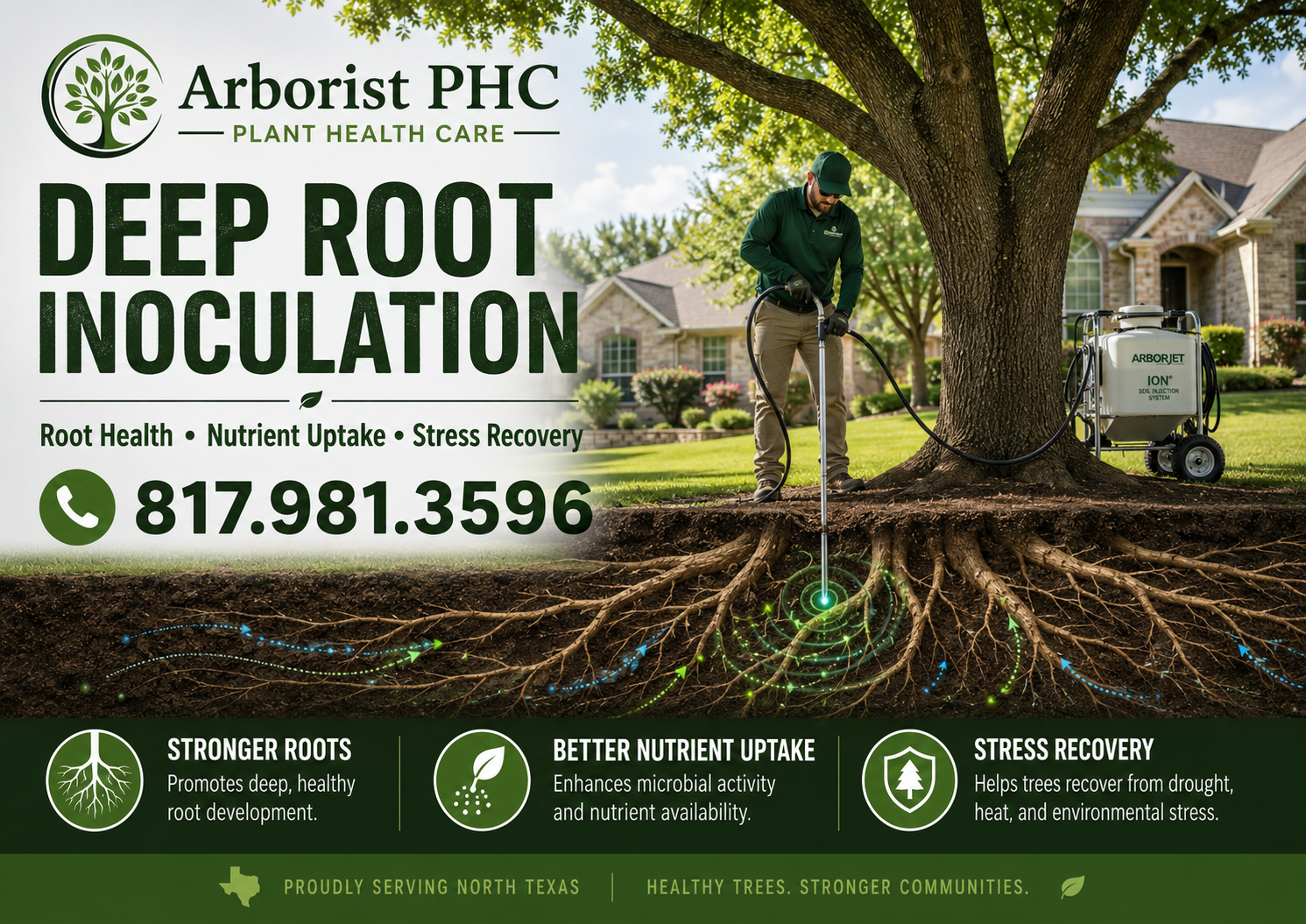
Deep Root Inoculation is a professional Plant Health Care service designed to deliver beneficial nutrients, organic materials, and soil-supporting components directly into the active root zone.
At Arborist PHC, we use customized Deep Root Inoculation programs to support root development, improve nutrient availability, reduce environmental stress, and strengthen the long-term health of trees throughout North Texas.
What Is Deep Root Inoculation?
Deep Root Inoculation places a customized treatment solution beneath the soil surface throughout the tree’s root zone.
Instead of applying materials only to the lawn or soil surface, the treatment is distributed into areas where active feeder roots can access them more effectively.
Depending on the tree’s needs, the program may include:
🌱 Essential nutrients
🌱 Micronutrients
🌱 Organic carbon sources
🌱 Seaweed-derived materials
🌱 Carbohydrates
🌱 Soil conditioners
🌱 Root-supporting biostimulants
🌱 Beneficial biological materials
Every application should be customized according to the tree species, soil condition, environmental stress, and diagnosis.
How Deep Root Inoculation Benefits Trees
A properly designed Deep Root Inoculation program may help:
✔️ Support fine feeder-root development
✔️ Improve nutrient availability
✔️ Encourage healthier canopy growth
✔️ Increase environmental stress tolerance
✔️ Improve soil conditions around the roots
✔️ Support recovery after drought or construction
✔️ Correct certain nutrient deficiencies
✔️ Improve overall tree vigor
This service is especially beneficial when poor soil conditions or environmental stress are limiting the tree’s performance.
Why Root Health Is So Important
A tree’s root system performs several essential functions.
Healthy roots help trees:
💧 Absorb water
🌱 Take up nutrients
🌳 Support canopy growth
🪨 Maintain structural stability
☀️ Tolerate heat and drought
🍄 Defend against disease pressure
🐛 Resist secondary insect activity
When roots become damaged or stressed, symptoms often appear throughout the canopy. Improving the root-zone environment is one of the most important parts of a comprehensive Plant Health Care program.
Signs Your Tree May Benefit from Deep Root Inoculation
Your tree may benefit from a professional root-zone evaluation if you notice:
🍂 Yellow or pale leaves
🍂 Premature leaf drop
🍂 Small or undersized foliage
🍂 Slow annual growth
🍂 Thin or sparse canopy
🍂 Wilting during hot weather
🍂 Dead branch tips
🍂 Reduced vigor
🍂 Construction-related stress
🍂 Decline following drought or freeze damage
These symptoms can have several causes, which is why a professional diagnosis should be completed before treatment begins.
Trees Growing in Compacted Soil
Soil compaction is common around residential and commercial properties.
Compaction can result from:
🚜 Heavy equipment
🚗 Vehicle traffic
🚧 Construction activity
🏡 New-home development
🌱 Repeated foot traffic
🪨 Heavy clay soil
Compacted soil contains fewer air spaces, making it more difficult for roots to access oxygen, moisture, and nutrients.
Deep Root Inoculation can be incorporated into a broader root-health program designed to reduce stress and improve conditions within the tree’s growing environment.
Support for Heat and Drought-Stressed Trees
Extreme summer temperatures and prolonged drought can significantly weaken North Texas trees.
Heat and drought stress may cause:
Wilting foliage
Brown or scorched leaf margins
Premature leaf drop
Canopy thinning
Branch-tip dieback
Reduced annual growth
Deep Root Inoculation does not replace proper watering. However, when combined with appropriate irrigation and soil management, it can help support root function and improve the tree’s ability to tolerate environmental stress.
Support Following Construction Damage
Construction activities frequently damage or compact tree roots.
Common causes include:
Excavation
Utility trenching
Pool installation
Foundation work
Driveway construction
Soil grading
Heavy-equipment traffic
Trees may not show visible symptoms until months or years after construction is completed.
A customized Deep Root Inoculation program may help support surviving roots, encourage new root development, and reduce the environmental stress associated with construction disturbance.
Nutrient Deficiencies and Poor Soil Conditions
North Texas soils are often alkaline and may limit the availability of certain nutrients.
Trees growing in these conditions may develop:
🍂 Yellow leaves
🍂 Green veins within yellow foliage
🍂 Reduced growth
🍂 Small leaves
🍂 Sparse canopies
🍂 Premature leaf loss
Deep Root Inoculation allows nutrients and supporting materials to be placed within the active root zone. However, the treatment should always be based on the tree’s symptoms, species, and site conditions rather than applying a general fertilizer to every tree.
How the Application Is Performed
During a Deep Root Inoculation service, treatment material is distributed throughout the accessible root zone using professional application equipment.
The treatment area may extend around the tree’s canopy and drip line, where many fine feeder roots are located.
The exact application method depends on:
✔️ Tree size
✔️ Tree species
✔️ Soil condition
✔️ Root-zone accessibility
✔️ Landscape features
✔️ Severity of decline
✔️ Treatment objectives
Our goal is to provide even coverage throughout the appropriate root zone without unnecessarily damaging existing roots.
Deep Root Inoculation vs. Surface Fertilization
Surface-applied fertilizer may primarily benefit nearby turfgrass before reaching deeper tree roots.
Deep Root Inoculation is designed specifically around the tree’s root system and overall health needs.
Potential advantages include:
✔️ More targeted placement
✔️ Customized nutrient selection
✔️ Better distribution throughout the root zone
✔️ Reduced competition from turfgrass
✔️ Integration with a complete Plant Health Care plan
Not every declining tree simply needs fertilizer. Accurate diagnosis remains essential because disease, insects, root rot, poor drainage, and construction damage may produce similar symptoms.
Part of Our BBT Program
Deep Root Inoculation may be used as part of our comprehensive BBT—Broad Brush Treatment—Program.
Depending on the diagnosis, the BBT Program may include:
🌱 Deep Root Inoculation
💧 Basal Drench Applications
🌳 Bark and foliar treatments
🍄 Disease-management support
🐛 Insect-management support
🌿 Nutrient and micronutrient applications
☀️ Environmental-stress reduction
Combining appropriate treatment methods allows us to address the roots, trunk, branches, and canopy rather than focusing on only one visible symptom.
How Often Is Deep Root Inoculation Needed?
The appropriate schedule depends on the tree’s condition and treatment goals.
Some trees may benefit from a single restorative application followed by monitoring. Trees experiencing chronic stress, nutrient limitations, construction damage, or recurring health problems may require a seasonal or annual Plant Health Care program.
Treatment frequency should be based on:
Tree species
Current health
Soil conditions
Weather patterns
Previous damage
Response to treatment
Long-term maintenance goals
Arborist PHC provides follow-up recommendations based on how the tree responds over time.
Can Deep Root Inoculation Save a Declining Tree?
Deep Root Inoculation can provide valuable support, but no treatment can guarantee the survival of a severely damaged tree. The best results are typically achieved when problems are diagnosed early, before extensive canopy loss, root decay, or structural decline occurs.
Treatment success depends on:
✔️ The underlying diagnosis
✔️ Severity of damage
✔️ Amount of healthy root tissue remaining
✔️ Soil and drainage conditions
✔️ Proper watering
✔️ Continued monitoring
✔️ The tree’s natural ability to recover
Our goal is to improve growing conditions and give the tree the strongest possible opportunity to stabilize and recover.
Why Choose Arborist PHC?
Arborist PHC specializes exclusively in Plant Health Care.
We focus on preserving trees through professional:
✔️ Diagnosis
✔️ Root-zone treatments
✔️ Disease management
✔️ Insect management
✔️ Nutrient support
✔️ Environmental-stress reduction
✔️ Preventive care
We do not focus on routine trimming or tree removal. Our mission is to identify what is affecting your trees and create a customized plan for their long-term health.
Diagnosis • Treatment • Prevention
Schedule a Deep Root Inoculation Assessment
If your tree has yellow leaves, slow growth, canopy thinning, premature leaf drop, or signs of environmental stress, the root system may need professional attention.
📞 Call or Text Arborist PHC at 817.981.3596
📸 Send Photos for a Preliminary Evaluation
Our Certified Arborist can evaluate the tree, soil, root flare, drainage, and surrounding environment before recommending a customized Deep Root Inoculation or Plant Health Care program.
Frequently Asked Questions
-
Deep Root Inoculation is a targeted Plant Health Care application that places customized nutrients, organic materials, and root-supporting components within the active root zone.
-
Not exactly. Fertilization may be one component, but Deep Root Inoculation can also include micronutrients, organic carbon, soil conditioners, biostimulants, and other materials selected according to the tree’s needs.
-
Response time depends on the tree’s condition, species, season, and underlying problem. Some trees produce improved foliage or new growth during the current growing season, while others may require several months or another growing cycle.
-
No. Proper watering remains essential. Deep Root Inoculation supports root and soil health but cannot compensate for severe underwatering, overwatering, or poor drainage.
-
It may support surviving roots and encourage new root development, but results depend on the severity of root loss and the tree’s overall condition.
-
No. Treatments should be recommended after evaluating the tree and site. Some symptoms may be caused by disease, insects, drainage problems, or root decay rather than nutrient limitations.
-
No. Arborist PHC specializes exclusively in tree diagnosis, treatment, prevention, and long-term Plant Health Care.