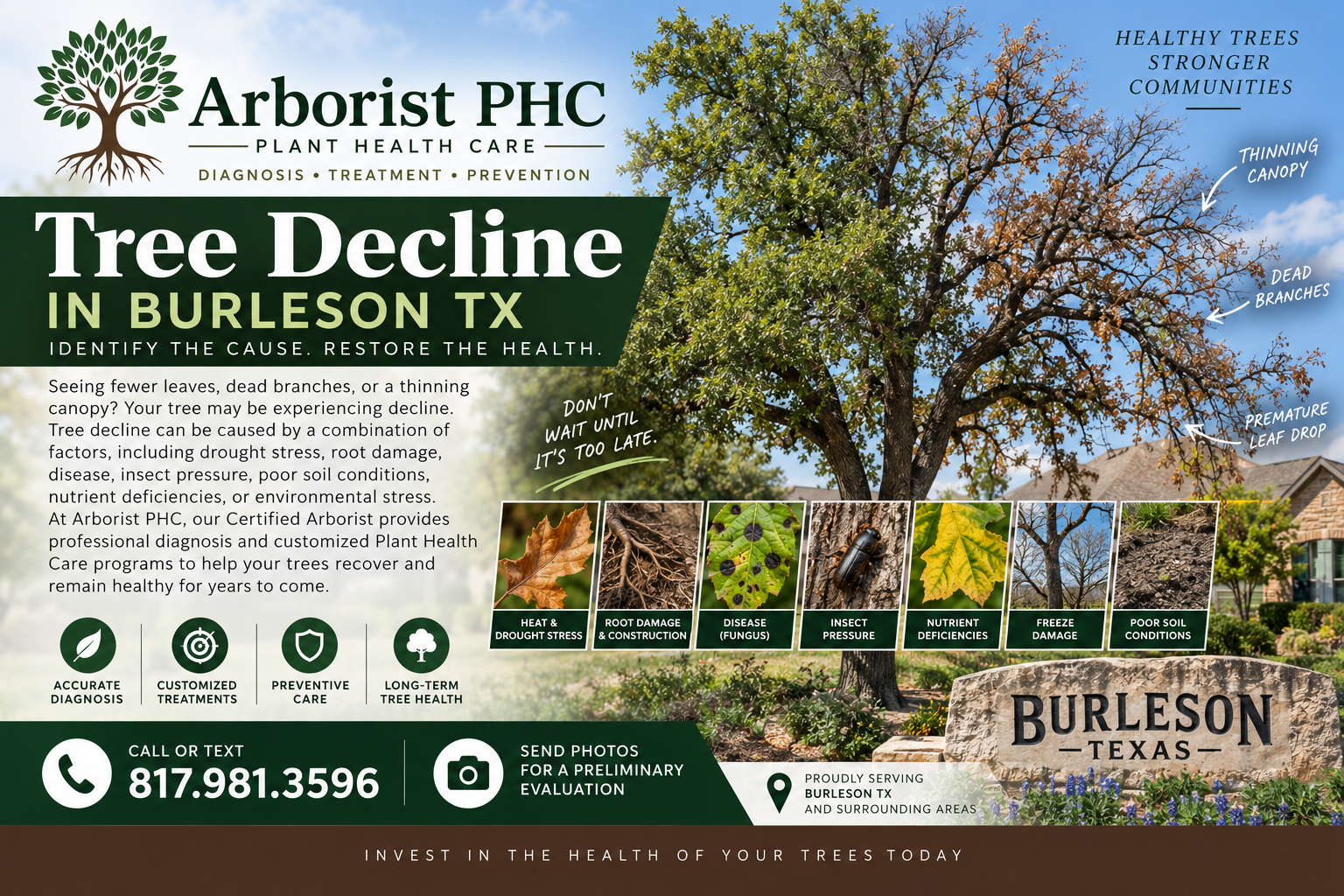
Tree Decline in Burleson TX | Causes, Diagnosis & Treatment
Tree Decline in Burleson TX
Why Are Trees Declining in Burleson?
If your tree is thinning out, dropping leaves early, developing dead branches, or simply not looking as healthy as it once did, it may be experiencing tree decline.
Tree decline is not one specific disease. It is usually the result of multiple stress factors building up over time, including heat, drought, root damage, poor soil conditions, disease pressure, insect activity, or nutrient deficiencies.
At Arborist PHC, we specialize exclusively in Plant Health Care (PHC) and help homeowners throughout Burleson identify the underlying cause of decline before the damage becomes severe.
Our focus is simple:
Diagnosis • Treatment • Prevention
What Is Tree Decline?
Tree decline describes a gradual loss of health and vigor.
A declining tree may still be alive and producing leaves, but it is no longer performing the way a healthy tree should.
Common signs include:
🍂 Premature leaf drop
🍂 Yellow or pale leaves
🍂 Brown or scorched foliage
🍂 Leaf curling
🍂 Thin or sparse canopy
🍂 Dead branch tips
🍂 Larger dead limbs
🍂 Reduced annual growth
🍂 Increased insect activity
🍂 Bark cracking or peeling
🍂 Fungal growth near the trunk or root flare
Because decline often develops slowly, many homeowners do not notice a problem until the canopy has already become significantly thinner.
Common Causes of Tree Decline in Burleson
North Texas summers place tremendous pressure on trees.
Prolonged heat and limited rainfall can reduce soil moisture, damage fine feeder roots, and cause trees to conserve energy by shedding leaves or reducing growth.
Common symptoms include:
Brown leaf edges
Wilting
Premature leaf drop
Canopy thinning
Branch-tip dieback
🌧 Poor Drainage & Overwatering
Too much water can be just as damaging as too little.
Saturated soil reduces oxygen around the roots and can lead to root decline.
Possible symptoms include:
Yellow leaves
Wilting despite wet soil
Slow growth
Root decay
Premature leaf drop
Healthy roots need both moisture and oxygen.
🚧 Root Damage & Construction Stress
Construction, trenching, grading, heavy equipment, driveway installation, and utility work can damage roots without touching the trunk.
Trees affected by root damage may decline months or even years later.
Symptoms often include:
Thin canopy
Dead branches
Slow growth
Wilting
Premature leaf drop
Increased insect or disease pressure
Several fungal diseases can contribute to tree decline in Burleson.
These may include:
Tubakia Leaf Spot
Root Rot
Phytophthora Root Rot
Some fungal problems are primarily foliar, while others affect the roots, trunk, or vascular system.
Proper diagnosis is essential because treatment depends on the specific disease involved.
🐛 Insect Pressure
Insects often become more active on trees that are already weakened.
Common pests include:
Beetle Borers
Aphids
Spider Mites
Scale Insects
Carpenter Ants
Bagworms
In many cases, insects are a secondary issue rather than the original cause of decline.
🌱 Nutrient Deficiencies
North Texas soils can limit the availability of certain nutrients.
Deficiencies may cause:
🍂 Yellow leaves
🍂 Green veins
🍂 Slow growth
🍂 Thin canopy
🍂 Reduced vigor
Iron Chlorosis is a common example, especially on susceptible tree species growing in alkaline soils.
Severe winter weather can damage buds, branches, vascular tissue, and roots.
Some freeze damage does not become fully visible until spring or summer, when the tree struggles to support new growth.
This can lead to:
Sparse canopy
Dead branch tips
Delayed leaf-out
Weak growth
Progressive decline
Trees Commonly Affected in Burleson
We frequently evaluate declining:
🌳 Live Oaks
🌳 Red Oaks
🌳 Bur Oaks
🌳 Post Oaks
🌳 Savannah Post Oaks
🌳 Pecan Trees
🌳 Cedar Elms
🌳 Chinese Pistachios
🌳 Magnolias
🌳 Bradford Pears
🌳 Maple Trees
🌳 Crape Myrtles
🌳 Cypress Trees
🌳 Newly Planted Trees
Why Accurate Diagnosis Matters
Tree decline often has more than one cause.
For example, a tree may initially suffer root damage from construction, then become drought-stressed, and later develop insect or fungal problems.
That is why treating only the visible symptom may not solve the issue.
Our Certified Arborist evaluates:
✔️ Tree species
✔️ Canopy density
✔️ Leaf condition
✔️ Root flare
✔️ Soil moisture
✔️ Drainage
✔️ Insect activity
✔️ Disease symptoms
✔️ Construction history
✔️ Environmental stress
✔️ Nutrient availability
The goal is to identify the primary stressor and any secondary problems affecting the tree.
Our Plant Health Care Approach
Every treatment plan is customized based on the tree’s condition and site environment.
🌱 Deep Root Inoculation
Deep Root Inoculation may help support:
✔️ Root development
✔️ Nutrient uptake
✔️ Drought tolerance
✔️ Stress recovery
✔️ Overall tree vigor
Our BBT Program is designed for trees dealing with multiple stress factors.
Depending on the diagnosis, it may include:
✔️ Deep Root Inoculation
✔️ Basal Drench Applications
✔️ Disease-management support
✔️ Insect management
✔️ Nutrient and micronutrient support
✔️ Environmental-stress reduction
This comprehensive approach helps address both the root system and above-ground symptoms.
💧 Basal Drench Applications
Basal Drench treatments may be used as part of a customized program to support systemic uptake and overall tree health.
Can a Declining Tree Recover?
In many cases, yes.
The outcome depends on:
How early the decline is detected
How much healthy canopy remains
Root condition
Severity of disease
Amount of construction damage
Soil and drainage conditions
Tree species
Continued environmental stress
The earlier the problem is identified, the more options are usually available.
Once a tree has lost a large portion of its canopy or developed extensive root decay, recovery becomes more difficult.
Tree Decline Often Starts Below Ground
Many homeowners focus on leaves and branches because those are the symptoms they can see.
However, the real problem often begins in the root zone.
Common below-ground issues include:
🌱 Compacted soil
💧 Poor drainage
🚧 Root cutting
🪨 Heavy clay soil
🌳 Buried root flare
☀️ Drought-stressed feeder roots
🍄 Root disease
That is why root health is such an important part of our Plant Health Care evaluations.
How to Help Prevent Tree Decline
Homeowners can reduce stress by:
🌱 Watering deeply and appropriately
🌱 Avoiding excessive irrigation
🌱 Keeping mulch away from the trunk
🌱 Protecting root zones during construction
🌱 Avoiding unnecessary soil compaction
🌱 Monitoring trees after drought or freeze events
🌱 Addressing pest and disease problems early
🌱 Scheduling regular tree health evaluations
Preventive care is often far more effective than waiting until severe decline occurs.
Why Choose Arborist PHC?
At Arborist PHC, we focus exclusively on Plant Health Care.
We specialize in:
✔️ Tree Diagnosis
✔️ Tree Decline Management
✔️ Root Health
✔️ Disease Management
✔️ Insect Management
✔️ Nutrient Support
✔️ Environmental Stress Reduction
✔️ Preventive Tree Care
We do not focus on routine trimming or removals. Our goal is to help preserve valuable trees whenever treatment is appropriate.
Diagnosis • Treatment • Prevention
Schedule a Tree Health Assessment in Burleson TX
If your tree is thinning, dropping leaves early, developing dead branches, or showing unexplained decline, don’t wait for the problem to become severe.
📞 Call or Text Arborist PHC at 817.981.3596
📸 Send Photos for a Preliminary Evaluation
Our Certified Arborist can evaluate the tree, identify contributing stress factors, and develop a customized Plant Health Care program designed to improve its health and long-term resilience.
Frequently Asked Questions
-
Tree decline can be caused by drought, heat stress, poor drainage, root damage, construction, nutrient deficiencies, fungal disease, insect activity, freeze damage, or a combination of these factors.
-
Many declining trees can stabilize or recover when the underlying problem is identified early and the tree still has enough healthy root and canopy tissue remaining.
-
The issue may be poor drainage, root damage, root disease, nutrient problems, or another condition that prevents the tree from using water properly.
-
Top-down dieback may be related to root stress, drought, vascular problems, nutrient limitations, or disease. A professional evaluation can help determine the cause.
-
No. Tree decline is a general loss of health and may be caused by disease, environmental stress, root damage, insects, or several issues occurring together.