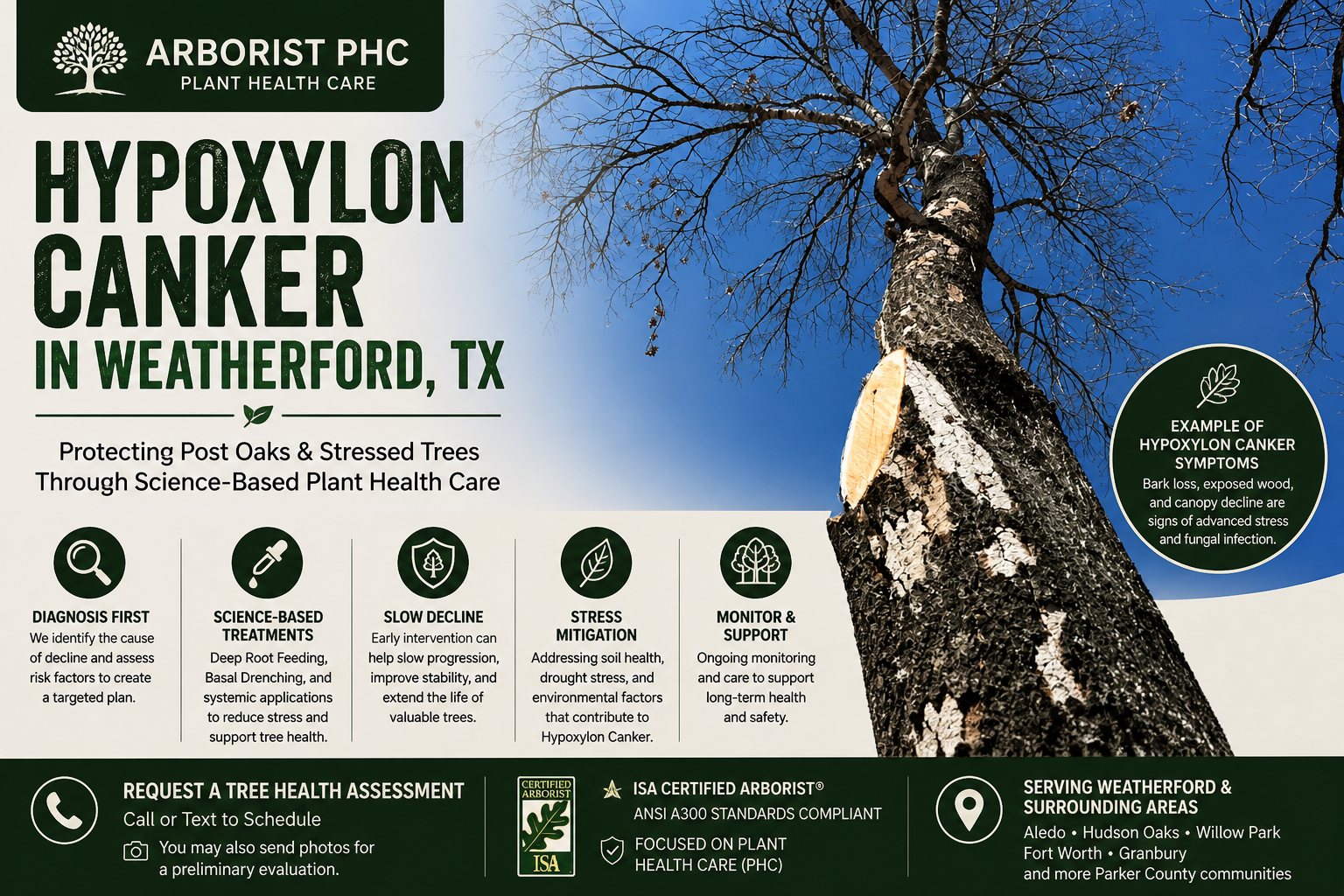
Hypoxylon Canker in Weatherford, TX
ISA Certified Arborist® | ANSI A300 Compliant | Serving Weatherford & North Texas
Understanding Post Oak Decline in North Texas
Hypoxylon Canker is a common and often fatal fungal disease affecting Savannah Post Oaks and other stressed hardwoods throughout Weatherford and surrounding areas.
At Arborist PHC, we focus on early detection, stress mitigation, and plant health care treatments to help slow decline and support remaining tree function.
Our approach follows ISA arboriculture principles and ANSI A300 standards, focusing on cause, risk, and treatment—not guesswork.
What is Hypoxylon Canker?
Hypoxylon Canker is an opportunistic fungal pathogen that attacks trees already under stress.
It does not typically infect healthy trees. Instead, it takes advantage of:
Drought stress
Soil compaction
Root damage
Environmental decline
Once established, it disrupts the tree’s ability to transport water and nutrients.
Signs of Hypoxylon Canker in Weatherford
Common symptoms include:
Bark sloughing or peeling away from the trunk
Gray, silver, or black fungal patches on exposed wood
Rapid canopy thinning
Branch dieback
Sudden decline in Post Oaks
In advanced stages, the structural integrity of the tree becomes compromised.
Why Hypoxylon Canker is Common in Weatherford, TX
Weatherford trees face significant environmental stress:
Heavy clay soils restricting root function
Extreme heat and drought cycles
Overwatering or poor drainage in some landscapes
Construction damage or soil disturbance
These stress factors weaken trees, making them highly susceptible to Hypoxylon.
Our Treatment Approach (Watch our process)
There is no direct “cure” for Hypoxylon Canker once advanced.
However, early intervention can improve tree stability and prolong life.
Deep Root Feeding (Soil Injection)
Improves soil conditions and nutrient availability
Enhances root function and stress tolerance
Basal Drench & Systemic Applications
Supports defense against secondary pests and fungal pressure
Helps stabilize declining trees
Broad-Spectrum Plant Health Care (BBT)
Addresses multiple stress factors at once
Includes nutrients, micronutrients, and systemic support
Our goal is to reduce stress, support the vascular system, and slow progression where possible.
When Removal May Be Necessary
In severe cases, Hypoxylon can lead to:
Structural weakness
Increased risk of failure
Safety hazards near homes or structures
While we specialize in plant health care, we will advise when a tree has reached a point where treatment is no longer effective.
Our Diagnosis-First Approach
Not all Post Oak decline is caused by Hypoxylon.
We evaluate:
Bark condition and fungal presence
Canopy health
Soil conditions
Pest activity
This ensures we are addressing the true cause of decline, not just symptoms.
Service Areas Near Weatherford
We proudly serve:
Hudson Oaks
Willow Park
Surrounding Parker County communities
Request a Tree Health Assessment in Weatherford, TX (Click here to submit a form)
If your Post Oaks are showing signs of decline, early action is critical.
📞 Call or Text to Schedule
📸 Send photos for a preliminary evaluation
We’re here to help you make informed decisions based on science—not guesswork.
Frequently Asked Questions
-
In early stages, treatment may help slow progression. In advanced stages, recovery is unlikely.
-
It is typically caused by environmental stress, including drought, poor soil conditions, and root damage.
-
It can progress quickly once a tree is severely stressed, especially during extreme weather conditions.
-
It depends on severity and location. Trees near structures may pose a risk if structural integrity is compromised.
-
No—Arborist PHC specializes strictly in plant health care, diagnosis, and treatment recommendations.