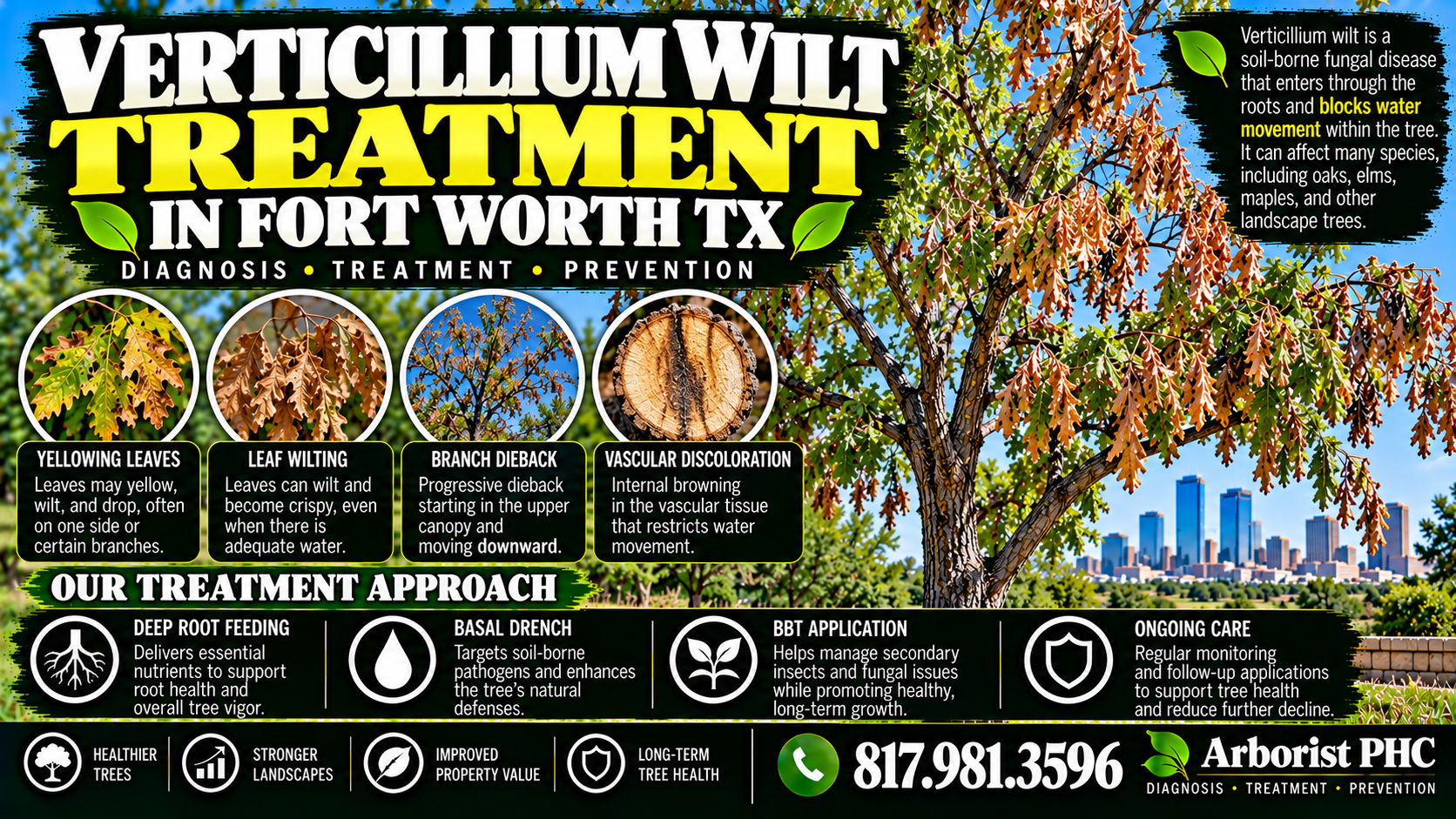
Verticillium Wilt Treatment in Fort Worth TX | Tree Disease Diagnosis | Arborist PHC
Verticillium Wilt Treatment in Fort Worth TX
What Is Verticillium Wilt?
Verticillium Wilt is a serious soil-borne fungal disease that attacks a tree’s vascular system, restricting the movement of water and nutrients from the roots to the canopy. As the fungus spreads through the xylem, affected branches begin to wilt, leaves discolor, and portions of the tree may suddenly decline.
Although not as common as some other tree diseases in North Texas, Verticillium Wilt can significantly impact susceptible tree species and should be diagnosed early to help reduce stress and improve the tree’s chances of recovery.
At Arborist PHC, we specialize exclusively in Plant Health Care (PHC) and provide professional diagnosis and customized treatment programs for trees affected by environmental stress and vascular diseases throughout Fort Worth and surrounding communities.
What Causes Verticillium Wilt?
Verticillium Wilt is caused by soil-borne fungi in the Verticillium genus that can survive in the soil for many years.
The fungus enters through the root system and spreads upward through the tree’s vascular tissue, reducing its ability to transport water.
Trees already weakened by drought, construction damage, poor soil conditions, or other environmental stressors are often more susceptible to severe symptoms.
Common Symptoms of Verticillium Wilt
Symptoms often begin on a single branch before spreading throughout the canopy.
Common signs include:
🍂 Wilting leaves
🍂 Yellowing foliage
🍂 Brown or scorched leaf margins
🍂 Sudden branch dieback
🍂 Sparse canopy
🍂 Stunted new growth
🍂 Premature leaf drop
🍂 Sections of the canopy dying while other portions remain healthy
Because these symptoms resemble several other diseases and environmental problems, proper diagnosis is essential.
Trees Commonly Affected
Verticillium Wilt affects many hardwood species, including:
🌳 Redbud Trees
🌳 Ash Trees
🌳 Elm Trees
🌳 Smoke Trees
🌳 Japanese Maple
🌳 Catalpa Trees
🌳 Pistache Trees (occasionally)
Although Oaks are generally less susceptible than some other species, similar symptoms can occur from different diseases, making professional diagnosis extremely important.
Why Accurate Diagnosis Matters
Several tree problems closely resemble Verticillium Wilt.
Symptoms may actually be caused by:
Nutrient Deficiencies
Insect Activity
At Arborist PHC, we evaluate the entire tree—not just the visible symptoms.
Our Certified Arborists assess:
✔️ Tree species
✔️ Soil conditions
✔️ Root health
✔️ Environmental stress
✔️ Irrigation practices
✔️ Disease symptoms
✔️ Insect activity
✔️ Overall canopy health
Proper diagnosis ensures the correct treatment strategy is recommended.
Our Plant Health Care Approach
Although there is no simple cure for Verticillium Wilt, improving the overall health and vigor of the tree can significantly reduce stress and help slow disease progression.
Every treatment program is customized based on the condition of the individual tree.
🌱 Deep Root Inoculation
Our Deep Root Inoculation program helps:
✔️ Improve root development
✔️ Increase nutrient uptake
✔️ Reduce environmental stress
✔️ Improve drought tolerance
✔️ Encourage healthier canopy growth
🌳 BBT (Broad Brush Treatment) Program
Our signature BBT (Broad Brush Treatment) combines multiple Plant Health Care techniques into one comprehensive program.
The program includes:
✔️ Deep Root Inoculation
✔️ Basal Drench Applications
✔️ Nutrient & Micronutrient Management
✔️ Environmental Stress Reduction
✔️ Root Zone Health Support
✔️ Tree Vigor Improvement
The goal is to strengthen the tree’s natural defenses and improve long-term health.
💧 Basal Drench Applications
Basal Drench treatments are applied around the root flare to improve systemic uptake, promote root health, and support nutrient movement throughout the tree.
Preventing Further Decline
While Verticillium Wilt cannot always be eliminated, reducing stress on the tree can greatly improve its long-term health.
We recommend:
🌱 Maintaining proper soil moisture
🌱 Avoiding unnecessary root disturbance
🌱 Applying mulch around the drip line
🌱 Improving soil health
🌱 Monitoring for secondary insect activity
🌱 Scheduling routine Plant Health Care inspections
Healthy trees are better equipped to tolerate disease and environmental stress.
Why Choose Arborist PHC?
Unlike traditional tree service companies, Arborist PHC specializes exclusively in Plant Health Care.
We focus on:
✔️ Tree Diagnosis
✔️ Disease Management
✔️ Environmental Stress Reduction
✔️ Nutrient Management
✔️ Root Health
✔️ Preventive Tree Care
Our philosophy is simple:
Diagnosis • Treatment • Prevention
Schedule a Tree Health Assessment in Fort Worth TX
If your tree is showing signs of wilting, branch dieback, yellow leaves, or unexplained decline, don’t wait until the damage becomes severe.
📞 Call or Text Arborist PHC
📸 Send Photos for a Preliminary Evaluation
Our Certified Arborists will determine whether Verticillium Wilt or another underlying issue is affecting your tree and develop a customized Plant Health Care program to help restore and protect its health.
Frequently Asked Questions
-
Verticillium Wilt is a soil-borne fungal disease that attacks a tree’s vascular system, reducing its ability to transport water and nutrients.
-
There is no guaranteed cure, but early diagnosis and improving overall tree health can help reduce stress, slow disease progression, and improve the tree’s condition.
-
Maples, Ash, Redbud, Elm, Magnolia, Japanese Maple, Smoke Tree, and several other hardwood species are commonly affected.
-
Yes. The fungus can persist in the soil for many years and may infect susceptible trees through the root system.
-
No. Arborist PHC specializes exclusively in Plant Health Care, diagnosis, treatment, and preventive care.