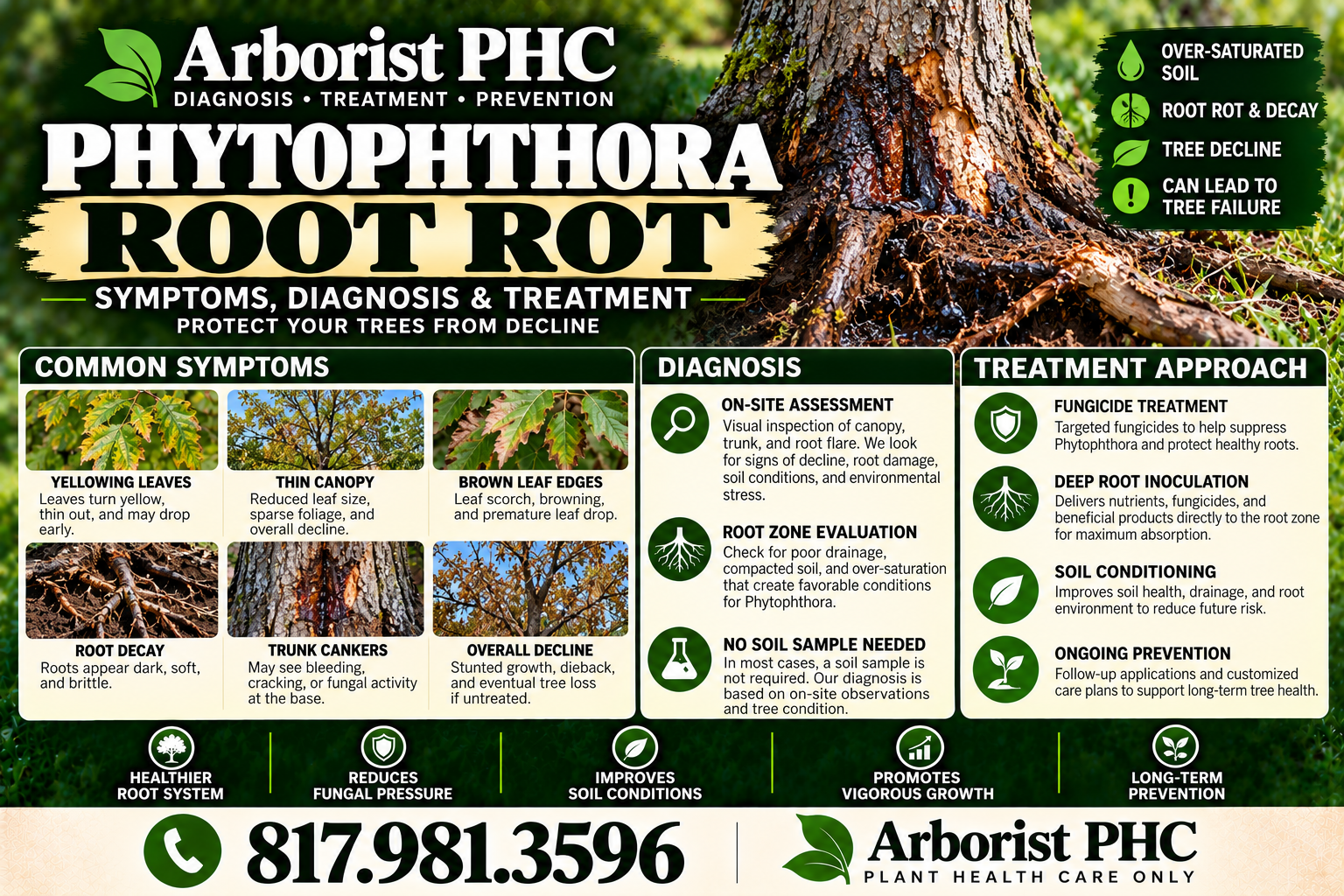
Phytophthora Root Rot | Symptoms, Diagnosis & Treatment | Arborist PHC
Phytophthora Root Rot
What Is Phytophthora Root Rot?
Phytophthora Root Rot is one of the most destructive root diseases affecting landscape trees and shrubs. Although it’s often referred to as a fungus, Phytophthora is actually a water mold (oomycete) that thrives in wet, poorly drained soils.
Once established, it attacks fine feeder roots and larger structural roots, reducing the tree’s ability to absorb water and nutrients. As the disease progresses, trees often decline rapidly and may eventually die if left untreated.
At Arborist PHC, we specialize exclusively in Plant Health Care (PHC) and provide professional diagnosis and customized treatment programs designed to improve tree health and reduce environmental stress.
What Causes Phytophthora Root Rot?
Phytophthora thrives in saturated soils where oxygen levels are low.
Common contributing factors include:
💧 Overwatering
🌧 Poor drainage
🪨 Heavy clay soils
🚧 Soil compaction
🌱 Planting too deeply
🏡 Improper grading
🌊 Standing water around the root zone
When roots remain wet for extended periods, they become stressed and highly susceptible to infection.
Common Symptoms of Phytophthora Root Rot
Symptoms usually begin below ground before becoming visible in the canopy.
Common signs include:
🍂 Yellow leaves
🍂 Wilting despite moist soil
🍂 Premature leaf drop
🍂 Thin canopy
🍂 Stunted growth
🍂 Dead branches
🍂 Dieback in the upper canopy
🍂 Dark, decaying roots
🍂 Soft or rotting root flare tissue
🍂 Sudden decline during hot weather
Because these symptoms resemble drought stress and nutrient deficiencies, professional diagnosis is essential.
Trees Commonly Affected
Phytophthora Root Rot can affect many ornamental and shade trees, including:
🌳 Red Oaks
🌳 Bradford Pears
🌳 Desert Willows
🌳 Newly Planted Trees
🌳 Ornamental Trees and Shrubs
Young and newly planted trees are especially vulnerable because their root systems are still developing.
Why Proper Diagnosis Is Important
Many tree problems produce similar symptoms.
A tree suffering from Phytophthora Root Rot may appear to have:
Nutrient Deficiencies
Insect Damage
General Transplant Shock
At Arborist PHC, our ISA Certified Arborists evaluate:
✔️ Root flare condition
✔️ Soil drainage
✔️ Root health
✔️ Irrigation practices
✔️ Canopy density
✔️ Environmental stress
✔️ Disease symptoms
✔️ Overall tree vigor
Accurate diagnosis is critical to developing the correct treatment strategy.
Our Plant Health Care Approach
Treatment focuses on improving root health, reducing stress, and correcting the conditions that allowed the disease to develop.
Every treatment plan is customized to the individual tree and site conditions.
🌱 Deep Root Inoculation
Our Deep Root Inoculation program helps:
✔️ Encourage healthier root development
✔️ Improve nutrient uptake
✔️ Increase drought tolerance
✔️ Strengthen overall tree vigor
✔️ Improve long-term root health
🌳 BBT (Broad Brush Treatment) Program
Our signature BBT (Broad Brush Treatment) combines several Plant Health Care techniques into one comprehensive treatment.
The program may include:
✔️ Deep Root Inoculation
✔️ Basal Drench Applications
✔️ Root Zone Health Management
✔️ Nutrient & Micronutrient Support
✔️ Environmental Stress Reduction
✔️ Disease Management Strategies
Each treatment is customized after a professional diagnosis.
💧 Basal Drench Applications
Basal Drench applications help improve systemic uptake around the root flare while supporting healthier root function and improving overall tree vitality.
How to Help Prevent Phytophthora Root Rot
Good cultural practices greatly reduce the risk of infection.
We recommend:
🌱 Water deeply but avoid constantly saturated soil
🌱 Improve drainage where possible
🌱 Avoid planting too deeply
🌱 Apply mulch correctly (2–4 inches deep, away from the trunk)
🌱 Avoid compacting soil around the root zone
🌱 Monitor irrigation systems for leaks or excessive watering
🌱 Schedule routine tree health inspections
Healthy root systems are the foundation of healthy trees.
Can Trees Recover?
Recovery depends on how early the disease is detected and how much of the root system has been affected.
Trees diagnosed early often have a much better chance of stabilizing when soil conditions are improved and a customized Plant Health Care program is implemented.
Once severe root decay has occurred, recovery becomes much more difficult.
Schedule a Tree Health Assessment
If your tree is wilting despite adequate watering or showing signs of unexplained decline, don’t ignore the warning signs.
Early diagnosis can make a significant difference.
📞 Call or Text Arborist PHC
📸 Send Photos for a Preliminary Evaluation
Our Certified Arborists will identify whether Phytophthora Root Rot or another underlying issue is affecting your tree and develop a customized Plant Health Care program designed to restore and protect its health.
Frequently Asked Questions
-
Phytophthora Root Rot is a destructive water mold disease that attacks a tree’s root system, reducing its ability to absorb water and nutrients.
-
The disease is most commonly associated with poor drainage, saturated soils, overwatering, and compacted soils that create favorable conditions for infection.
-
Trees diagnosed early may recover or stabilize if soil conditions are corrected and a proper Plant Health Care program is implemented.
-
Proper watering, improving drainage, avoiding soil compaction, and maintaining healthy root systems are the best ways to reduce the risk.
-
No. Arborist PHC specializes exclusively in Plant Health Care, diagnosis, treatment, and preventive care.