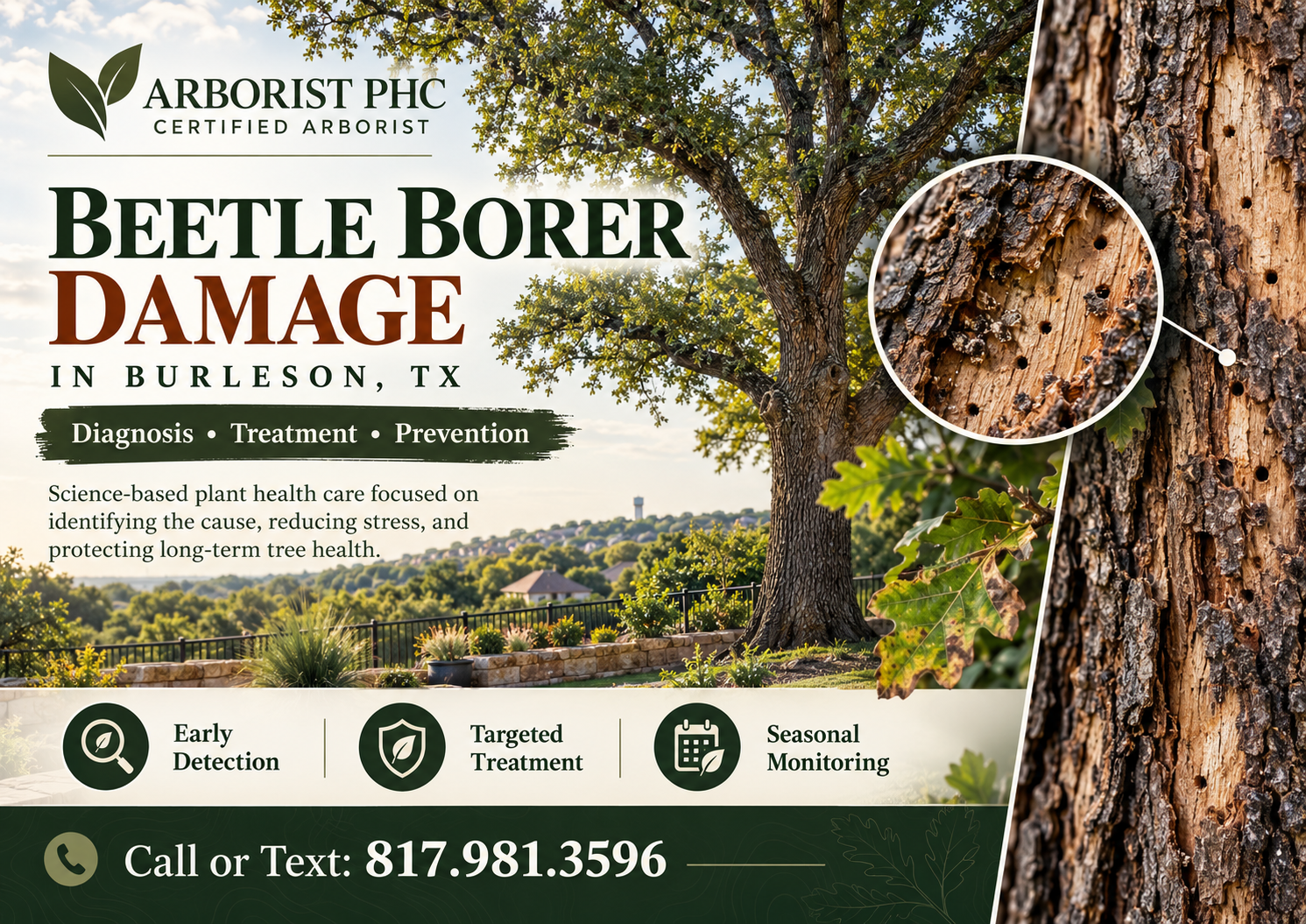
Beetle Borer Damage on Trees in Burleson, TX | Tree Insect Treatment | Arborist PHC
Certified Arborist | Serving Burleson & North Texas
Beetle Borer Damage on Trees in Burleson, TX
Identifying and Treating Tree Borer Damage in North Texas
Beetle borers are a common and serious threat to trees in Burleson and across North Texas, especially when trees are already under stress.
At Arborist PHC, we specialize in diagnosing insect-related tree decline and implementing targeted plant health care treatments to manage borer activity and improve overall tree health.
Our approach follows on identifying the cause—not just treating surface symptoms.
What Are Beetle Borers?
Beetle borers are insects that tunnel into the trunk, branches, and vascular system of trees, disrupting the flow of water and nutrients.
Common borers in North Texas include:
Flathead borers
Bark beetles
Longhorn beetles
These insects are typically attracted to stressed, weakened, or declining trees.
Signs of Beetle Borer Damage
Early detection is critical. Common symptoms include:
Small holes in the bark (entry/exit holes)
Sawdust-like material (frass) around the base or trunk
Bark splitting or peeling
Dieback in upper branches
Thinning canopy
Increased woodpecker activity
In many cases, borer damage is a secondary issue, meaning the tree was already under stress.
Why Trees in Burleson Are Vulnerable
Trees in Burleson often face environmental stress factors that attract borers:
Drought and heat stress
Heavy clay soils limiting root function
Overwatering or poor drainage
Nutrient deficiencies
Previous disease or damage
When trees are weakened, they become more susceptible to insect invasion.
Our Treatment Approach (Watch Our Process)
Borer management requires a combined strategy focused on both the insect and the underlying stress factors.
Basal Drench & Bark Applications
Applied at the root flare and lower trunk
Absorbed through the vascular system
Targets active insect populations
Helps control borers feeding within the tree
Provides ongoing protection against reinfestation
Deep Root Feeding (Soil Injection)
Improves overall tree health and vigor
Helps trees better defend against insect attack
Supports long-term recovery
Broad-Spectrum Plant Health Care (BBT)
Addresses multiple stress factors at once
Includes nutrients, micronutrients, and systemic materials
Strengthens tree resilience
The Importance of Early Intervention
Once borers establish themselves, damage can progress quickly.
Early treatment can:
Reduce active infestations
Prevent further structural damage
Improve the tree’s ability to recover
Delayed action often leads to:
Severe canopy loss
Structural weakening
Increased risk of tree failure
Our Diagnosis-First Approach
Not all tree decline is caused by borers.
We evaluate:
Tree species and condition
Environmental stress factors
Presence of disease
Extent of insect activity
This ensures that treatment is accurate and effective—not unnecessary or misapplied.
Service Areas Near Burleson
We proudly serve:
Crowley
Joshua
Surrounding Johnson and Tarrant County communities
Request a Tree Health Assessment in Burleson, TX (Click here to submit a form)
If your trees are showing signs of insect damage or decline, early diagnosis is critical.
📞 Call or Text to Schedule
📸 Send photos for a preliminary evaluation
We’re here to help you protect your trees and address the root cause of decline—based on science, not guesswork.
Frequently Asked Questions
-
Borers can cause significant damage, especially if the tree is already stressed. Early treatment improves the chances of recovery.
-
Borers are typically attracted to stressed or weakened trees, not healthy ones.
-
Damage cannot be undone, but treatment can stop progression and improve tree health.
-
Both. We target the insects while also improving the tree’s overall health to prevent reinfestation.
-
No—Arborist PHC focuses strictly on plant health care, diagnosis, and treatment programs.