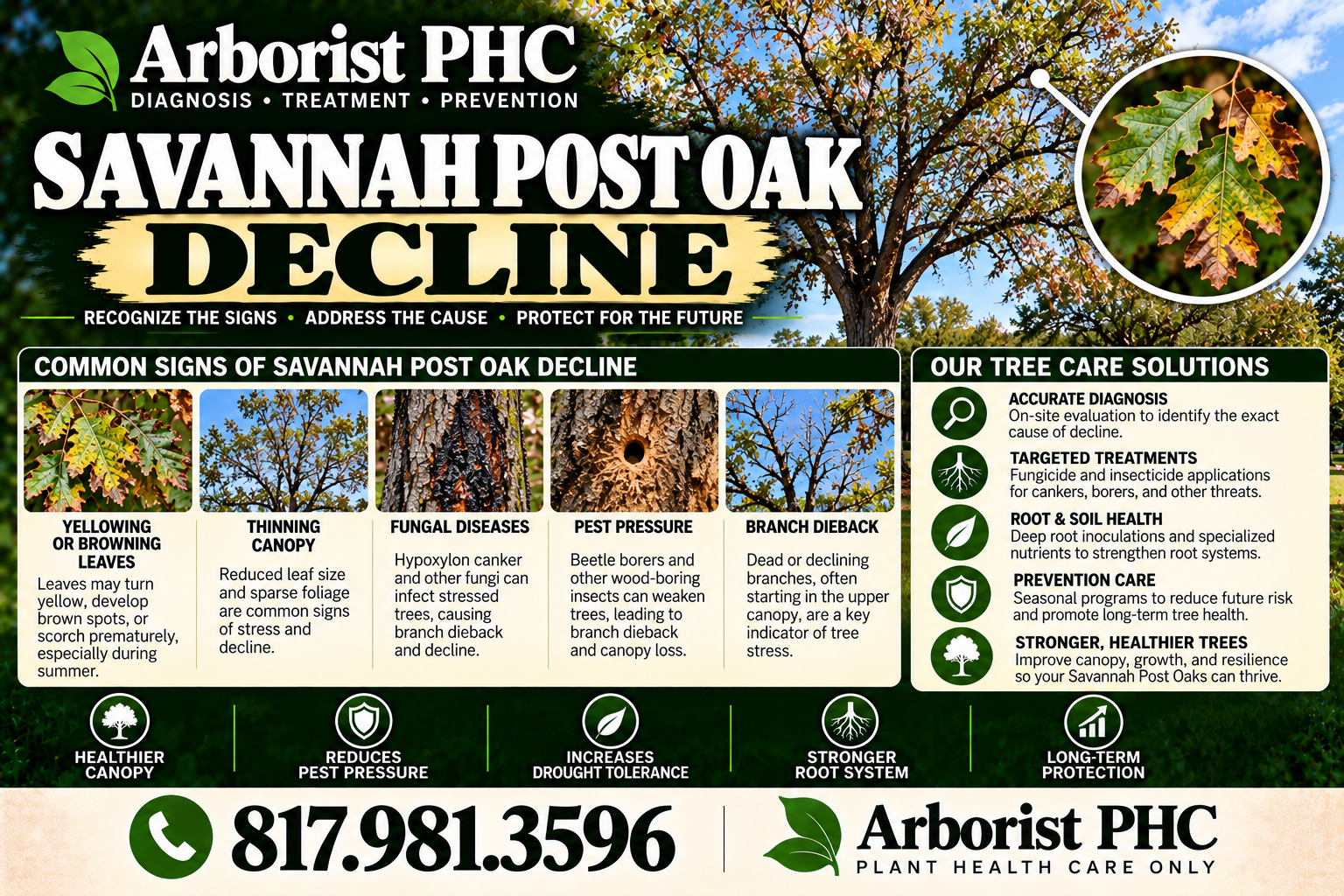
Savannah Post Oak Decline | Savannah Post Oak Tree Stress & Care | Arborist PHC
Savannah Post Oak Decline - Serving Fort Worth & North Texas
Understanding Savannah Post Oak Decline in North Texas
Savannah Post Oaks are one of the most environmentally sensitive Oak species commonly found throughout North Texas landscapes and rural properties.
At Arborist PHC, we commonly evaluate Savannah Post Oaks experiencing:
Canopy thinning
Sparse foliage development
Branch dieback
Reduced vigor
Environmental stress-related decline
Secondary pest and fungal pressure
Our approach follows:
Science-based Plant Health Care strategies focused on long-term tree vitality
In many cases, Savannah Post Oak decline develops gradually over multiple years before severe canopy symptoms become visible.
Why Savannah Post Oaks Commonly Decline
Savannah Post Oaks are naturally adapted to:
✔️ Native undisturbed soils
✔️ Stable moisture conditions
✔️ Open woodland environments
✔️ Minimal root disturbance
When exposed to:
☀️ Prolonged drought conditions
🌧 Excessive moisture fluctuations
🚧 Construction-related root disturbance
🪨 Soil compaction
🌱 Environmental stress accumulation
their natural defense system may gradually weaken over time.
Savannah Post Oaks are especially sensitive to root damage and environmental changes within the root zone.
Environmental Stress & Savannah Post Oaks
Environmental stress is one of the leading causes of Savannah Post Oak decline throughout North Texas.
Common stress factors include:
Extreme summer heat
Drought conditions
Freeze damage
Heavy clay soils
Root compaction
Excessive moisture retention
Nutrient deficiencies
Over time, prolonged environmental stress may weaken vascular function and overall canopy resilience.
Common Signs of Savannah Post Oak Decline
Symptoms associated with Savannah Post Oak decline may include:
🍂 Thinning canopy growth
🍂 Sparse foliage development
🍂 Browning or yellowing leaves
🍂 Premature leaf drop
🍂 Branch dieback
🍂 Reduced vigor and slowed growth
🍂 Epicormic sprouting along the trunk or limbs
🍂 Progressive canopy decline
These symptoms are often associated with long-term root stress and vascular dysfunction.
Root Stress & Soil Compaction
One of the most common problems affecting Savannah Post Oaks is root stress caused by soil compaction.
Compacted soils may:
Restrict oxygen movement
Reduce root expansion
Limit nutrient uptake
Increase moisture retention
Weaken environmental stress tolerance
Savannah Post Oaks rely heavily on healthy, functioning root systems for long-term vitality.
Healthy roots create stronger, more resilient trees.
Secondary Problems Commonly Associated With Declining Savannah Post Oaks
Trees weakened by environmental stress often become increasingly vulnerable to:
Beetle Borer activity
Hypoxylon Canker
Root-related decline
Secondary fungal pathogens
Environmental stress disorders
Healthy trees are naturally more resilient to pests and disease activity.
Why Decline Often Appears Suddenly
Many Savannah Post Oaks appear healthy for years before rapidly declining.
Trees are biologically designed to compartmentalize stress internally over extended periods.
In many cases:
Root stress develops first
Internal vascular function weakens gradually
Stored energy reserves become depleted over time
Canopy symptoms appear once stress reaches a critical threshold
This is why many homeowners feel their Savannah Post Oak “suddenly declined,” even though stress progression often began years earlier.
The Importance of Root Health
Healthy root systems are essential for:
✔️ Water absorption
✔️ Nutrient uptake
✔️ Oxygen movement
✔️ Structural stability
✔️ Environmental stress tolerance
Supporting root health is one of the most important strategies for improving Savannah Post Oak resilience.
Healthy roots create stronger, more resilient trees.
Our Plant Health Care Approach (Watch Our Process)
At Arborist PHC, our programs focus on reducing environmental stress and supporting long-term Savannah Post Oak vitality.
Deep Root Inoculation (Soil Injection)
Delivers nutrients and support materials directly into the root absorption zone
Supports root development and nutrient uptake
Improves drought tolerance and overall vigor
Basal Drench Applications
Applied near the root flare and lower trunk
Supports vascular system function and systemic uptake
Helps reduce environmental stress-related pressure
Root Zone & Soil Health Support
Healthy soil biology is essential for:
✔️ Oxygen movement
✔️ Moisture regulation
✔️ Root development
✔️ Long-term canopy vitality
Monitoring & Reassessment
Environmental stress often develops gradually over time. Ongoing monitoring helps track canopy response and identify progression patterns early.
Preventative Savannah Post Oak Care Programs
Preventative care is one of the most effective long-term strategies for maintaining healthy Savannah Post Oaks.
Programs may include:
🌱 Deep Root Inoculation
🌱 Root zone support
🌱 Nutrient management
🌱 Environmental stress reduction
🌱 Seasonal monitoring and reassessment
Early intervention is critical before severe canopy decline develops.
Our Diagnosis-First Philosophy
Not all Savannah Post Oak decline is caused by the same issue.
We evaluate:
Tree age and structure
Soil and environmental conditions
Root health and compaction
Pest and disease activity
Overall canopy condition and stress levels
This allows us to develop:
✔️ Accurate evaluations
✔️ Targeted treatment recommendations
✔️ Long-term management strategies
Areas We Serve
We proudly serve:
Surrounding North Texas communities
Schedule a Savannah Post Oak Assessment
If your Savannah Post Oaks are showing signs of canopy thinning, branch dieback, environmental stress, or progressive decline, early evaluation is important.
📞 Call or Text to Schedule
📸 Send photos for a preliminary review
We’re here to help identify environmental stress factors early and implement science-based Plant Health Care solutions for long-term Savannah Post Oak vitality.
Frequently Asked Questions
-
Savannah Post Oak decline is commonly associated with environmental stress, root dysfunction, drought conditions, soil compaction, and secondary pest or fungal pressure.
-
Yes. Savannah Post Oaks are highly sensitive to soil compaction, grading changes, and root disturbance.
-
Healthy roots improve water absorption, nutrient uptake, and overall environmental stress tolerance.
-
Many Savannah Post Oaks improve significantly when environmental stress factors are identified early and properly managed.
-
No—Arborist PHC specializes strictly in Plant Health Care, diagnosis, and treatment programs.