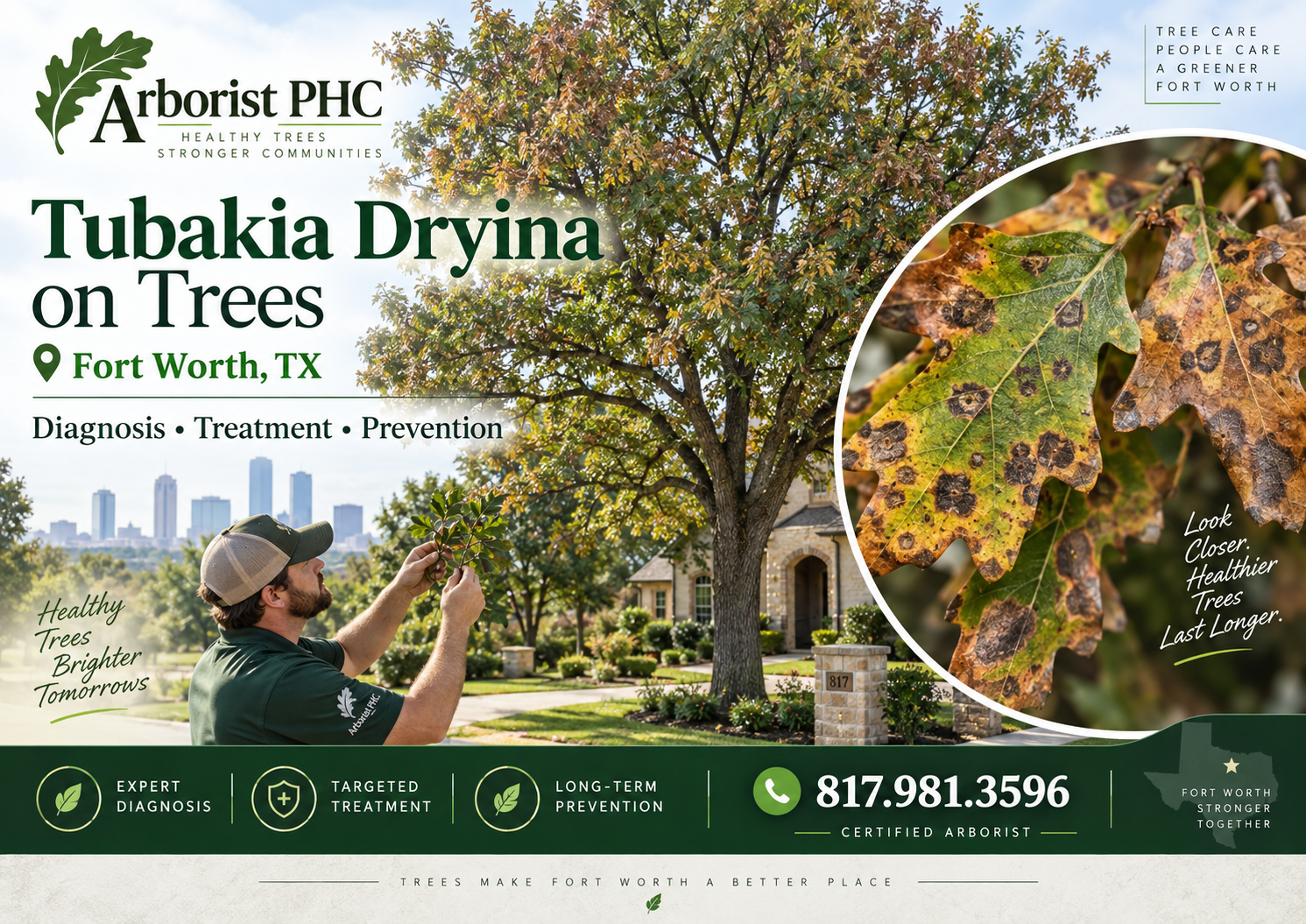
Tubakia Dryina on Trees in Fort Worth TX | Oak Leaf Spot Diagnosis & Treatment | Arborist PHC
Tubakia Dryina on Trees in Fort Worth TX
What Is Tubakia Dryina?
Tubakia dryina is a fungal leaf-spot disease that commonly affects Oak trees and other hardwoods. Homeowners often first notice dark brown or black spots developing across the leaves, followed by browning, premature leaf drop, or a thinning canopy.
In many cases, Tubakia primarily affects the foliage rather than the trunk or root system. However, repeated infections—especially on trees already weakened by heat, drought, root damage, poor soil conditions, or other stress—can contribute to long-term decline.
At Arborist PHC, we specialize exclusively in Plant Health Care (PHC) and provide professional diagnosis and customized disease-management programs for trees throughout Fort Worth and surrounding North Texas communities.
Diagnosis • Treatment • Prevention
What Does Tubakia Leaf Spot Look Like?
Tubakia symptoms can vary depending on the tree species and severity of infection.
Common signs include:
🍂 Brown or dark leaf spots
🍂 Circular or irregular lesions
🍂 Dark margins around affected tissue
🍂 Larger blotches as spots merge together
🍂 Browning foliage
🍂 Premature leaf drop
🍂 Thin or sparse canopy
🍂 Reduced overall tree vigor
Severe infections can make an otherwise healthy Oak appear to be declining rapidly during the growing season.
Which Trees Are Commonly Affected?
Tubakia is particularly associated with Oak species.
We commonly evaluate symptoms on:
🌳 Bur Oaks
🌳 Red Oaks
🌳 Shumard Red Oaks
🌳 Live Oaks
🌳 Post Oaks
🌳 Savannah Post Oaks
🌳 Other susceptible hardwood trees
Some Oak species may show stronger symptoms than others depending on weather, site conditions, and overall tree health.
Why Does Tubakia Develop?
Tubakia is favored by warm, humid, or wet conditions that allow spores to infect foliage.
Several factors may increase disease pressure:
🌧 Frequent rainfall
💧 Prolonged leaf wetness
🌿 Dense foliage with limited airflow
☀️ Heat and drought stress
🌱 Nutrient deficiencies
🚧 Root damage
🪨 Soil compaction
🍂 Infected fallen leaves
🌳 Previous seasonal stress
Trees weakened by environmental stress are often less able to tolerate repeated foliar disease.
Is Tubakia Dryina Dangerous?
A mild case of Tubakia may be mostly cosmetic.
However, repeated or severe infections can lead to:
🍂 Premature defoliation
🍂 Reduced photosynthesis
🍂 Lower energy reserves
🍂 Canopy thinning
🍂 Reduced annual growth
🍂 Greater susceptibility to secondary stress
A tree that repeatedly loses foliage early may gradually become weaker over time.
That is why the overall health of the tree matters just as much as the visible leaf spots.
Tubakia vs. Other Oak Diseases
Several Oak problems can look very similar at first glance.
Tubakia may be confused with:
Anthracnose
Oak Wilt
Bacterial Leaf Scorch
Heat Stress
Drought Stress
Iron Chlorosis
Other fungal leaf spots
Insect-related foliage damage
This is why proper diagnosis is important before applying treatment.
Not every brown or spotted Oak leaf is Tubakia.
Why Accurate Diagnosis Matters
At Arborist PHC, we evaluate more than the leaf itself.
Our Certified Arborist looks at:
✔️ Tree species
✔️ Leaf-spot pattern
✔️ Canopy density
✔️ Branch dieback
✔️ Root flare condition
✔️ Soil moisture
✔️ Drainage
✔️ Environmental stress
✔️ Insect activity
✔️ Overall tree vigor
The objective is to determine whether Tubakia is the primary issue or simply one part of a larger decline pattern.
Our Tubakia Disease Management Approach
Treatment depends on severity, timing, and overall tree condition.
A customized management program may include:
🌱 Deep Root Inoculation
Deep Root Inoculation may help support:
✔️ Root development
✔️ Nutrient uptake
✔️ Environmental-stress tolerance
✔️ Healthy new growth
✔️ Overall tree vigor
Supporting the root system is especially important when foliar disease is occurring on a tree already stressed by North Texas heat.
Our BBT Program may combine several Plant Health Care strategies depending on the diagnosis.
This may include:
✔️ Deep Root Inoculation
✔️ Basal Drench Applications
✔️ Targeted disease-management support
✔️ Nutrient and micronutrient support
✔️ Insect management when needed
✔️ Environmental-stress reduction
The goal is to manage disease pressure while strengthening the tree as a whole.
🍄 Targeted Disease Management
For certain foliar diseases, preventive or targeted fungicide applications may be appropriate.
Timing is critical.
Fungicides are generally most effective when applied according to the disease cycle and before infection becomes severe, rather than after heavily damaged leaves are already present.
Treatment recommendations should be based on the tree species, disease severity, season, and previous history.
Should Infected Leaves Be Removed?
Where practical, removing heavily infected fallen leaves may help reduce overwintering disease material around the tree.
Good sanitation may include:
🍂 Removing heavily diseased leaf litter
🌱 Maintaining proper mulch depth
💧 Avoiding unnecessary overhead irrigation
🌳 Improving overall tree vigor
🌿 Maintaining appropriate airflow
Sanitation alone may not eliminate the disease, but it can be part of a complete management strategy.
Can an Oak Recover from Tubakia?
Yes, many Oaks can recover well from Tubakia—especially when the tree is otherwise healthy.
Recovery depends on:
Severity of infection
Amount of premature leaf loss
Root health
Drought stress
Soil conditions
Nutrient availability
Recurring disease pressure
Overall canopy condition
A tree suffering from repeated defoliation year after year may need a more comprehensive Plant Health Care program.
Tubakia and Heat Stress in Fort Worth
Fort Worth trees often experience both foliar disease and environmental stress at the same time.
High temperatures and drought can weaken trees while wet spring periods encourage fungal infections.
This combination can result in:
🍂 Leaf spotting
🍂 Browning
🍂 Premature leaf casting
🍂 Thin canopy
🍂 Branch-tip dieback
🍂 Reduced vigor
Addressing both disease pressure and environmental stress often produces better long-term results than treating the leaf spots alone.
How to Help Reduce Future Tubakia Problems
Homeowners can help by:
🌱 Maintaining proper watering
🌱 Avoiding excessive irrigation
🌱 Protecting the root zone
🌱 Reducing soil compaction
🌱 Maintaining appropriate mulch
🌱 Removing heavily diseased leaf litter when practical
🌱 Monitoring trees annually
🌱 Addressing heat and drought stress
🌱 Scheduling preventive treatment when appropriate
Healthy trees are generally better able to tolerate foliar disease.
Why Choose Arborist PHC?
At Arborist PHC, we specialize exclusively in Plant Health Care.
We focus on:
✔️ Tree Diagnosis
✔️ Fungal Disease Management
✔️ Root Health
✔️ Nutrient Support
✔️ Environmental Stress Reduction
✔️ Insect Management
✔️ Preventive Tree Care
We do not focus on routine trimming or removals. Our goal is to identify what is affecting your tree and develop a treatment strategy designed around its health.
Diagnosis • Treatment • Prevention
Schedule a Tubakia Assessment in Fort Worth TX
If your Oak has brown spots, black lesions, premature leaf drop, or a thinning canopy, Tubakia may be one possible cause.
📞 Call or Text Arborist PHC at 817.981.3596
📸 Send Photos for a Preliminary Evaluation
Our Certified Arborist can evaluate the foliage, canopy, root zone, and surrounding environment to determine whether Tubakia or another disease is affecting your tree.
Frequently Asked Questions
-
Tubakia dryina is a fungal leaf-spot pathogen that commonly affects Oaks and can cause brown or dark leaf spots, premature leaf drop, and canopy thinning.
-
Tubakia alone is not always fatal, but repeated severe infections can weaken a tree over time, especially when combined with drought, heat, root damage, or other stress.
-
Typical symptoms include circular or irregular brown spots, darker margins, larger blotches, browning foliage, and premature leaf drop.
-
No. Tubakia is primarily a foliar disease, while Oak Wilt is a vascular disease. The two require completely different management strategies.
-
In some cases, targeted fungicide applications may be appropriate. Timing is important, and treatment should be based on diagnosis, severity, species, and disease history.
-
Many trees can recover if enough healthy canopy and root function remain. Supporting overall tree health is important when premature defoliation occurs.