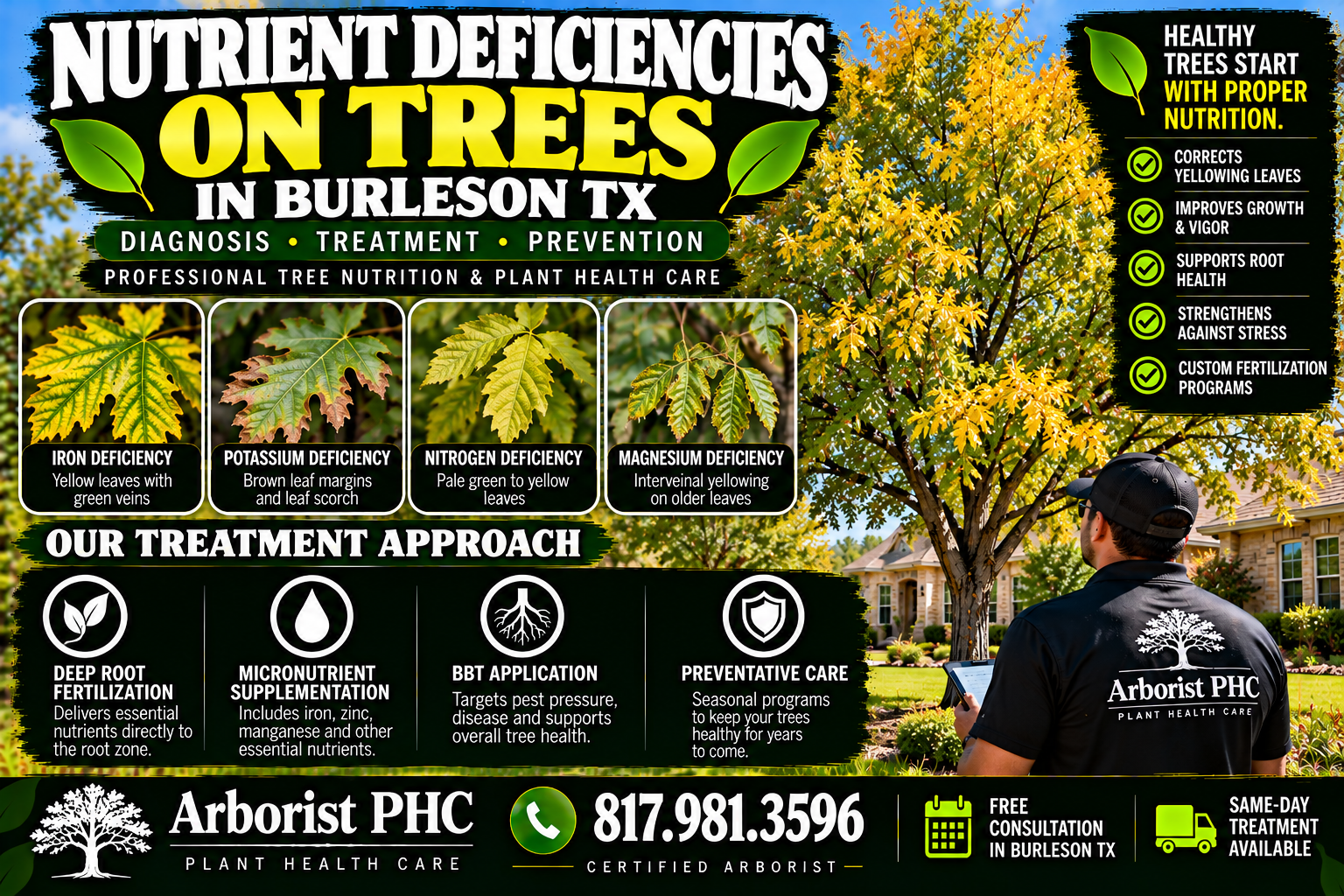
Nutrient Deficiencies in Trees in Burleson, TX | Tree Fertilization & Plant Health Care
Professional Tree Nutrition, Deep Root Fertilization & Nutrient Deficiency Treatment
Are your trees developing yellow leaves, weak growth, thinning canopies, or premature leaf drop? These symptoms may indicate a nutrient deficiency, poor soil conditions, root-related stress, or another underlying tree health concern.
Throughout Burleson, TX, and surrounding North Texas communities, trees frequently experience challenges associated with alkaline soils, nutrient availability, soil compaction, drought stress, and improper watering.
At Arborist PHC, we specialize in diagnosing tree health problems and developing customized Plant Health Care programs to address nutritional deficiencies and support healthy tree development.
Our services include tree health evaluations, deep root inoculation, targeted fertilization, micronutrient supplementation, and preventative tree care.
We offer free on-site tree health consultations in Burleson, TX, with same-day treatment availability when appropriate.
What Causes Nutrient Deficiencies in Trees?
Trees require essential nutrients to maintain healthy foliage, develop strong roots, produce new growth, and perform important biological functions.
When nutrients are unavailable or cannot be absorbed efficiently, trees may begin displaying visible signs of stress.
However, nutrient deficiencies do not always mean that the soil lacks nutrients.
In many cases, nutrients are already present in the soil but are unavailable to the tree because of unfavorable growing conditions.
Common contributing factors include:
Alkaline soil conditions
Elevated soil pH
Poor drainage
Excessive soil moisture
Drought stress
Root damage
Soil compaction
Limited root development
Nutrient imbalances
Construction-related disturbances
Improper fertilization
Identifying the underlying cause is important before applying fertilizers or other nutritional products.
Common Signs of Nutrient Deficiencies in Trees
Nutritional problems may affect leaf color, canopy density, root development, and overall tree vigor.
Common symptoms include:
Yellowing Leaves
Yellow foliage, also known as chlorosis, is one of the most recognizable symptoms of certain nutrient deficiencies.
Some deficiencies cause uniform yellowing, while others produce yellow tissue between leaf veins.
Interveinal Chlorosis
Interveinal chlorosis occurs when the tissue between leaf veins turns yellow while the veins remain green.
This symptom is commonly associated with iron or manganese availability problems, although other conditions may produce similar patterns.
Reduced Canopy Density
Trees experiencing nutritional limitations may produce fewer leaves or smaller-than-normal foliage.
Over time, the canopy may appear thin or uneven.
Stunted Growth
Nutrient deficiencies can interfere with normal growth, resulting in reduced shoot development and shorter annual growth increments.
Premature Leaf Drop
Severe nutritional stress may contribute to early leaf loss, particularly when combined with drought, root damage, or environmental stress.
Branch Dieback
Advanced nutritional problems can contribute to reduced tree vigor and branch deterioration.
However, branch dieback may also indicate serious root problems, vascular diseases, or other conditions that require professional evaluation.
Iron Deficiency in Trees in Burleson, TX
Iron deficiency is an important nutritional concern in portions of North Texas where alkaline soil conditions limit iron availability.
Iron is essential for chlorophyll formation and normal plant function.
When iron becomes unavailable, trees may develop a condition known as iron chlorosis.
Signs of Iron Chlorosis
Yellow leaves with green veins
Pale new growth
Reduced leaf size
Slow canopy development
Leaf scorching in severe cases
Reduced overall vigor
Iron chlorosis often becomes noticeable on younger foliage because iron is relatively immobile within the plant.
Why Iron Chlorosis Occurs
Many North Texas soils have elevated pH levels.
Under alkaline conditions, iron may become chemically unavailable even when sufficient iron is present in the soil.
Simply applying additional fertilizer may not correct the problem.
Treatment may require appropriately selected iron products, soil management, or other corrective measures based on the diagnosis.
Nitrogen Deficiency in Trees
Nitrogen is a primary macronutrient required for foliage development, chlorophyll production, and normal plant growth.
Trees experiencing nitrogen deficiency may display:
Pale green foliage
Uniform yellowing
Reduced shoot growth
Smaller leaves
Thin canopy development
Because nitrogen is mobile within the plant, deficiency symptoms often become noticeable on older foliage first.
Can Nitrogen Fertilization Help?
When nitrogen deficiency is confirmed, properly selected fertilizer applications may support healthier growth.
However, excessive nitrogen can create undesirable growth, increase nutrient runoff, and contribute to additional stress.
Fertilization should be based on the tree's condition and actual nutritional needs.
Phosphorus Deficiency and Root Development
Phosphorus plays an important role in energy transfer, cellular function, and root development.
Deficiencies may contribute to:
Reduced growth
Poor root development
Delayed establishment
Darker-than-normal foliage
Occasional reddish or purplish discoloration
Phosphorus deficiency is not always common in established landscape trees.
Unnecessary phosphorus applications may contribute to nutrient imbalances and environmental runoff.
Soil testing can help determine whether supplementation is appropriate.
Potassium Deficiency in Trees
Potassium helps regulate water movement, enzyme activity, and several important physiological functions.
It contributes to normal plant water regulation and stress responses.
Possible deficiency symptoms include:
Browning along leaf margins
Yellowing of older foliage
Reduced growth
Increased sensitivity to environmental stress
Potassium deficiency can resemble drought stress or leaf scorch.
Proper diagnosis is important before treatment.
Magnesium Deficiency
Magnesium is a central component of chlorophyll and is essential for photosynthesis.
Deficiency symptoms may include:
Interveinal yellowing
Discoloration on older leaves
Reduced growth
Premature leaf loss in severe cases
Magnesium deficiency may occur when soil conditions or nutrient imbalances limit its availability.
Manganese and Zinc Deficiencies
Manganese and zinc are essential micronutrients involved in enzyme activity and normal plant development.
Deficiencies may contribute to:
Yellowing foliage
Abnormal leaf development
Reduced shoot growth
Smaller leaves
Poor canopy development
Because symptoms can overlap with other deficiencies and root-related problems, soil or tissue testing may be necessary.
How Soil pH Affects Tree Nutrition in North Texas
Soil pH is one of the most important factors affecting nutrient availability.
Many soils throughout the Fort Worth and Burleson area are naturally alkaline.
When soil pH is elevated, certain micronutrients may become less available to tree roots.
These commonly include:
Iron
Manganese
Zinc
A tree may display nutrient deficiency symptoms even when those nutrients are present in the soil.
This is why simply adding general-purpose fertilizer may not provide the desired results.
At Arborist PHC, we evaluate visible tree symptoms and root-zone conditions before recommending nutritional treatment.
Soil or tissue testing may be recommended when the diagnosis is uncertain.
Our Tree Fertilization and Nutrient Treatment Programs in Burleson, TX
At Arborist PHC, we provide customized Plant Health Care applications designed to address identified nutritional concerns.
Deep Root Inoculation
Deep Root Inoculation is one of the application methods we may recommend for targeted root-zone nutritional care.
This process involves delivering selected materials into the soil where roots can access them.
Depending on the diagnosis, treatment may include:
Nitrogen
Phosphorus
Potassium
Iron
Zinc
Manganese
Other appropriate micronutrients
The formulation and application rate depend on the tree species, soil conditions, and identified nutritional needs.
Deep root applications are not automatically necessary for every tree and should be used when there is a clear benefit.
Broad Brush Treatment (BBT) Program
Our Broad Brush Treatment program is a customized Plant Health Care approach designed to address multiple tree health concerns.
Depending on the findings, the program may include:
Nutritional supplementation
Micronutrient correction
Targeted insect management
Fungicide applications for appropriate diseases
Root-zone support
Preventative monitoring
The objective is to manage identifiable problems and support overall tree vigor.
Chelated Iron Applications
When iron chlorosis is identified, certain chelated iron products may help improve iron availability.
However, not all iron formulations perform equally in alkaline soils.
Product selection is important because some iron compounds become ineffective at elevated soil pH.
Soil and Root-Zone Management
Nutrient deficiencies may be related to underlying root or soil problems.
When appropriate, recommendations may include:
Improved irrigation practices
Soil compaction management
Organic mulch
Drainage improvements
Root-zone protection
Correcting planting depth problems
Addressing these conditions may be necessary before nutritional applications can provide meaningful benefits.
Nutrient Deficiencies vs. Tree Diseases
One of the most important aspects of tree diagnosis is distinguishing nutritional problems from fungal diseases, pest infestations, and environmental stress.
For example, yellowing leaves may result from iron chlorosis, but similar symptoms may also develop because of:
Phytophthora Root Rot
Excessive moisture
Drought stress
Root damage
Soil compaction
Vascular diseases
Applying fertilizer to a tree suffering from severe root rot may not improve its condition.
In some situations, unnecessary fertilizer applications can create additional stress.
Accurate diagnosis should always come before treatment.
Tree Species Commonly Affected by Nutritional Problems
Arborist PHC provides nutritional assessments and Plant Health Care services for many tree species throughout Burleson, including:
Live Oaks may develop nutritional symptoms associated with poor root conditions, soil disturbances, or nutrient availability problems.
Shumard Red Oak (Quercus shumardii)
Shumard Red Oaks may experience chlorosis and reduced vigor when soil conditions interfere with nutrient uptake.
Bur Oaks can experience nutrient-related symptoms, particularly when root function is affected by soil compaction, moisture problems, or other environmental conditions.
Chinese Pistache (Pistacia chinensis)
Chinese Pistache trees may display yellowing foliage and reduced growth associated with root stress or nutrient availability problems.
Cedar Elms may experience nutrient-related symptoms, especially when growing in disturbed or compacted soils.
Pecan trees can develop nutrient deficiencies involving zinc and other essential elements.
Magnolia (Magnolia grandiflora)
Magnolias may experience chlorosis and reduced vigor when soil conditions interfere with nutrient availability and root function.
Why Fall Can Be a Good Time to Evaluate Tree Nutrition
Fall is an important period for evaluating the health of trees following the stressful North Texas summer season.
During this time, trees may be recovering from prolonged heat, drought, and environmental stress.
A fall assessment can help identify:
Nutritional symptoms
Root-zone problems
Canopy thinning
Soil moisture concerns
Pest and disease activity
When a nutritional deficiency is identified, certain fall applications may be appropriate depending on the species, soil temperature, product, and treatment objective.
However, not every tree requires fall fertilization.
The goal is to provide the right treatment at the right time rather than applying nutrients unnecessarily.
Newly Planted Trees and Nutritional Care
Newly planted trees often experience transplant stress while their root systems become established.
During this period, yellowing leaves or reduced growth may result from watering problems, root disturbance, or planting depth issues rather than a true nutrient deficiency.
Proper watering, drainage, planting depth, and root protection are usually the first priorities.
Nutritional treatment may be recommended when an actual deficiency or specific soil-related problem is identified.
Can Nutrient Treatment Save a Declining Tree?
Nutritional treatment may improve tree health when an identified deficiency is contributing to the decline.
However, recovery depends on the underlying cause and severity of damage.
Trees with healthy, functioning root systems may respond more favorably than trees experiencing advanced root rot, severe vascular disease, or extensive structural damage.
At Arborist PHC, our goal is to provide realistic treatment recommendations based on the condition of each tree.
No fertilizer or nutritional program can guarantee the survival of a severely declining tree.
Free Tree Nutrient Deficiency Consultation in Burleson, TX
Arborist PHC offers complimentary on-site tree health consultations for homeowners and property owners throughout Burleson and surrounding North Texas communities.
During our evaluation, we inspect accessible trees for:
Yellowing foliage
Interveinal chlorosis
Reduced canopy density
Poor seasonal growth
Root-related stress
Soil condition concerns
Nutrient deficiency symptoms
Pest and disease activity
After the assessment, we explain our findings and recommend appropriate next steps.
Same-Day Tree Fertilization and Treatment Available
When nutritional treatment is recommended and approved, Arborist PHC can often complete the application during the same visit, depending on product requirements and scheduling availability.
There is no obligation to proceed with treatment following the complimentary consultation.
Frequently Asked Questions
Why are my tree leaves turning yellow in Burleson, TX?
Yellow leaves may be caused by nutrient deficiencies, alkaline soil conditions, excessive moisture, drought, root damage, or disease. Proper evaluation is important before applying fertilizer.
Can iron deficiency kill a tree?
Severe or prolonged iron deficiency can weaken tree growth and contribute to decline. However, yellowing leaves may also indicate other serious conditions.
Does deep root fertilization help trees?
Deep root fertilization may help when the tree has an identified nutrient deficiency and the selected product is appropriate. It is not automatically beneficial for every tree.
How often should trees be fertilized?
There is no universal fertilization schedule. Applications should depend on the species, soil conditions, growth, and identified nutritional needs.
Can fertilizer fix yellow leaves?
Fertilizer may improve yellowing caused by a correctable nutrient deficiency. It will not necessarily resolve yellowing caused by root rot, excessive moisture, drought, or vascular disease.
Is fall a good time to fertilize trees?
Fall can be appropriate for certain nutritional treatments, depending on the tree species and soil conditions. A professional evaluation can help determine whether fertilization is needed.
Do you offer free tree evaluations in Burleson?
Yes. Arborist PHC offers complimentary on-site tree health consultations in Burleson, TX.
Schedule Professional Tree Nutrient Deficiency Treatment in Burleson, TX
If your trees are experiencing yellowing leaves, poor growth, thinning canopies, or other signs of nutritional stress, a professional evaluation can help determine the underlying cause.
At Arborist PHC, we specialize in Plant Health Care programs designed to address tree health concerns through accurate diagnosis, targeted treatment, and preventative care.
Our services include deep root inoculation, nutritional supplementation, pest and disease management, root-zone care, and seasonal tree health assessments.
ARBORIST PHC — PLANT HEALTH CARE
CERTIFIED ARBORIST
Diagnosis • Treatment • Prevention
Free On-Site Consultations | Same-Day Treatment Availability
Call or Text: 817.981.3596
Serving Burleson, Crowley, Fort Worth, Joshua, Cleburne, Alvarado, and surrounding North Texas communities.