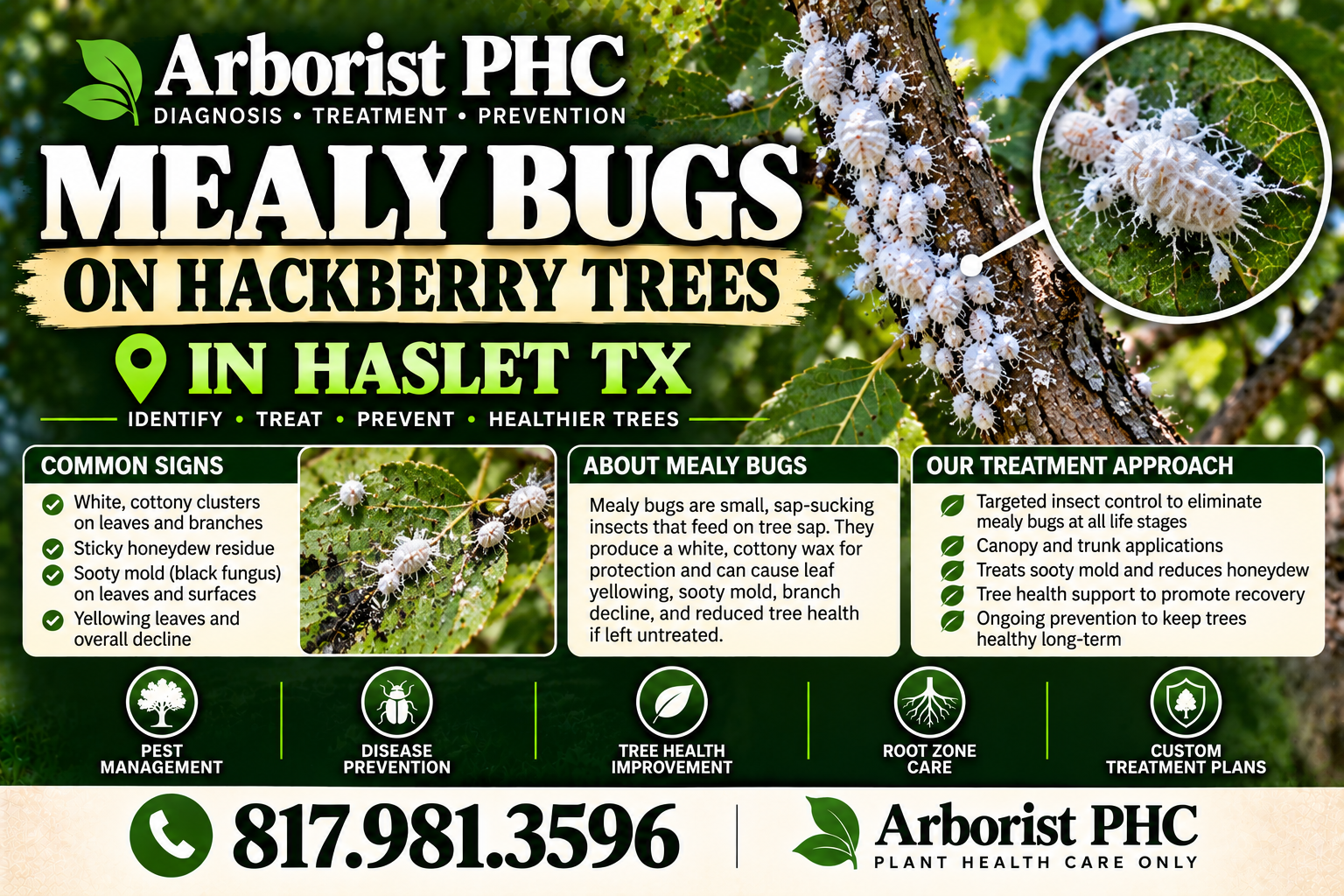
Mealy Bugs on Hackberry Trees in Haslet TX | Hackberry Tree Pest Control | Arborist PHC
Mealy Bugs on Hackberry Trees in Haslet TX
Understanding Mealy Bugs on Hackberry Trees
Mealy Bugs are a common sap-feeding insect that can affect Hackberry trees throughout Haslet and North Texas.
These insects are easily identified by their:
✔️ White cotton-like appearance
✔️ Waxy protective coating
✔️ Clusters along leaves and stems
✔️ Sticky honeydew production
While small in size, Mealy Bugs can create significant stress on Hackberry trees when populations become established.
At Arborist PHC, we frequently evaluate Hackberry trees in Haslet showing signs of Mealy Bug infestations, environmental stress, and canopy decline.
What Are Mealy Bugs?
Mealy Bugs are soft-bodied insects that feed by piercing plant tissue and extracting nutrients directly from the tree.
As they feed, they weaken foliage and interfere with normal plant function.
Heavy infestations may contribute to:
🍂 Reduced vigor
🍂 Leaf distortion
🍂 Premature leaf drop
🍂 Increased environmental stress
🍂 Declining canopy health
The white cotton-like material often seen on branches and leaves is the protective wax coating produced by the insects.
Why Hackberry Trees Are Vulnerable
Hackberry trees commonly become more susceptible to Mealy Bug infestations when already dealing with:
☀️ Drought stress
☀️ Heat stress
🌧 Excessive moisture fluctuations
🪨 Soil compaction
🚧 Root disturbance
🌱 Nutrient deficiencies
In many cases, insect activity is a secondary symptom of an underlying environmental stress issue.
Healthy trees are naturally more resistant to pest infestations.
Common Signs of Mealy Bugs on Hackberry Trees
Symptoms may include:
🍂 White cotton-like masses on leaves and stems
🍂 Sticky honeydew residue
🍂 Leaf curling or distortion
🍂 Yellowing foliage
🍂 Premature leaf drop
🍂 Sooty mold development
🍂 Reduced canopy density
🍂 Branch dieback in severe cases
As populations increase, the tree may struggle to maintain healthy growth and canopy development.
Honeydew & Sooty Mold
One of the most noticeable signs of Mealy Bug activity is honeydew production.
Honeydew is a sticky sugary substance deposited on:
Leaves
Branches
Vehicles
Sidewalks
Outdoor furniture
This honeydew often leads to black sooty mold growth.
While sooty mold itself does not typically infect the tree, it can reduce photosynthesis and contribute to overall canopy stress.
Mealy Bugs vs Woolly Aphids
Hackberry trees are commonly affected by both Mealy Bugs and Woolly Aphids.
Because both insects produce a white cotton-like appearance, they are often confused with one another.
Key differences include:
Mealy Bugs
✔️ Cluster tightly on stems and foliage
✔️ Produce thick waxy coatings
✔️ Feed directly on plant tissue
Woolly Aphids
✔️ Often appear more fluffy or fuzzy
✔️ Frequently found on new growth
✔️ Produce larger amounts of honeydew
Both pests can contribute to canopy stress and reduced tree vigor.
The Importance of Root Health
Healthy root systems are essential for:
✔️ Water absorption
✔️ Nutrient uptake
✔️ Oxygen movement
✔️ Stress tolerance
✔️ Natural pest resistance
Supporting root health is one of the most effective long-term strategies for improving a Hackberry tree’s ability to withstand insect pressure.
Healthy roots create stronger, more resilient trees.
Environmental Stress & Pest Pressure
Trees experiencing prolonged stress often become increasingly vulnerable to insect infestations.
Common stress factors include:
☀️ Extreme Texas heat
☀️ Drought conditions
🌧 Excessive rainfall periods
🪨 Soil compaction
🚧 Construction-related root damage
🌱 Nutrient deficiencies
When these conditions occur together, Mealy Bug populations often increase rapidly.
Our Plant Health Care Approach
At Arborist PHC, we focus on identifying the underlying causes of tree stress while implementing science-based Plant Health Care solutions.
Deep Root Inoculation (Soil Injection)
Supports root development and nutrient uptake
Improves drought tolerance
Encourages long-term tree vigor
Strengthens overall canopy health
Basal Drench Applications
Applied near the root flare and lower trunk
Supports systemic uptake throughout the tree
Helps reduce pest pressure and environmental stress
Nutrient & Stress Management
Our programs focus on:
✔️ Root health improvement
✔️ Environmental stress reduction
✔️ Pest management support
✔️ Long-term canopy vitality
Monitoring & Reassessment
Environmental stress and pest pressure often develop gradually over time.
Ongoing monitoring helps identify changes before severe decline occurs.
Preventative Plant Health Care Programs
Preventative care is one of the most effective strategies for reducing Mealy Bug pressure and improving overall tree health.
Programs may include:
🌱 Deep Root Inoculation
🌱 Basal Drench Applications
🌱 Root Zone Support
🌱 Nutrient Management
🌱 Seasonal Monitoring & Reassessment
Early intervention is critical before severe canopy decline develops.
Our Diagnosis-First Philosophy
Not all insect problems originate from the same cause.
We evaluate:
Tree species and age
Root health and soil conditions
Environmental stress factors
Pest pressure levels
Overall canopy condition
This allows us to develop:
✔️ Accurate evaluations
✔️ Targeted treatment recommendations
✔️ Long-term management strategies
Areas We Serve
We proudly serve:
Surrounding North Texas communities
Schedule a Hackberry Tree Assessment
If your Hackberry trees are showing signs of Mealy Bugs, honeydew buildup, leaf distortion, or canopy decline, early evaluation is important.
📞 Call or Text to Schedule
📸 Send photos for a preliminary review
We’re here to help identify the underlying causes of tree stress and implement science-based Plant Health Care solutions for long-term tree vitality.
Frequently Asked Questions
-
Heavy infestations can contribute to reduced vigor, canopy stress, leaf drop, and overall decline when combined with environmental stress factors.
-
This is typically the waxy protective coating produced by Mealy Bugs.
-
Mealy Bugs produce honeydew, a sugary substance that accumulates on surfaces beneath the tree.
-
Yes. Honeydew produced by Mealy Bugs commonly leads to black sooty mold growth on leaves and branches.
-
No. Arborist PHC specializes strictly in Plant Health Care, diagnosis, and treatment programs.