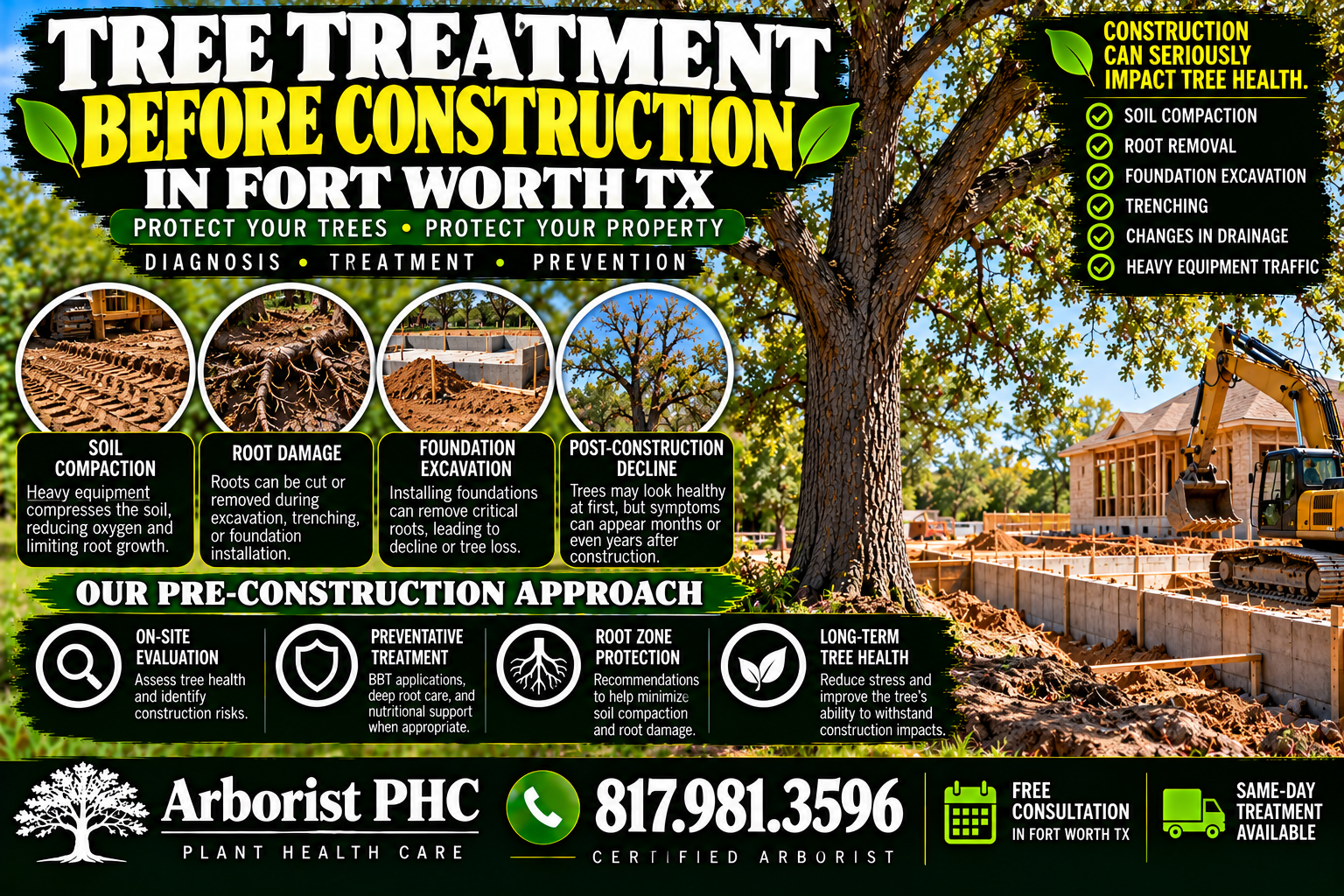
Tree Treatment Before Construction in Fort Worth, TX | Preventing Root Damage & Soil Compaction
Pre-Construction Tree Health Care | Root Protection • Soil Compaction Prevention • Construction Stress Management
Construction projects can significantly impact the health and longevity of mature trees, even when the trees themselves are not directly touched.
At Arborist PHC, we specialize in preventative Plant Health Care services designed to help trees withstand environmental stress associated with construction, foundation installation, excavation, trenching, soil compaction, and root disturbances.
Throughout Fort Worth, Weatherford, Aledo, Burleson, Granbury, and surrounding North Texas communities, we frequently encounter mature trees experiencing decline following residential and commercial construction projects.
One of the most important steps property owners can take is to have their trees professionally evaluated before construction begins, rather than waiting until signs of decline become visible.
Preventative planning, root protection, and appropriate tree health management can help reduce the risk of irreversible damage.
Why Tree Treatment Before Construction Is Important
Many homeowners assume that as long as a tree's trunk and branches are not damaged, construction activities will have little impact on its health.
Unfortunately, this is not always the case.
A substantial portion of a tree's functional root system is located within the upper layers of soil, often extending well beyond the outer edges of the canopy.
These roots are responsible for absorbing water, nutrients, and oxygen while providing structural support.
When construction activities disturb the surrounding soil, the tree's ability to maintain normal physiological functions may become compromised.
Common construction-related problems include:
Soil compaction from heavy machinery
Root severance during excavation
Root removal for foundation installation
Trenching for plumbing, electrical, or drainage systems
Changes in soil elevation
Excessive soil accumulation over roots
Reduced oxygen availability
Altered drainage patterns
Mechanical injuries to trunks and exposed roots
Increased vulnerability to insects and fungal diseases
The most effective way to reduce construction-related tree decline is to protect the root system before damage occurs.
1. Soil Compaction: One of the Biggest Threats to Mature Trees
Soil compaction is one of the most common forms of tree damage associated with construction.
When heavy equipment, trucks, machinery, or repeated foot traffic move across the root zone, soil particles become compressed.
This reduces the amount of pore space available for oxygen and water movement.
How Soil Compaction Affects Trees
Healthy roots require oxygen to function properly.
When soil becomes severely compacted, roots may struggle to obtain sufficient oxygen, absorb moisture, and maintain normal growth.
Over time, affected trees may begin displaying:
Yellowing foliage
Reduced canopy density
Smaller leaves
Premature leaf drop
Branch dieback
Reduced seasonal growth
Increased environmental stress
Severe compaction can also restrict the development of new roots, making recovery more difficult.
Preventing Soil Compaction Before Construction
Before construction begins, we recommend identifying the tree's critical root protection area and establishing protective barriers.
Heavy machinery, building materials, excavation equipment, and vehicle traffic should be kept outside protected root zones whenever practical.
Protective measures may include temporary fencing, designated equipment routes, and engineered ground-protection systems when access cannot be avoided.
Once significant soil compaction occurs, correcting the damage may be difficult, particularly around mature native oak trees.
2. Root Removal During Foundation Installation
Foundation construction can be particularly damaging when excavation occurs near established trees.
Roots may be cut or removed to accommodate:
Concrete slab foundations
Pier-and-beam foundations
Footings
Retaining walls
Driveways
Sidewalks
Utility trenches
Drainage installations
Foundation repairs
Although some root disturbance may be unavoidable, removing large structural roots or substantial portions of the absorbing root system can seriously compromise tree health.
What Happens When Tree Roots Are Severed?
Roots serve two important purposes: anchoring the tree and supplying the canopy with water and nutrients.
When roots are removed, the tree may experience a reduction in its ability to absorb sufficient moisture and nutrients.
Severing major structural roots can also reduce stability, increasing the potential risk of tree failure.
Symptoms may develop gradually and include:
Canopy thinning
Leaf scorch
Wilting
Branch dieback
Reduced growth
Premature leaf drop
Progressive decline
The severity of damage depends on the number, size, and location of roots removed, along with the species and overall condition of the tree.
Root removal should be evaluated before excavation whenever possible. Significant structural root damage may require a tree risk assessment.
3. Post-Construction Tree Decline: Why Trees May Look Healthy at First
One of the most concerning aspects of construction-related tree damage is that symptoms do not always appear immediately.
A tree may continue producing foliage after construction, even when part of its root system has been damaged.
Over the following months or years, the tree may begin experiencing progressive decline.
This delayed response occurs because the remaining root system may initially support the canopy, but continued environmental stress can eventually exceed the tree's ability to compensate.
Common Symptoms of Post-Construction Tree Decline
Progressive canopy thinning
Yellow or brown leaves
Premature leaf drop
Dead branches
Reduced spring growth
Increased insect activity
Fungal growth
Bark deterioration
Sudden decline during extreme summer temperatures
By the time these symptoms become severe, some root damage may already be irreversible.
This is why pre-construction evaluation and protection are generally more effective than relying solely on treatment after damage occurs.
4. Construction Damage Can Increase the Risk of Fungal Diseases
Trees weakened by root damage, soil compaction, or environmental stress may become more vulnerable to certain fungal diseases.
In North Texas, one concern involving stressed oak trees is Hypoxylon Canker, associated with fungi in the Biscogniauxia group.
These fungi commonly affect trees already weakened by drought, root damage, or other environmental problems.
Symptoms may include:
Branch dieback
Rapid canopy deterioration
Bark separation
Dark fungal structures beneath damaged bark
Exposed dead wood
There is no proven curative fungicide for established Hypoxylon Canker.
Management focuses on protecting tree health, minimizing environmental stress, and evaluating affected trees for structural concerns.
Other root-related diseases may become more problematic when construction changes soil drainage or creates prolonged wet conditions.
5. Preventative Tree Treatment Before Construction
At Arborist PHC, our approach begins with evaluating the existing condition of the trees and identifying potential construction-related risks.
Depending on the findings, we may recommend a customized Plant Health Care program before work begins.
Broad Brush Treatment (BBT) Program
Our BBT applications are designed to address specific tree health concerns through targeted treatment methods.
Depending on the tree's condition, the program may include:
Nutritional support
Appropriate micronutrient supplementation
Targeted pest management
Fungicide applications when indicated
Root-zone health support
Seasonal monitoring
These applications are intended to manage identified conditions and support tree vigor.
BBT treatment does not prevent physical root damage or eliminate the effects of severe soil compaction. Physical root protection remains the most important preventative measure.
Deep Root Inoculation
Deep Root Inoculation involves applying selected materials into the tree's root zone.
When appropriate, this method may be used to address identified nutrient deficiencies or provide other root-zone support.
Applications should be carefully planned around mature trees because unnecessary soil disturbance, excessive fertilization, or poorly selected treatments can create additional stress.
Basal Drench Applications
Basal drench treatments may be recommended when a specific pest or disease concern warrants the use of an appropriately labeled product.
Depending on the product, treatment may be applied around the lower trunk or root flare.
Basal drenches are not a substitute for root protection and cannot repair severed structural roots.
Pre-Construction Tree Health Monitoring
We may also recommend documenting existing tree conditions before construction begins.
This allows property owners to compare canopy density, branch condition, foliage development, and overall tree vigor during and after the project.
6. The Importance of Protecting Native Oaks Before Construction
North Texas is home to several mature oak species that can be particularly sensitive to root disturbances.
These include:
Savannah Post Oak (Quercus stellata)
Post Oaks are native to the Cross Timbers region and are often found on properties throughout Weatherford, Aledo, and Parker County.
Although they tolerate drought and relatively poor soils, mature Post Oaks can be highly sensitive to construction disturbances, soil compaction, excessive irrigation, and root removal.
Blackjack Oak (Quercus marilandica)
Blackjack Oaks are naturally adapted to rocky and dry soil environments.
However, extensive excavation, grading, and root damage can contribute to long-term decline.
Live Oak (Quercus virginiana)
Live Oaks often develop extensive root systems that may extend far beyond their canopies.
Excavation and foundation installation near mature Live Oaks can damage absorbing and structural roots.
Shumard Red Oak (Quercus shumardii)
Shumard Red Oaks can experience significant stress following root disturbances, soil compaction, and changes in drainage.
Protecting the root system is especially important during residential development and major landscaping projects.
7. Tree Protection During Foundation Repairs
Foundation repairs are common throughout North Texas because of expansive clay soils and seasonal changes in soil moisture.
Unfortunately, excavation near mature trees can disturb roots that have developed around existing foundations.
Before foundation repair work begins, property owners should consider having nearby trees evaluated.
Potential concerns include:
Excavation through established roots
Root cutting near the trunk
Equipment traffic over root zones
Soil removal
Changes in irrigation or drainage
Damage to major structural roots
Coordinating with the foundation contractor and a qualified arborist can help identify ways to reduce unnecessary damage.
Where feasible, alternative excavation methods, adjustments to construction plans, or carefully planned root pruning may help preserve important roots.
8. What If Construction Has Already Damaged My Trees?
If construction has already occurred, a professional evaluation can help determine whether the trees are experiencing stress or structural damage.
Our assessment may include:
Evaluating canopy density
Inspecting accessible root flare areas
Identifying signs of root damage
Assessing visible soil compaction
Looking for insect activity
Examining fungal disease symptoms
Reviewing changes in drainage and watering
Treatment recommendations depend on the severity and type of damage.
Some trees may benefit from improved irrigation management, mulching, soil rehabilitation, and targeted nutritional care when deficiencies are present.
Others may require continued monitoring or a detailed tree risk assessment.
Severely damaged trees may not recover, particularly when large portions of the root system have been removed.
9. When Should Trees Be Evaluated Before Construction?
Ideally, mature trees should be evaluated during the planning stage, before excavation, grading, or heavy equipment enters the property.
Early evaluation provides an opportunity to identify sensitive root zones and discuss tree protection measures with contractors.
A pre-construction plan may involve:
Identifying trees intended for preservation.
Evaluating their existing health and structural condition.
Establishing appropriate tree protection zones.
Reviewing proposed excavation and foundation locations.
Minimizing soil compaction and root disturbance.
Recommending targeted Plant Health Care when appropriate.
Monitoring tree health during and after construction.
Planning ahead can help protect mature trees that may be difficult or impossible to replace.
10. Free Pre-Construction Tree Health Consultations in North Texas
At Arborist PHC, we offer complimentary on-site tree health consultations for property owners concerned about construction-related tree stress.
Whether you are planning a new home, installing a foundation, building an addition, repairing a driveway, or preparing for major landscaping work, having your trees evaluated beforehand can help identify potential risks.
During the consultation, we assess visible tree health conditions and discuss appropriate preventative care recommendations.
When treatment is recommended and approved, same-day applications may be available, depending on the treatment requirements and scheduling.
For projects involving major excavation or significant structural root removal, a more detailed tree protection or risk assessment may also be necessary.
Frequently Asked Questions
Can construction kill a healthy tree?
Yes. Severe root damage, soil compaction, drainage changes, and other construction-related disturbances can cause significant decline or death, even in previously healthy trees.
Can trees recover after their roots are cut?
Some trees can recover from limited root damage, depending on their species, condition, and the amount of root system affected. Extensive damage to major roots can cause permanent decline or instability.
Can fertilization prevent construction damage?
No. Fertilization cannot prevent physical root damage or compensate for the loss of major structural roots. Nutritional treatment is appropriate only when it addresses an identified need.
How long after construction can tree decline appear?
Symptoms may develop within weeks or months, but delayed decline can also become noticeable several years after construction.
Should I treat my trees before installing a foundation?
A pre-construction evaluation is strongly recommended when mature trees are located near the proposed work area. Treatment may be beneficial for specific health concerns, but root protection and construction planning are the primary priorities.
Can soil compaction be corrected?
Certain soil rehabilitation techniques may help improve compacted conditions, but success depends on the severity of compaction, soil characteristics, and existing root damage.
Do you offer free consultations?
Yes. Arborist PHC offers complimentary on-site tree health consultations throughout our North Texas service area.
Schedule a Pre-Construction Tree Health Consultation Today
If you are preparing for construction, foundation installation, excavation, trenching, or major landscaping work, protecting your trees should be part of the planning process.
At Arborist PHC, we specialize in diagnosing tree health concerns, recommending preventative treatment programs, and helping property owners identify construction-related risks.
Our goal is to help preserve valuable mature trees by addressing potential problems before significant decline occurs.
Don't wait until your trees begin losing leaves or developing dead branches after construction. Early evaluation and root protection can make a significant difference.
ARBORIST PHC — PLANT HEALTH CARE
CERTIFIED ARBORIST
Diagnosis • Treatment • Prevention
Free On-Site Consultations | Same-Day Treatment Availability
Call or Text: 817.981.3596
Serving Fort Worth, Weatherford, Aledo, Burleson, Granbury, Crowley, Benbrook, Hudson Oaks, Willow Park, and surrounding North Texas communities.