Early Signs of Oak Wilt on Oak Trees in Weatherford, TX | Oak Wilt Detection | Arborist PHC
Early Signs of Oak Wilt on Oak Trees in Weatherford, TX - Serving Weatherford & North Texas
Understanding Early Oak Wilt Symptoms in North Texas
Oak Wilt is one of the most serious vascular diseases affecting oak trees throughout Weatherford and surrounding Parker County communities.
At Arborist PHC, we specialize in identifying early signs of stress and decline associated with Oak Wilt and implementing science-based plant health care strategies focused on long-term tree protection.
Our approach follows:
Diagnosis-first treatment strategies
Early detection is one of the most important factors in slowing disease progression and protecting surrounding trees.
What Is Oak Wilt?
Oak Wilt is a vascular disease that affects a tree’s ability to transport water and nutrients throughout the canopy.
The disease spreads through:
Root graft connections between nearby oak trees
Sap-feeding beetles attracted to fresh wounds
As the disease progresses, water movement becomes restricted, leading to canopy decline and stress symptoms.
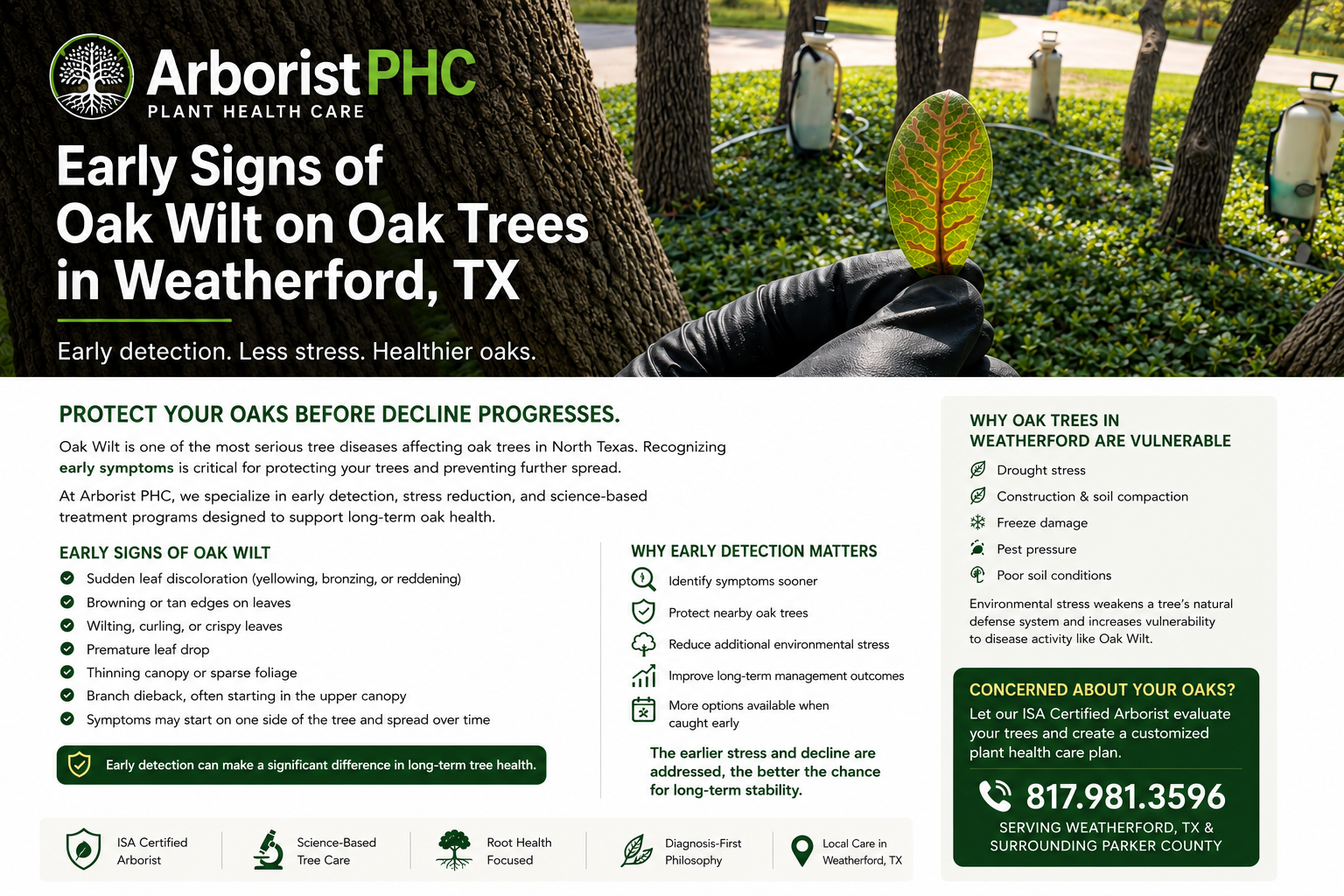
Early Signs of Oak Wilt on Oak Trees
Common early symptoms may include:
Sudden leaf discoloration
Browning along leaf edges
Wilting or curling foliage
Premature leaf drop
Thinning canopy sections
Branch dieback beginning in upper canopy areas
In many cases, symptoms may initially appear on only one section of the tree before progressing further.
Why Early Detection Matters
Oak Wilt becomes significantly more difficult to manage once decline progresses throughout the canopy.
Early evaluation may help:
Identify potential Oak Wilt symptoms sooner
Reduce additional environmental stress
Protect nearby oak populations
Improve long-term management planning
The earlier stress and decline are identified, the more options may be available moving forward.
Why Oak Trees in Weatherford Are Vulnerable
Oak trees throughout Weatherford commonly experience:
Drought stress
Construction trauma
Soil compaction
Freeze damage
Pest pressure
Environmental stress weakens a tree’s natural defense system, increasing vulnerability to disease activity.
Live Oaks and Red Oaks are particularly susceptible to Oak Wilt in North Texas.
The Connection Between Stress & Disease
Trees under stress are more vulnerable to:
Disease progression
Pest activity
Root dysfunction
Canopy decline
Healthy trees are naturally better equipped to compartmentalize injury and resist environmental pressures.
Reducing overall stress is one of the most important components of long-term tree health management.
Our Plant Health Care Approach (Watch Our Process)
At Arborist PHC, we focus on supporting overall tree health and reducing environmental stress factors commonly associated with decline.
Deep Root Feeding (Soil Injection)
Delivers nutrients directly into the root zone
Supports root function and drought tolerance
Improves overall tree vigor
Macro-Infusion Kit
Specialized Plant Health Care method used to manage and suppress Oak Wilt, a destructive vascular disease affecting Live Oaks and Red Oaks throughout North Texas. This process involves installing infusion ports at the base of the tree and delivering a systemic fungicide directly into the vascular system, allowing for internal distribution through the xylem.
Basal Drench & Systemic Applications
Applied near the root flare and lower trunk
Supports vascular system performance
Helps reduce additional stress-related pressure
Broad-Spectrum Plant Health Care (BBT)
Addresses multiple stress factors simultaneously
Includes nutrients, micronutrients, and systemic support
Monitoring & Reassessment
Tracks canopy response over time
Helps identify progression patterns early
Supports long-term tree management strategies
Preventative Oak Tree Care
Preventative care is critical in reducing stress-related decline in oak populations.
Recommended practices include:
Avoiding unnecessary pruning during high-risk periods
Improving soil and root health
Reducing compaction around root zones
Monitoring for early canopy changes
Supporting trees during drought and freeze stress
Healthy trees are more resilient to environmental pressure.
Our Diagnosis-First Philosophy
Not all oak decline is caused by Oak Wilt.
We evaluate:
Tree species and age
Canopy symptoms and progression
Soil and environmental conditions
Root health and stress levels
Signs of pest or fungal activity
This allows us to develop:
✔️ Accurate evaluations
✔️ Targeted treatment recommendations
✔️ Long-term management strategies
Service Areas Near Weatherford
We proudly serve:
Surrounding Parker County communities
Request an Oak Tree Health Assessment in Weatherford, TX (Click Here To Submit A Form)
If your oak trees are showing signs of decline, discoloration, or canopy stress, early evaluation is important.
📞 Call or Text to Schedule
📸 Send photos for a preliminary review
We’re here to help you identify stress factors early and implement science-based strategies for long-term oak tree health.
Frequently Asked Questions
-
Early symptoms may include leaf discoloration, canopy thinning, wilting, and premature leaf drop.
-
Yes—Oak Wilt may spread through connected root systems and sap-feeding beetles.
-
Live Oaks and Red Oaks are among the most vulnerable species in North Texas.
-
Recovery potential depends on species, severity of decline, and overall environmental conditions.
-
No—Arborist PHC specializes strictly in plant health care, diagnosis, and treatment programs.