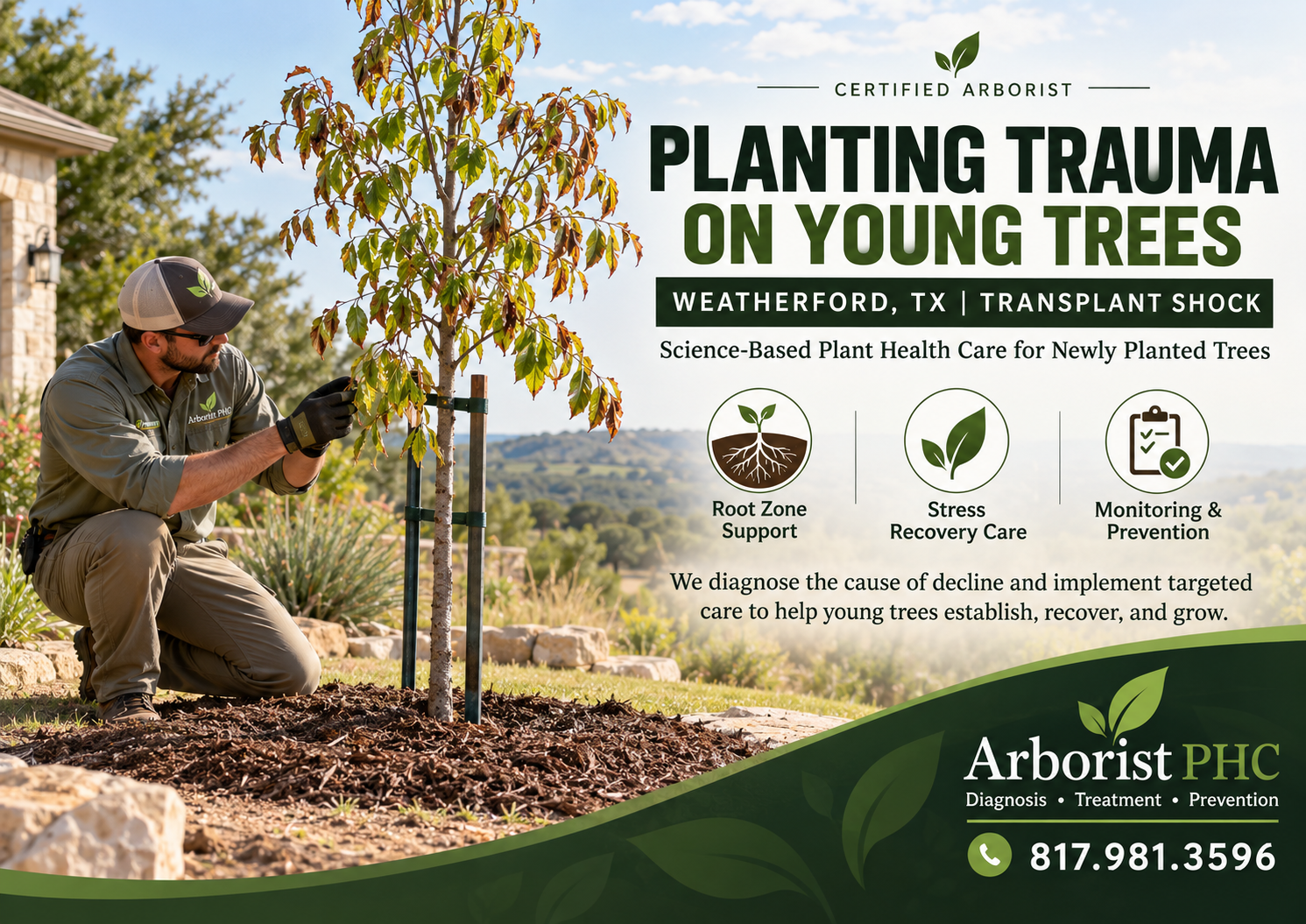
Planting Trauma on Young Trees in Weatherford, TX | Transplant Shock & Tree Stress | Arborist PHC
Certified Arborist | Serving Weatherford & North Texas
Planting Trauma on Young Trees in Weatherford, TX
Why Newly Planted Trees Struggle in North Texas
Planting new trees is an investment—but in Weatherford, TX, many young trees experience planting trauma, also known as transplant shock, shortly after installation.
At Arborist PHC, we specialize in identifying early signs of stress and implementing plant health care treatments to support recovery and long-term establishment.
Our approach follows proper diagnosis and corrective care.
What Is Planting Trauma (Transplant Shock)?
Planting trauma occurs when a tree is unable to properly adapt to its new environment after being planted.
This can happen due to:
Root disturbance during installation
Poor soil conditions
Improper planting depth
Environmental stress (heat, drought, wind)
As a result, the tree struggles to establish roots and maintain normal growth.
Signs of Planting Trauma in Young Trees
Common symptoms include:
Wilting or drooping leaves
Leaf discoloration (yellowing or browning)
Delayed or minimal new growth
Leaf drop shortly after planting
Sparse canopy development
Overall stunted appearance
In many cases, these symptoms appear within the first 30–90 days after planting.
Why This Happens in Weatherford, TX
Young trees in this region face unique challenges:
Heavy clay soils limiting root expansion
Extreme heat and drought conditions
Inconsistent watering practices
Poor planting techniques (too deep or too shallow)
These factors create stress that slows root development and increases the risk of decline.
Our Treatment Approach (Watch Our Process)
Young trees require targeted support to establish a healthy root system and adapt to their environment.
Deep Root Feeding (Soil Injection)
Delivers nutrients directly into the root zone
Improves soil conditions and root development
Encourages faster establishment
Root Zone Support & Soil Health
Improves oxygen and water movement
Reduces compaction-related stress
Enhances microbial activity
Basal Drench & Systemic Applications
Helps protect against early pest and disease pressure
Supports overall tree health during establishment
Broad-Spectrum Plant Health Care (BBT)
Addresses multiple stress factors at once
Includes nutrients, micronutrients, and growth support
The Importance of Proper Establishment
The first year after planting is critical.
If trees are not properly supported:
Root systems may fail to establish
Growth may remain stunted
Long-term health may be compromised
👉 Early intervention significantly improves success rates.
Our Diagnosis-First Approach
Not all young tree decline is caused by transplant shock.
We evaluate:
Planting depth and root flare exposure
Soil conditions and drainage
Watering practices
Environmental stress factors
This ensures treatment is accurate and effective.
Preventing Planting Trauma
To reduce the risk of transplant shock:
Ensure proper planting depth (visible root flare)
Maintain consistent watering
Improve soil conditions
Avoid over-fertilization early on
Implement preventative plant health care
Service Areas Near Weatherford
We proudly serve:
Hudson Oaks
Willow Park
Surrounding Parker County communities
Request a Tree Health Assessment in Weatherford, TX (Click Here To Submit A Form)
If your newly planted trees are struggling, early evaluation is key.
📞 Call or Text to Schedule
📸 Send photos for a preliminary review
We’re here to help you protect your investment and ensure your trees establish properly—based on science, not guesswork.
Frequently Asked Questions
-
Some stress is normal, but significant decline is not and should be evaluated.
-
It can last several weeks to months depending on conditions and care.
-
Yes—if addressed early and properly supported.
-
Not always. Improper fertilization can increase stress—professional guidance is recommended.
-
No—Arborist PHC focuses strictly on plant health care, diagnosis, and treatment programs.