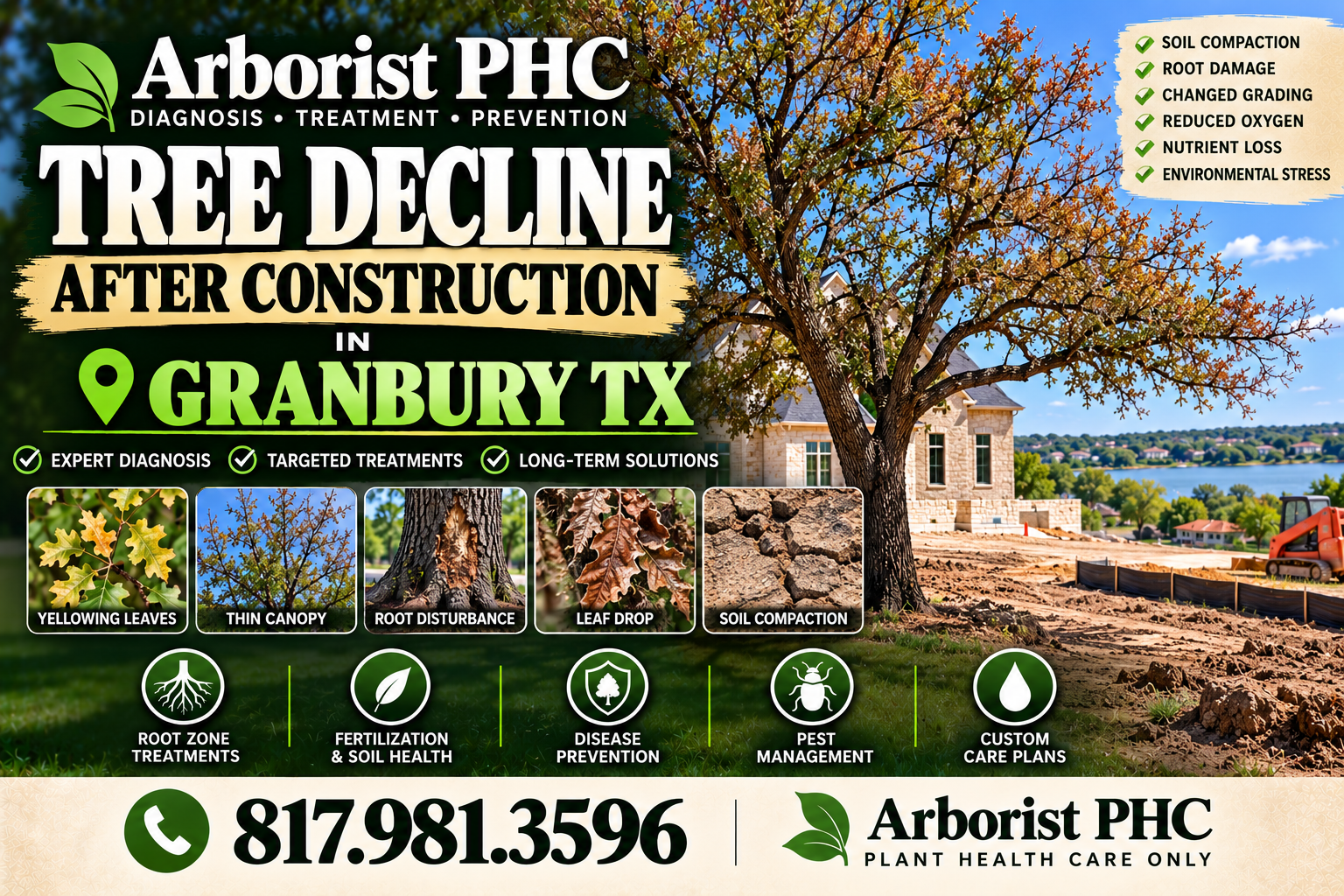
Tree Decline After Construction in Granbury TX | Root Damage & Tree Preservation | Arborist PHC
Tree Decline After Construction in Granbury TX
Is Your Tree Declining After Construction?
Have your trees started looking unhealthy after building a new home, installing a swimming pool, adding a driveway, or completing a landscape renovation?
Many homeowners are surprised when a tree begins declining months—or even years—after construction has been completed. In most cases, the damage isn’t caused by the construction itself but by injury to the tree’s root system.
At Arborist PHC, we specialize exclusively in Plant Health Care (PHC) and help homeowners throughout Granbury diagnose and treat construction-related tree stress before it leads to permanent decline.
Why Do Trees Decline After Construction?
Most of a tree’s absorbing roots are found within the top 12–18 inches of soil and often extend well beyond the edge of the canopy.
Construction activities can severely impact these roots through:
🚧 Excavation
🚜 Heavy equipment traffic
🪨 Soil compaction
🏊 Pool installation
🏡 Home additions
🛠 Utility trenching
🧱 Retaining wall construction
🚗 Driveways and sidewalks
Even when the trunk appears untouched, damage to the root system can dramatically reduce a tree’s ability to absorb water and nutrients.
Signs of Construction-Related Tree Decline
Construction damage is often delayed.
Symptoms may not appear until several months—or even several years—after the project is complete.
Common warning signs include:
🍂 Premature leaf drop
🍂 Yellow leaves
🍂 Wilting foliage
🍂 Thin canopy
🍂 Dead branches
🍂 Branch tip dieback
🍂 Slow annual growth
🍂 Sparse foliage
🍂 Bark cracking
🍂 Increased insect activity
🍂 Fungal growth near the base
If your trees begin showing these symptoms after nearby construction, root damage should be considered as a possible cause.
Why Root Damage Is So Serious
Healthy roots are responsible for:
✔️ Water absorption
✔️ Nutrient uptake
✔️ Energy storage
✔️ Structural stability
✔️ Supporting healthy canopy growth
When a large percentage of the root system is damaged or compacted, the tree becomes increasingly vulnerable to drought, disease, insect infestations, and long-term decline.
Secondary Problems Following Construction
Construction stress weakens a tree’s natural defense system, making it more susceptible to additional health problems.
🍄 Fungal Diseases
Construction-damaged trees are at greater risk for:
Tubakia Leaf Spot
🐛 Insect Activity
Stressed trees frequently attract:
Carpenter Ants
Scale Insects
These secondary pests often accelerate decline if the underlying stress is not addressed.
🌱 Nutrient Deficiencies
Damaged roots struggle to absorb essential nutrients, increasing the likelihood of:
Iron Chlorosis
Yellow foliage
Reduced annual growth
Thin canopies
Trees Commonly Affected
We commonly evaluate construction-related decline on:
🌳 Red Oaks
🌳 Bur Oaks
🌳 Savannah Post Oaks
🌳 Desert Willows
🌳 Bradford Pears
🌳 Newly Planted Trees
Large, mature trees are especially vulnerable because a significant portion of their root system often extends well beyond the visible canopy.
Our Plant Health Care Approach
Every tree responds differently to construction stress.
Our Certified Arborists develop customized treatment plans based on each tree’s condition.
🌱 Deep Root Inoculation
Our Deep Root Inoculation program helps:
✔️ Stimulate new root growth
✔️ Improve nutrient uptake
✔️ Increase drought tolerance
✔️ Reduce construction stress
✔️ Improve overall tree vigor
🌳 BBT (Broad Brush Treatment) Program
Our signature BBT (Broad Brush Treatment) combines several Plant Health Care techniques into one comprehensive treatment.
The program may include:
✔️ Deep Root Inoculation
✔️ Basal Drench Applications
✔️ Nutrient & Micronutrient Management
✔️ Environmental Stress Reduction
✔️ Disease Prevention Support
✔️ Insect Management Support
Our goal is to strengthen the tree from the roots upward while improving long-term recovery.
💧 Basal Drench Applications
Basal Drench treatments support systemic uptake through the root flare, improving nutrient movement and overall root health.
Preventing Tree Decline During Construction
Whenever possible, preventive care should begin before construction starts.
Best practices include:
🌱 Installing protective fencing around root zones
🌱 Avoiding excavation beneath the canopy
🌱 Limiting heavy equipment traffic near trees
🌱 Maintaining consistent soil moisture
🌱 Scheduling professional tree health evaluations before and after construction
Preventive Plant Health Care is often far less expensive than replacing mature trees.
Why Choose Arborist PHC?
Unlike companies that primarily trim or remove trees, Arborist PHC specializes exclusively in Plant Health Care.
We focus on:
✔️ Tree Diagnosis
✔️ Tree Preservation
✔️ Root Health
✔️ Disease Management
✔️ Environmental Stress Reduction
✔️ Long-Term Preventive Care
Our philosophy is simple:
Diagnosis • Treatment • Prevention
Schedule a Tree Health Assessment in Granbury TX
If your trees are declining after construction, don’t wait for the damage to become irreversible.
Early diagnosis and treatment can significantly improve your tree’s chances of recovery.
📞 Call or Text Arborist PHC
📸 Send Photos for a Preliminary Evaluation
Our Certified Arborists will evaluate your trees, identify the effects of construction-related stress, and develop a customized Plant Health Care program to restore and protect your landscape.
Frequently Asked Questions
-
Yes. Root damage from construction may not become visible until months or even years after the project has been completed.
-
Root damage often reduces water and nutrient uptake, causing yellow leaves, canopy thinning, and premature leaf drop.
-
Many trees can recover when the underlying stress is identified early and treated with a customized Plant Health Care program.
-
Absolutely. Preventive treatments and proper root zone protection can significantly reduce long-term damage.
-
No. Arborist PHC specializes exclusively in Plant Health Care, diagnosis, treatment, and preventive care.