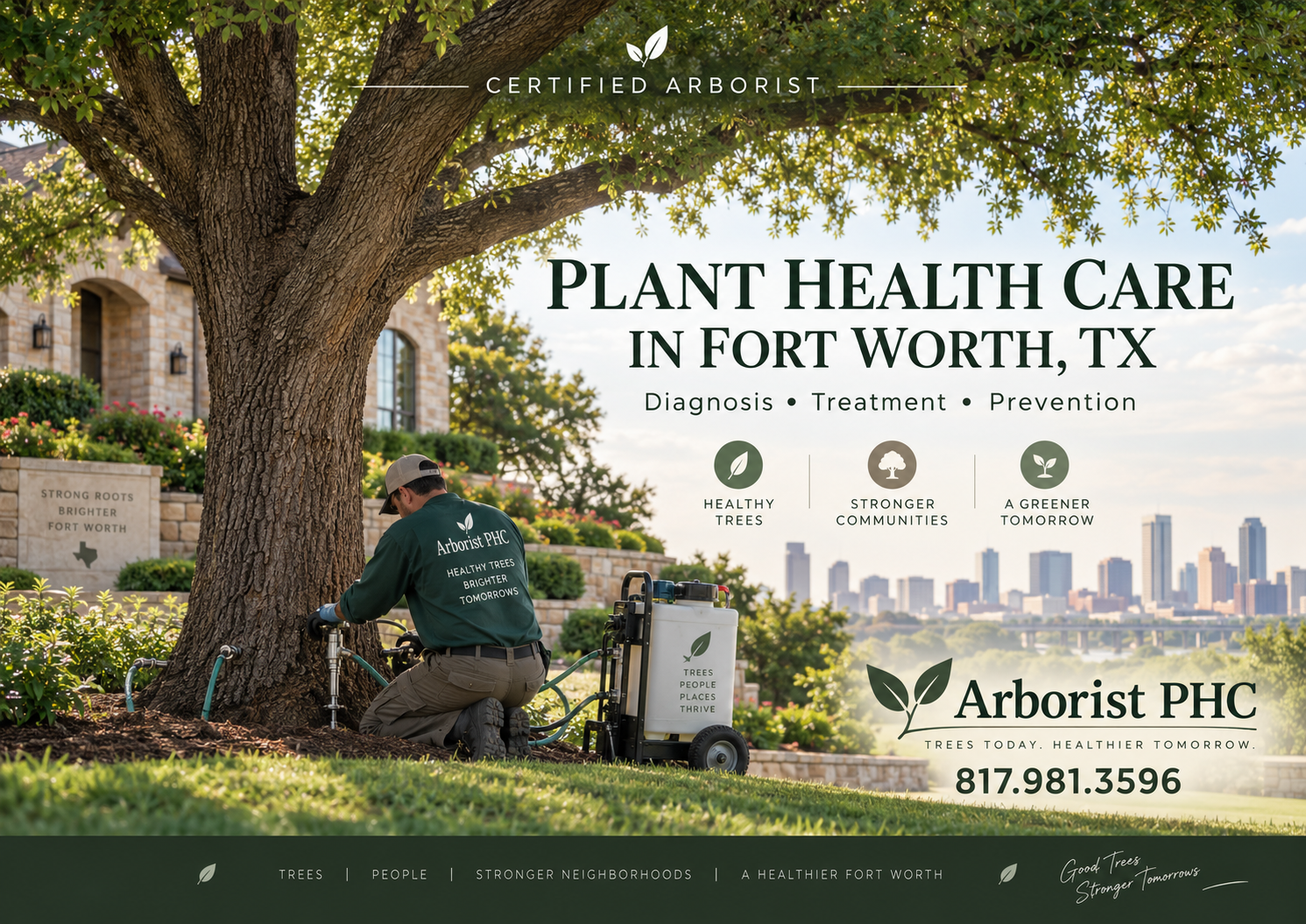
Plant Health Care in Fort Worth, TX
Serving Fort Worth & North Texas
Science-Based Tree & Shrub Care in North Texas
At Arborist PHC, we specialize strictly in plant health care (PHC)—focusing on diagnosing and treating the underlying causes of tree and shrub decline.
We do not offer trimming or removals—our focus is keeping trees alive, healthy, and structurally sound.
What We Diagnose & Treat
Trees in Fort Worth commonly experience stress due to extreme heat, clay soils, drought cycles, and pest pressure. These conditions lead to:
Oak Wilt (Live Oaks & Red Oaks)
Hypoxylon Canker (Post Oaks)
Anthracnose & Leaf Spot Diseases
Iron Chlorosis (nutrient deficiency)
Aphids, Scale, and Mites
Beetle Borers & Secondary Insect Damage
Root Stress & Compaction Issues
Our role is to identify the cause, evaluate risk, and implement a targeted treatment plan.
Our Treatment Process (Watch our process)
Every property is different. That’s why we use a combination of treatment methods based on tree condition, species, and site factors:
Deep Root Feeding (Soil Injection)
Delivers nutrients and systemic materials directly into the root zone
Improves soil biology and long-term uptake
Targets stress, nutrient deficiencies, and pest/disease pressure
Basal Drench & Bark Applications
Applied at the root flare and lower trunk
Absorbed through the vascular system
Effective for insect control, fungal suppression, and overall health support
Includes insecticides, fungicides, and micronutrients
Designed to address both active issues and preventative care
Our approach is often referred to as a broad-spectrum plant health treatment, meaning even if multiple stress factors are present, they are addressed simultaneously.
Why Trees Struggle in Fort Worth, TX
The Fort Worth area presents several environmental challenges:
Heavy clay soils restrict oxygen and water movement
Extreme summer heat increases transpiration and stress
Drought followed by heavy rain disrupts root function
Urban landscapes create compaction and limited root zones
These conditions weaken trees over time, making them more vulnerable to disease and insect infestation.
Our Approach (What Makes Us Different)
Certified Arborist
Diagnosis-First Approach
Family-Owned & Operated
Focused strictly on Plant Health Care
We don’t guess—we diagnose based on observable symptoms, environmental conditions, and tree biology.
Treatment Programs & Warranty
Our treatment programs are designed to support trees through their critical recovery period.
This often includes:
Initial application
Follow-up treatment (within ~30 days if needed)
Seasonal reassessment (spring/fall)
These follow-ups are typically included under a one-time program cost, allowing us to monitor progress and make adjustments as needed.
Note: Treatments are designed to improve health and reduce risk, but are not a guaranteed cure for severely declining trees.
Service Areas Near Fort Worth
We proudly serve:
Request a Tree Health Assessment (Click here to submit a form)
If your trees are showing signs of decline, early diagnosis is critical.
📞 Call or Text to Schedule
📸 You may also send photos for a preliminary review
We’re here to help you make the right decision for your trees—based on science, not guesswork.
Frequently Asked Questions
-
Most trees benefit from annual or seasonal treatments, depending on stress levels and environmental conditions.
-
We typically recommend a program approach, which includes follow-ups to ensure proper recovery and effectiveness.
-
No—Arborist PHC specializes strictly in plant health care, diagnosis, and treatment.
-
Results can take several weeks to months, depending on tree condition and severity of the issue.
-
Our programs often include follow-up applications and reassessments within a defined period at no additional cost.