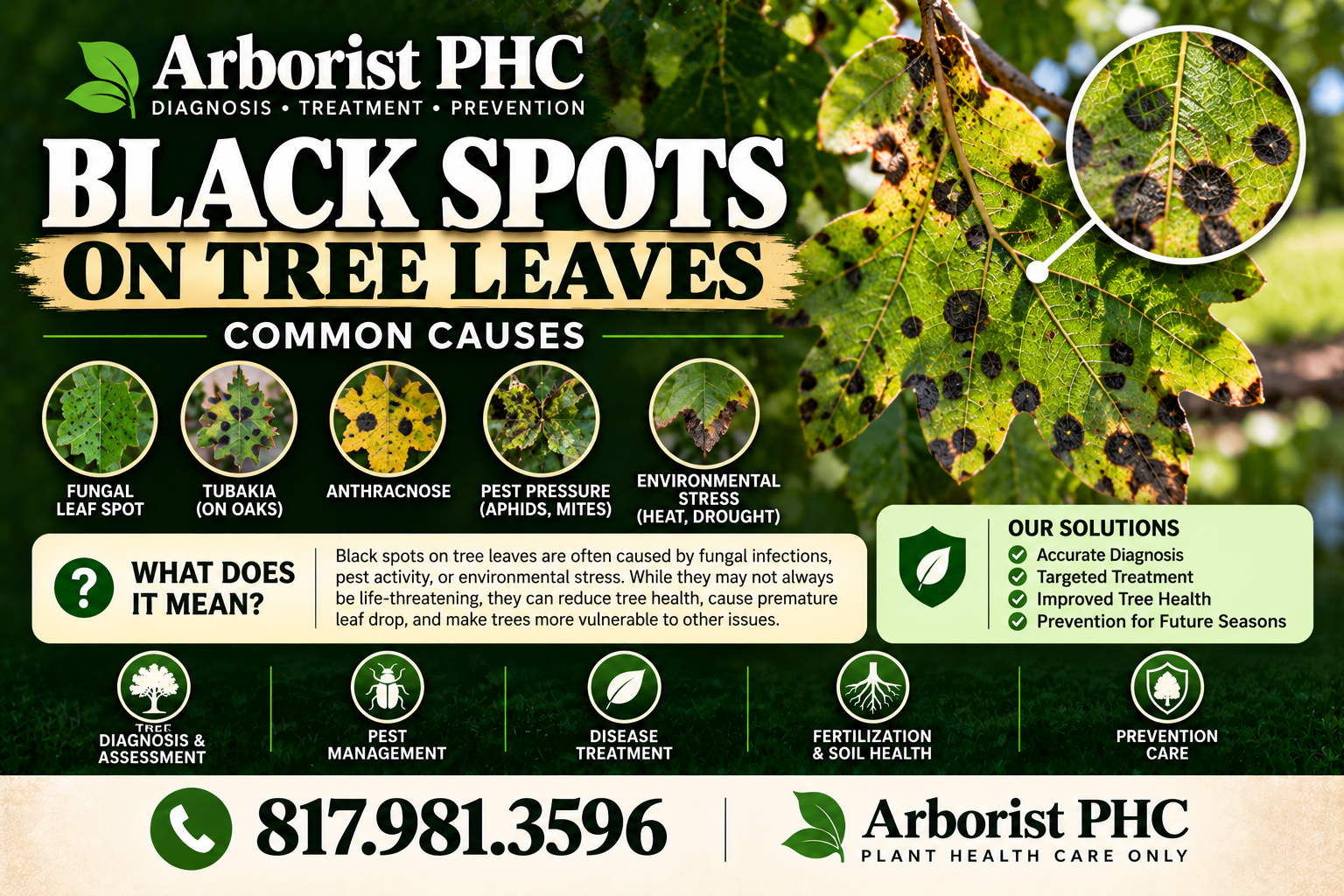
Black Spots on Tree Leaves | Causes, Diagnosis & Treatment | Arborist PHC
Black Spots on Tree Leaves
Why Do My Tree Leaves Have Black Spots?
Black spots on tree leaves are one of the most common signs that something is affecting your tree’s health. While a few spots may seem harmless, widespread spotting can indicate fungal diseases, bacterial infections, insect activity, or environmental stress.
At Arborist PHC, we specialize exclusively in Plant Health Care (PHC) and help homeowners identify the underlying cause of leaf spotting before it leads to premature leaf drop, canopy thinning, or long-term decline.
Black spots are a symptom—not the actual problem.
What Causes Black Spots on Tree Leaves?
Several different issues can cause black or dark-colored spots to develop on foliage.
Proper diagnosis is essential because each cause requires a different treatment approach.
Common Causes of Black Spots
Anthracnose is one of the most common fungal diseases affecting shade trees throughout Texas.
Symptoms include:
🍂 Irregular black or brown leaf spots
🍂 Leaf curling
🍂 Twisted new growth
🍂 Premature leaf drop
🍂 Branch tip dieback
Anthracnose is commonly found on:
Live Oaks
Red Oaks
Sycamores
Maples
Ash Trees
Elms
🍄 Tubakia Leaf Spot
Tubakia Leaf Spot commonly affects Oaks, particularly during warm, humid weather.
Symptoms include:
🍂 Circular black or dark brown spots
🍂 Tan centers surrounded by dark margins
🍂 Premature leaf drop
🍂 Canopy thinning
While often cosmetic during mild infections, repeated outbreaks can weaken trees over time.
🍄 Tar Spot
Tar Spot causes raised, black lesions that resemble drops of tar on the surface of leaves.
Although more common on Maple trees in cooler climates, similar fungal leaf spot diseases may occur on ornamental trees in Texas.
🦠 Bacterial Leaf Spot
Certain bacterial pathogens produce:
🍂 Small black lesions
🍂 Water-soaked spots
🍂 Yellow halos surrounding lesions
🍂 Premature leaf drop
Proper diagnosis is necessary because bacterial diseases require different management strategies than fungal infections.
🐛 Insect Activity
Some insects leave behind honeydew, which promotes the growth of sooty mold.
Common insects include:
🐛 Scale Insects
🐛 Whiteflies
🐛 Mealybugs
The black coating often wipes off the leaf surface, unlike fungal leaf spots that develop within the leaf tissue.
Heat, drought, hail damage, nutrient deficiencies, and poor air circulation can weaken foliage and increase susceptibility to leaf spot diseases.
Trees under stress are more likely to develop secondary fungal infections.
Trees Commonly Affected
We frequently diagnose black leaf spots on:
🌳 Red Oaks
🌳 Bur Oaks
🌳 Savannah Post Oaks
🌳 Maple Trees
🌳 Sycamores
🌳 Ash Trees
🌳 Elms
🌳 Bradford Pears
🌳 Crape Myrtles
Why Accurate Diagnosis Matters
Not every black spot is caused by the same disease.
Some trees have fungal infections.
Others have bacterial diseases.
Some simply have sooty mold caused by insects.
Our Certified Arborists evaluate:
✔️ Tree species
✔️ Leaf symptoms
✔️ Disease progression
✔️ Insect activity
✔️ Root health
✔️ Soil conditions
✔️ Environmental stress
✔️ Nutrient deficiencies
Proper diagnosis ensures the correct treatment plan is recommended.
Our Plant Health Care Solutions
Every treatment plan is customized based on your tree’s specific condition.
🌱 Deep Root Inoculation
Our Deep Root Inoculation program helps:
✔️ Improve nutrient uptake
✔️ Stimulate healthy root development
✔️ Increase drought tolerance
✔️ Strengthen overall tree vigor
✔️ Reduce environmental stress
🌳 BBT (Broad Brush Treatment) Program
Our signature BBT (Broad Brush Treatment) combines several Plant Health Care techniques into one comprehensive treatment.
The program may include:
✔️ Deep Root Inoculation
✔️ Basal Drench Applications
✔️ Disease Management
✔️ Nutrient & Micronutrient Support
✔️ Environmental Stress Reduction
✔️ Insect Management
Each treatment is customized after a professional diagnosis.
💧 Basal Drench Applications
Basal Drench treatments improve systemic uptake while supporting healthier root systems and improved nutrient movement.
Can Trees Recover from Leaf Spot Diseases?
Yes—many trees recover very well when treated early.
Most leaf spot diseases are not immediately fatal, but repeated infections can weaken trees over time, making them more susceptible to drought, insects, and other diseases.
Early diagnosis and treatment provide the best long-term results.
Schedule a Tree Health Assessment
If you’ve noticed black spots developing on your tree’s leaves, don’t ignore them.
Early diagnosis can prevent more serious health problems later.
📞 Call or Text Arborist PHC
📸 Send Photos for a Preliminary Evaluation
Our Certified Arborists will identify the underlying cause of leaf spotting and develop a customized Plant Health Care program designed to restore and protect your trees.
Frequently Asked Questions
-
Black spots are commonly caused by fungal diseases such as Anthracnose or Tubakia Leaf Spot, bacterial infections, insect-related sooty mold, or environmental stress.
-
Some infections are mostly cosmetic, while others can lead to premature leaf drop, canopy thinning, and long-term tree stress if left untreated.
-
Certain fungal and bacterial diseases can spread under favorable conditions, especially during warm, wet weather.
-
Leaves that are already heavily damaged may not recover, but proper treatment can help protect new growth and improve the tree’s overall health.
-
No. Arborist PHC specializes exclusively in Plant Health Care, diagnosis, treatment, and preventive care.