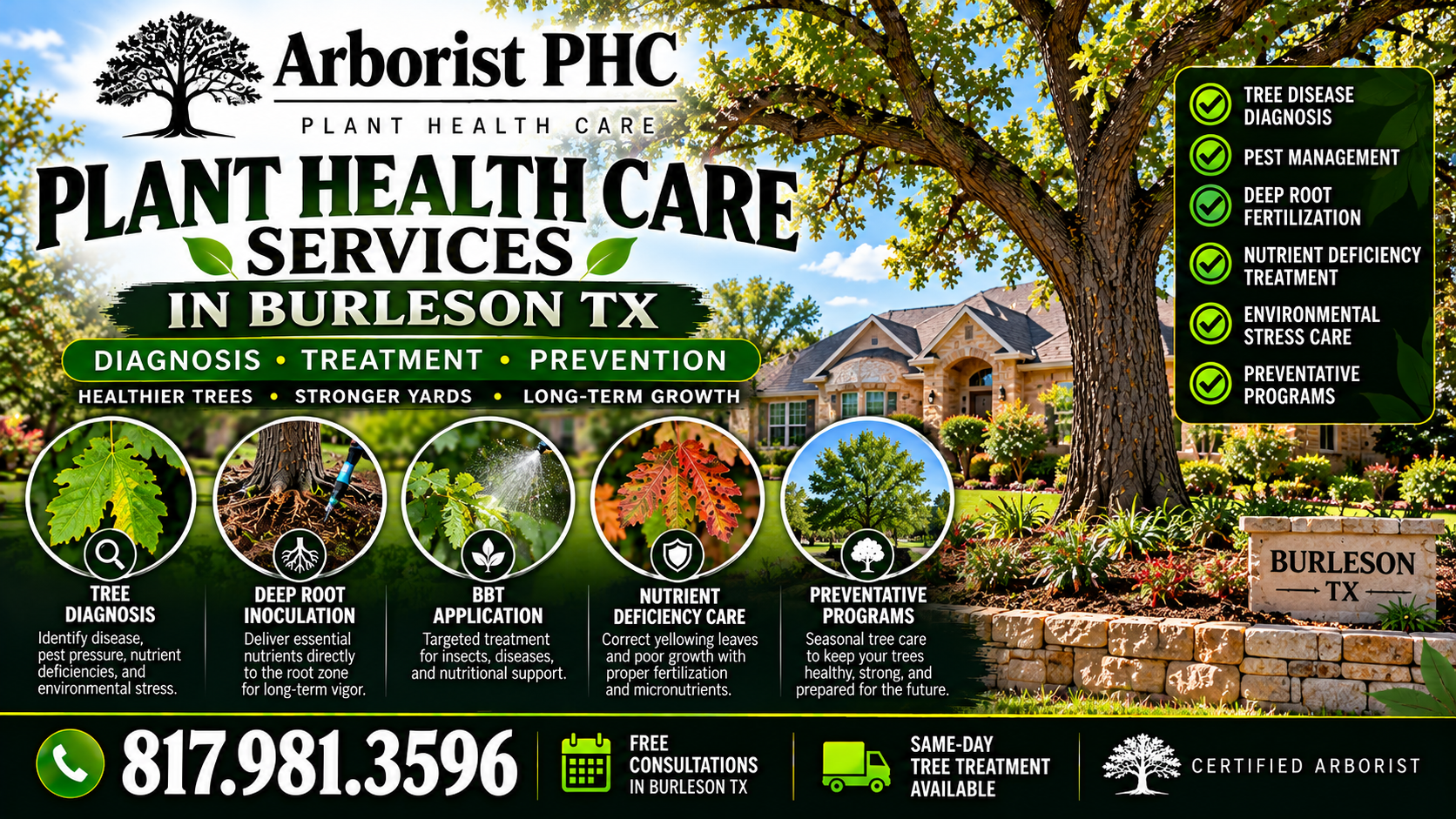
Plant Health Care Services in Burleson, TX | Professional Tree Diagnosis, Treatment & Prevention
Free On-Site Tree Consultations | Same-Day Tree Treatment Available | Certified Arborist
Trees are an important investment in your property, providing shade, natural beauty, and environmental benefits. However, maintaining healthy trees throughout North Texas can be challenging due to extreme summer temperatures, prolonged drought, fungal diseases, insect infestations, soil compaction, and nutrient deficiencies.
At Arborist PHC, we specialize in professional Plant Health Care services in Burleson, TX, providing customized treatment programs designed to address tree health concerns, manage damaging pests and diseases, and support long-term tree development.
Our approach focuses on three essential principles:
Diagnosis • Treatment • Prevention
Whether your trees are experiencing leaf discoloration, canopy thinning, branch dieback, fungal infections, or environmental stress, our goal is to identify the underlying cause and develop appropriate treatment recommendations.
We proudly provide complimentary on-site tree health consultations throughout Burleson, with same-day treatment availability when appropriate and approved.
What Is Plant Health Care?
Plant Health Care (PHC) is a comprehensive approach to maintaining and improving the health of trees and landscape plants through professional diagnosis, monitoring, preventative management, and targeted treatment.
Rather than waiting until a tree develops severe symptoms, Plant Health Care emphasizes identifying problems early and addressing the factors contributing to declining health.
A professional Plant Health Care program may include:
Tree disease diagnosis and management
Insect and pest control
Deep root inoculation
Targeted tree fertilization
Soil and root-zone care
Micronutrient supplementation
Environmental stress management
Preventative disease treatments
Seasonal tree health monitoring
Oak Wilt assessments and treatment recommendations
Each tree has different biological requirements, which is why treatment recommendations should be based on the species, growing conditions, and specific health concerns.
Why Plant Health Care Is Important in Burleson, TX
Trees growing throughout Burleson experience environmental conditions that can place considerable stress on their root systems and canopies.
North Texas weather can change dramatically throughout the year, exposing trees to extreme heat, drought, heavy rainfall, occasional freezing temperatures, and fluctuating soil moisture.
These conditions can affect a tree's ability to absorb water, obtain nutrients, and maintain healthy growth.
Common Tree Health Challenges in Burleson
Extended periods of high temperatures can contribute to leaf scorch, premature leaf drop, canopy thinning, and branch dieback.
Excessive Moisture and Root Rot
Poor drainage and prolonged soil saturation can reduce oxygen availability around tree roots and create favorable conditions for certain root pathogens.
Fungal Diseases
Oak Wilt, Tubakia Leaf Spot, Anthracnose, Hypoxylon Canker, and other diseases may affect susceptible trees.
Aphids, spider mites, scale insects, beetle borers, and other pests can contribute to tree health problems.
Alkaline soils and unfavorable root-zone conditions can limit the availability of iron, manganese, zinc, and other essential nutrients.
Construction-Related Damage
Foundation work, trenching, excavation, and heavy equipment traffic can damage roots and compact surrounding soil.
At Arborist PHC, we evaluate these factors to help determine the most appropriate course of action.
Professional Tree Disease Diagnosis in Burleson, TX
Identifying the cause of tree decline is one of the most important steps in developing an effective treatment plan.
Many tree diseases produce symptoms similar to drought stress, nutrient deficiencies, or root damage.
For example, yellowing leaves may be associated with iron chlorosis, but they may also indicate excessive moisture, root deterioration, or other underlying problems.
Our evaluations focus on identifying visible symptoms and determining whether additional diagnostic testing may be necessary.
Oak Wilt
Oak Wilt is a serious vascular disease caused by Bretziella fagacearum.
The disease can affect multiple oak species and may spread through connected root systems or, under certain conditions, by sap-feeding beetles.
Symptoms vary by species and may include leaf discoloration, premature defoliation, and canopy decline.
When Oak Wilt is suspected, laboratory testing may be recommended.
Disease-specific management may include root-graft disruption, appropriate sanitation measures, and labeled propiconazole trunk injections for selected trees.
Hypoxylon Canker
Hypoxylon Canker is associated with fungi in the Biscogniauxia group and commonly affects trees weakened by environmental stress.
Symptoms may include bark separation, exposed fungal structures, branch dieback, and rapid canopy deterioration.
There is no proven curative fungicide for established Hypoxylon Canker. Management focuses on reducing stress and evaluating affected trees for safety concerns.
Tubakia Leaf Spot
Tubakia Leaf Spot affects several oak species and may cause brown leaf lesions, discoloration, and premature leaf drop.
Disease severity varies depending on the species, environmental conditions, and infection level.
Phytophthora Root Rot
Phytophthora species are water molds capable of causing root and collar diseases in susceptible trees.
Poor drainage and excessive soil moisture can contribute to disease development.
Treatment may involve correcting moisture conditions and using appropriately labeled products when suitable.
Anthracnose
Anthracnose is a group of fungal diseases that may cause leaf spots, irregular brown lesions, and premature defoliation.
Management depends on the affected species, severity, and environmental conditions.
Our Broad Brush Treatment (BBT) Program
At Arborist PHC, our Broad Brush Treatment (BBT) program is a customized Plant Health Care approach designed to address multiple tree health concerns through selected treatment products and application methods.
Depending on the diagnosis, a BBT program may incorporate:
Targeted insect management
Fungicide applications for appropriate diseases
Nutritional supplementation
Micronutrient support
Root-zone health management
Seasonal preventative care
Our objective is to address identifiable problems while supporting overall tree vigor.
Not every tree requires the same combination of products, and healthy trees do not automatically need routine pesticide applications.
Deep Root Inoculation Services in Burleson
Deep Root Inoculation involves applying selected materials into the tree's root zone.
Depending on the diagnosis and soil conditions, this method may be used to provide nutrients or other products approved for root-zone application.
Potential Benefits of Deep Root Inoculation
Addressing identified nutrient deficiencies
Supporting root-zone nutrition
Providing targeted soil applications
Supporting healthy growth when nutrient availability is limiting
Managing certain conditions with appropriately labeled systemic products
Deep root treatment is not a universal solution for tree decline.
Product selection and application rates should be based on the tree's needs, soil conditions, and applicable label directions.
Basal Drench Tree Treatment
Basal drench applications involve applying selected products around the lower trunk or root flare area, according to the product's labeled instructions.
Depending on the target condition, basal drench applications may be recommended for certain systemic insect management or disease treatment programs.
These treatments may be incorporated into a broader Plant Health Care plan when appropriate.
Basal drenches cannot repair severe root damage, reverse advanced decay, or replace disease-specific treatments such as properly administered Oak Wilt trunk injections.
Tree Fertilization and Nutrient Deficiency Treatment
Healthy trees require essential nutrients for normal growth, root development, and physiological function.
However, nutrient deficiencies do not always mean the surrounding soil lacks nutrients.
Throughout portions of North Texas, alkaline soil conditions may limit the availability of certain micronutrients.
Common Nutritional Concerns
Nitrogen Deficiency: May contribute to pale foliage and reduced growth.
Iron Chlorosis: Often produces yellow leaves with green veins, particularly on newer foliage.
Potassium Deficiency: May cause leaf margin discoloration and reduced stress tolerance.
Magnesium Deficiency: Can contribute to interveinal yellowing, often on older foliage.
Zinc Deficiency: May affect leaf development and shoot growth, particularly in susceptible species such as Pecans.
Our nutritional programs are designed to address identified deficiencies rather than automatically applying fertilizer to every tree.
Soil or tissue testing may be recommended when symptoms are unclear.
Preventative Tree Care in Burleson, TX
One of the most important aspects of Plant Health Care is identifying potential problems before significant decline occurs.
Trees can experience root damage, environmental stress, or early pest activity before visible canopy symptoms become severe.
Preventative evaluations can help identify developing concerns and guide appropriate management.
Our preventative services may include:
Seasonal tree health assessments
Pest monitoring
Disease evaluations
Root-zone inspections
Nutritional assessments
Irrigation recommendations
Follow-up monitoring
Preventative treatment should be based on the tree's condition and identifiable risks.
Newly Planted Tree Health Care
Newly planted trees require special attention during their establishment period.
When trees are transplanted, their root systems must adapt to new soil conditions and surrounding environmental factors.
Common establishment problems include:
Transplant shock
Improper watering
Excessive soil moisture
Incorrect planting depth
Root restriction
Nutrient-related symptoms
Heat stress
At Arborist PHC, we evaluate newly planted trees to help identify conditions that may interfere with healthy establishment.
Proper watering, planting depth, drainage, and root protection are often the most important priorities.
Targeted treatment may be recommended when a specific pest, disease, or nutritional concern is identified.
Tree Treatment Before and After Construction
Construction activities can significantly affect tree health, particularly when excavation, foundation installation, or heavy machinery disturb established root systems.
Common construction-related concerns include:
Soil compaction
Root severance
Foundation excavation damage
Trenching injuries
Changes in drainage
Reduced soil oxygen availability
Progressive canopy decline
Trees may not show visible symptoms immediately following construction.
In some cases, decline becomes noticeable months or years after the original disturbance.
A pre-construction tree evaluation can help identify root protection areas and reduce unnecessary damage.
When construction has already occurred, we can assess visible symptoms and recommend appropriate next steps.
Tree Species We Treat in Burleson, TX
Arborist PHC provides Plant Health Care services for many common North Texas tree species.
Disease monitoring, pest management, root-zone care, and preventative treatment recommendations.
Shumard Red Oak (Quercus shumardii)
Assessments for Oak Wilt, fungal diseases, environmental stress, insect activity, and nutritional concerns.
Savannah Post Oak (Quercus stellata)
Evaluation of drought stress, root damage, Hypoxylon Canker, insect activity, and progressive canopy decline.
Blackjack Oak (Quercus marilandica)
Management recommendations for environmental stress, fungal concerns, and root-related problems.
Bur Oak (Quercus macrocarpa)
Evaluations for Tubakia Leaf Spot, Bur Oak Blight, nutrient-related symptoms, and environmental stress.
Treatment recommendations for fungal scab, insect activity, nutritional deficiencies, and root-zone conditions.
Chinese Pistache (Pistacia chinensis)
Assessments for transplant shock, moisture stress, root problems, and nutrient-related symptoms.
Cedar Elm (Ulmus crassifolia)
Evaluations for pest activity, leaf diseases, drought stress, and declining canopy development.
Southern Magnolia (Magnolia grandiflora)
Management of moisture stress, fungal leaf problems, insect activity, and nutritional concerns.
We also evaluate Maples, ornamental trees, Hollies, Cedars, Pines, and other landscape plants.
Seasonal Plant Health Care Programs
Tree health changes throughout the year, making seasonal monitoring an important part of long-term care.
Spring Tree Care
Spring evaluations focus on new growth, emerging pest activity, leaf development, and signs of nutritional stress.
Summer Tree Care
Summer programs prioritize heat stress, drought management, active insect infestations, and developing disease symptoms.
Fall Tree Care
Fall is a useful time to assess tree health following the summer season and identify root-zone or nutritional concerns before winter.
Certain applications may be appropriate depending on the diagnosis and environmental conditions.
Winter Tree Care
Winter evaluations can focus on root flare conditions, structural concerns, soil management, and planning for the following growing season.
Some treatments can be performed during cooler weather when product labeling and environmental conditions permit.
Why Choose Arborist PHC for Plant Health Care in Burleson?
At Arborist PHC, we focus specifically on tree diagnosis, treatment, and prevention.
Our approach is centered on understanding why a tree is experiencing problems and recommending appropriate solutions.
We provide:
Complimentary On-Site Consultations
Homeowners can have their trees evaluated without an obligation to purchase treatment.
Customized Treatment Programs
Recommendations are based on the tree species, visible symptoms, environmental conditions, and overall health.
Same-Day Treatment Availability
When appropriate, approved applications can often be completed during the initial visit.
Professional Plant Health Care
Our services focus on tree health management, including disease assessments, pest management, nutritional care, and root-zone treatment.
Preventative and Seasonal Programs
We offer ongoing evaluations and follow-up care when included in the recommended program.
Clear Treatment Recommendations
We explain our findings, discuss available options, and provide treatment recommendations based on the condition of the trees.
Free Plant Health Care Consultation in Burleson, TX
Arborist PHC offers free on-site tree health consultations throughout Burleson and surrounding communities.
During the evaluation, we inspect accessible trees for visible signs of:
Fungal diseases
Insect infestations
Nutrient-related symptoms
Root-zone problems
Environmental stress
Canopy decline
Construction-related damage
After completing the assessment, we explain our findings and discuss whether treatment is recommended.
Same-Day Tree Treatment Available
When treatment is appropriate and approved, Arborist PHC can often complete the application during the same visit, depending on scheduling availability, product requirements, and environmental conditions.
Our goal is to make professional Plant Health Care convenient while providing appropriate recommendations for each property.
Frequently Asked Questions About Plant Health Care
What is included in a Plant Health Care consultation?
Our complimentary consultation includes a visual assessment of accessible trees, evaluation of visible symptoms, and discussion of recommended next steps. Additional laboratory or specialized testing may be recommended when necessary.
Can tree treatment be completed the same day?
Yes. When appropriate treatment is recommended and approved, same-day applications may be available.
Can Plant Health Care save a declining tree?
Treatment may help manage certain diseases, pest infestations, nutritional deficiencies, and environmental stress factors. Recovery depends on the underlying cause and severity of damage, and no treatment can guarantee survival.
Do healthy trees need preventative treatment?
Healthy trees may benefit from periodic monitoring and appropriate preventative management. However, routine pesticide or fertilizer applications are not automatically necessary.
What causes trees to suddenly decline in Burleson?
Possible causes include drought stress, root damage, excessive moisture, fungal diseases, insect activity, and construction-related disturbances.
Do you treat multiple trees on the same property?
Yes. We can evaluate multiple trees throughout the property and recommend individual or property-wide Plant Health Care programs when appropriate.
Do you provide tree trimming or removal services?
Arborist PHC specializes in Plant Health Care rather than trimming or removal. If those services are needed, we can discuss coordinating with a separate tree service provider.
Is the consultation free?
Yes. We offer complimentary on-site tree health consultations in Burleson, TX, with no obligation to proceed with treatment.
Schedule Professional Plant Health Care Services in Burleson, TX
If your trees are experiencing leaf discoloration, branch dieback, insect activity, fungal disease symptoms, or other signs of declining health, a professional evaluation can help determine the most appropriate course of action.
At Arborist PHC, we specialize in helping homeowners and property owners maintain healthier trees through professional diagnosis, targeted treatment, and preventative care.
Whether you have mature Live Oaks, Red Oaks, Post Oaks, Bur Oaks, Pecans, Chinese Pistache trees, or newly planted ornamental trees, our goal is to provide practical Plant Health Care recommendations tailored to your property.
ARBORIST PHC — PLANT HEALTH CARE
CERTIFIED ARBORIST
Diagnosis • Treatment • Prevention
FREE ON-SITE CONSULTATIONS
SAME-DAY TREE TREATMENT AVAILABLE
Call or Text: 817.981.3596
Serving Burleson, Crowley, Joshua, Fort Worth, Cleburne, Alvarado, Rendon, and surrounding North Texas communities.