Why Are My Tree Leaves Turning Yellow in Texas? | Causes, Diagnosis & Treatment | Arborist PHC
Why Are My Tree Leaves Turning Yellow in Texas?
Why Are My Tree Leaves Turning Yellow?
One of the most common questions homeowners ask during the growing season is:
“Why are my tree leaves turning yellow?”
Yellow leaves, also known as chlorosis, are often one of the earliest warning signs that a tree is under stress. While some yellowing can occur naturally, widespread yellow foliage usually indicates an underlying problem that should be addressed before it leads to long-term decline.
At Arborist PHC, we specialize exclusively in Plant Health Care (PHC) and help homeowners diagnose the root cause of yellowing leaves using science-based tree health evaluations and customized treatment programs.
Yellow leaves are a symptom—not the actual problem.
Common Causes of Yellow Leaves on Trees
Several factors can cause leaves to lose their healthy green color.
Iron Chlorosis is one of the most common causes of yellow leaves in Texas.
Because North Texas soils are naturally alkaline, trees often struggle to absorb available iron, even when iron is present in the soil.
Common symptoms include:
🍂 Bright yellow leaves
🍂 Dark green veins
🍂 Sparse canopy
🍂 Reduced annual growth
🍂 Premature leaf drop
Red Oaks, Pin Oaks, Chinese Pistachios, and other ornamental trees are especially susceptible.
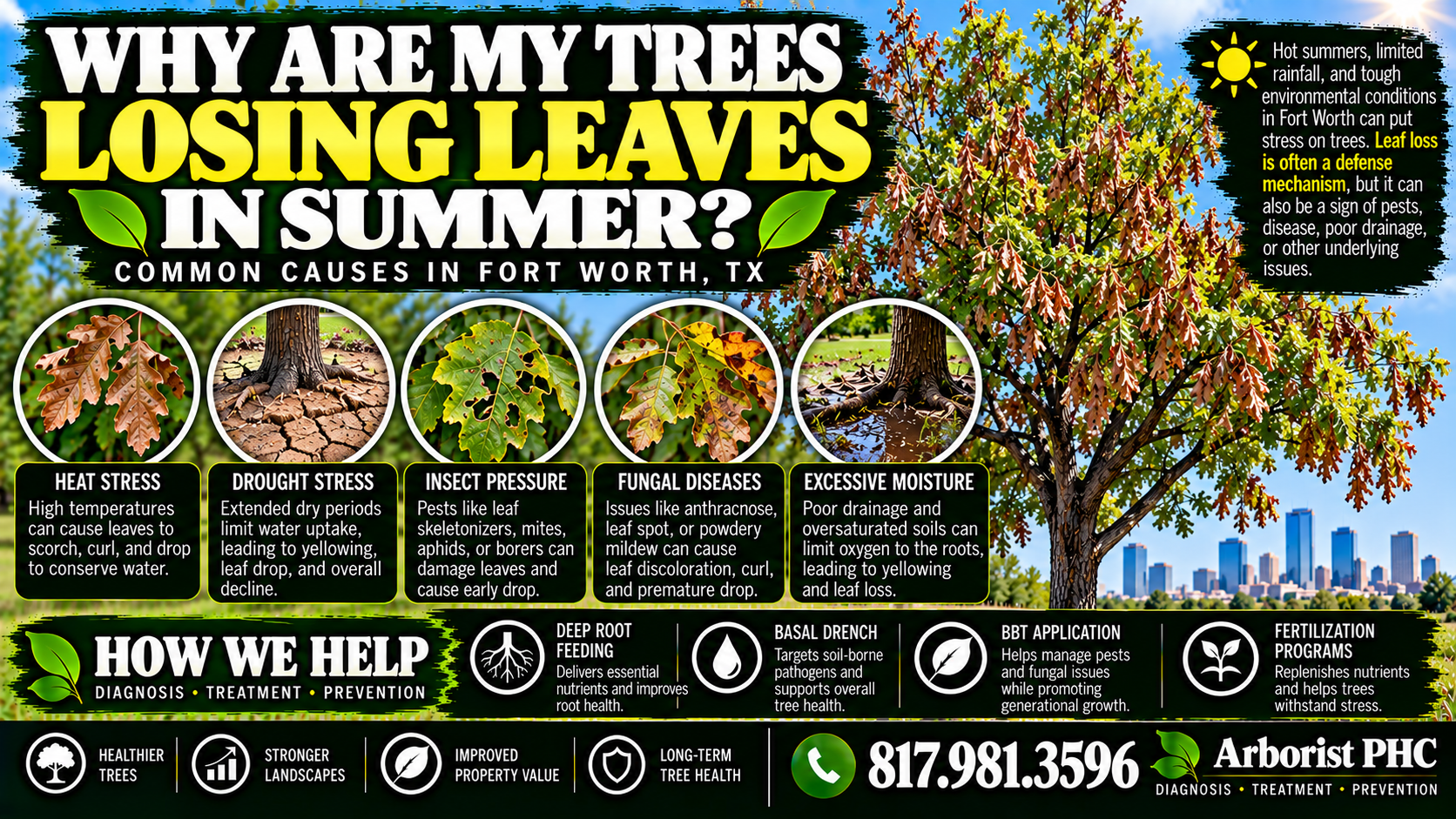
Extended periods of extreme heat and drought reduce a tree’s ability to move water and nutrients throughout the canopy.
Symptoms often include:
Yellowing leaves
Brown leaf edges
Wilting foliage
Thin canopy
Premature leaf drop
Heat stress is one of the leading causes of summer decline throughout Texas.
🌧 Overwatering & Poor Drainage
Too much water can be just as damaging as too little.
Saturated soils reduce oxygen around the roots, causing:
🍂 Yellow leaves
🍂 Wilting despite wet soil
🍂 Root decline
🍂 Slow growth
🍂 Early leaf drop
Healthy roots require both moisture and oxygen.
🍄 Fungal Diseases
Several fungal diseases interfere with normal leaf function and nutrient movement.
Common diseases include:
Tubakia Leaf Spot
Depending on the disease, symptoms may include yellow leaves, leaf spots, curling foliage, branch dieback, and canopy thinning.
🐛 Insect Activity
Certain insects damage leaves or interfere with the tree’s ability to transport nutrients.
Common pests include:
🐛 Scale Insects
Many insect infestations occur after environmental stress has weakened the tree.
🚧 Root Damage
Tree roots can be damaged by:
Construction
Trenching
Soil compaction
Heavy equipment
Utility installation
Damaged roots reduce water and nutrient uptake, frequently resulting in yellow leaves and canopy decline.
Trees Commonly Affected
We frequently diagnose yellow leaves on:
🌳 Red Oaks
🌳 Savannah Post Oaks
🌳 Bradford Pears
🌳 Desert Willows
🌳 Maple Trees
🌳 Newly Planted Trees
Why Proper Diagnosis Matters
Not every yellow leaf has the same cause.
Two trees growing side by side may both have yellow foliage but require completely different treatment plans.
Our Certified Arborists evaluate:
✔️ Tree species
✔️ Soil conditions
✔️ Root health
✔️ Nutrient availability
✔️ Disease symptoms
✔️ Insect activity
✔️ Environmental stress
✔️ Irrigation practices
Identifying the true cause allows us to develop the most effective Plant Health Care program for your tree.
Our Plant Health Care Treatment Programs
Every tree receives a customized treatment plan based on its specific needs.
🌱 Deep Root Inoculation
Our Deep Root Inoculation program helps:
✔️ Improve nutrient uptake
✔️ Stimulate root development
✔️ Increase drought tolerance
✔️ Strengthen overall tree health
✔️ Promote healthy new foliage
🌳 BBT (Broad Brush Treatment) Program
Our signature BBT (Broad Brush Treatment) combines multiple Plant Health Care techniques into one comprehensive treatment.
The program includes:
✔️ Deep Root Inoculation
✔️ Basal Drench Applications
✔️ Nutrient & Micronutrient Management
✔️ Disease Prevention Support
✔️ Environmental Stress Reduction
✔️ Insect Management Support
This integrated treatment program strengthens trees from the roots upward while improving long-term health and resilience.
💧 Basal Drench Applications
Basal Drench treatments promote systemic uptake while helping reduce environmental stress and improve nutrient movement throughout the tree.
Can Yellow Leaves Turn Green Again?
It depends on the cause.
Leaves that are already severely damaged may not recover, but many trees are capable of producing healthy new foliage once the underlying problem has been identified and treated.
The earlier treatment begins, the better the chances of long-term recovery.
Schedule a Tree Health Assessment
If your trees are turning yellow, don’t assume they’ll recover on their own.
Yellow leaves are often the first visible warning sign that something is affecting your tree’s health.
📞 Call or Text Arborist PHC
📸 Send Photos for a Preliminary Evaluation
Our Certified Arborists will identify the underlying cause of yellowing leaves and develop a customized Plant Health Care program designed to restore and protect your trees.
Frequently Asked Questions
-
Yellow leaves are commonly caused by Iron Chlorosis, heat stress, drought, root damage, poor drainage, nutrient deficiencies, fungal diseases, or insect activity.
-
Yes. Overwatering and poor drainage reduce oxygen around the roots, leading to yellow foliage and root decline.
-
Iron Chlorosis occurs when trees cannot absorb enough iron from alkaline soils, causing yellow leaves with dark green veins.
-
Many trees recover successfully when the underlying problem is diagnosed and treated early.
-
No. Arborist PHC specializes exclusively in Plant Health Care, diagnosis, treatment, and preventive care.