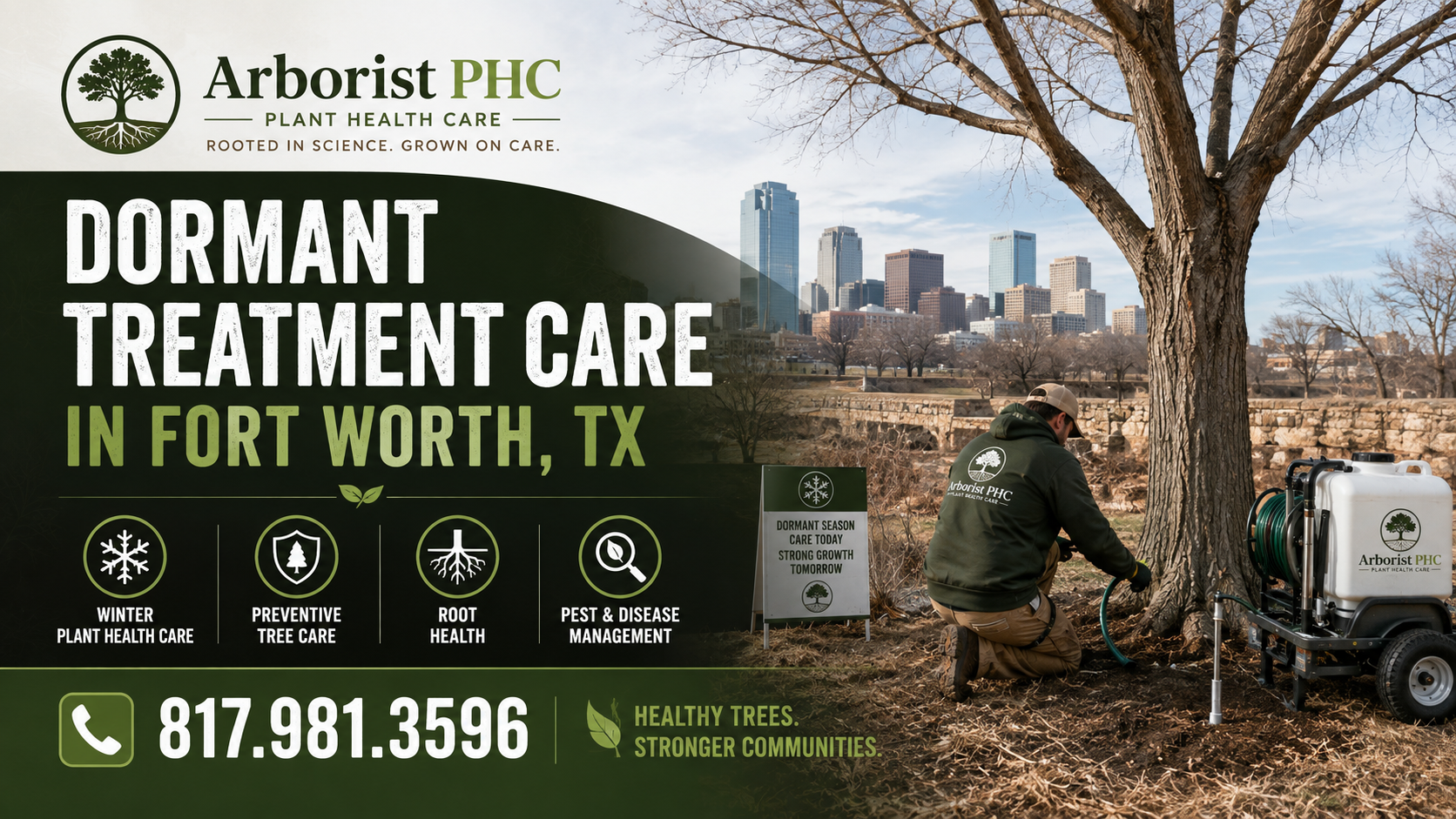
Dormant Tree Treatment Care in Fort Worth TX | Winter Tree Health & Preventive Care
Dormant Tree Treatment Care in Fort Worth TX
Why Dormant-Season Tree Care Matters in Fort Worth
Winter may look like a quiet time for your trees, but below the surface they are preparing for the next growing season.
During dormancy, many deciduous trees slow their above-ground growth and redirect energy toward maintaining their root systems and stored reserves. This makes the dormant season an excellent time to evaluate tree health, address certain pest and disease concerns, improve root-zone conditions, and prepare stressed trees for spring.
At Arborist PHC, we specialize exclusively in Plant Health Care (PHC) and provide customized dormant-season treatment programs throughout Fort Worth and surrounding North Texas communities.
Our goal is simple:
Diagnosis • Treatment • Prevention
Rather than waiting for problems to become severe during spring or summer, dormant care allows us to take a proactive approach to tree health.
What Is Dormant Tree Treatment?
Dormant tree treatment refers to Plant Health Care applications and preventive services performed while deciduous trees are resting between growing seasons.
Depending on the tree species, diagnosis, and property conditions, a dormant-season program may focus on:
🌳 Root health
🌱 Soil conditioning
🐛 Overwintering insect pressure
🍄 Disease prevention
💧 Moisture management
🌿 Nutrient availability
❄️ Recovery from environmental stress
🛡 Preventive Plant Health Care
There is no one-size-fits-all dormant treatment. Every application should be based on the tree’s species, health history, existing symptoms, and surrounding environment.
Why Winter Is an Important Time for Tree Health
Many homeowners don’t think about their trees until leaves begin emerging in spring.
However, problems that become visible during spring and summer often began much earlier.
Dormant-season evaluations give us an opportunity to identify:
✔️ Dead or declining branch tips
✔️ Bark abnormalities
✔️ Previous insect damage
✔️ Fungal fruiting structures
✔️ Root-flare problems
✔️ Soil compaction
✔️ Poor drainage
✔️ Construction damage
✔️ Nutrient-related stress
✔️ Weak growth from the previous season
Catching these issues before spring growth begins may help reduce stress and improve the tree’s ability to perform during the upcoming growing season
Dormant-Season Pest Management
Many insects survive the winter as eggs, immature stages, or protected populations on bark, branches, and surrounding plant material.
Depending on the pest and tree species, dormant-season management may help reduce certain overwintering populations before temperatures warm.
Common pests that may require seasonal monitoring include:
🐛 Scale insects
🐛 Aphids
🐛 Mites
🐛 Certain overwintering insect eggs
🐛 Other sap-feeding pests
Proper identification is extremely important. Not every tree requires a dormant insect application, and treatments should only be performed when appropriate for the pest, plant species, and time of year.
Dormant Oils and Preventive Pest Care
Dormant or horticultural oils may be recommended for certain trees and shrubs when specific overwintering pests are present.
These applications work primarily through contact and are commonly used as part of an Integrated Pest Management strategy for susceptible pests.
Timing and environmental conditions are important.
Applications should consider:
🌡 Temperature
🌳 Tree species
🐛 Target pest
🌱 Bud development
💨 Wind conditions
🌧 Upcoming weather
Using the correct product at the correct time helps reduce unnecessary applications while protecting beneficial organisms and plant tissue.
Disease Prevention During Dormancy
Dormant-season care can also be an important part of a preventive disease-management program.
Certain fungal and bacterial problems may overwinter in infected tissue, fallen leaves, bark, or surrounding plant material
Depending on the diagnosis, management may include:
🍄 Monitoring previous infection sites
🍂 Removing heavily infected fallen plant material when appropriate
🌳 Improving overall tree vigor
💧 Correcting irrigation and drainage issues
🌱 Improving root-zone conditions
🛡 Planning preventive applications before susceptible growth emerges
Disease prevention is most effective when based on the specific pathogen involved rather than applying fungicides indiscriminately.
Deep Root Inoculation During the Dormant Season
Winter can be an excellent opportunity to focus on the part of the tree homeowners cannot see—the root system.
Our Deep Root Inoculation program is designed to support the active root zone with customized materials selected according to the tree’s condition.
The program may help:
✔️ Support fine feeder-root development
✔️ Improve nutrient availability
✔️ Strengthen root-zone health
✔️ Support recovery from summer heat and drought
✔️ Improve overall tree vigor
✔️ Prepare trees for spring growth
Healthy roots provide the foundation for a healthier canopy when trees begin actively growing again.
BBT — Broad Brush Treatment During Dormancy
Our BBT (Broad Brush Treatment) Program takes a comprehensive approach to Plant Health Care.
Depending on the diagnosis and season, the program may incorporate:
🌱 Deep Root Inoculation
💧 Basal Drench Applications
🐛 Targeted pest management
🍄 Disease-management support
🌿 Nutrient and micronutrient support
☀️ Environmental-stress management
🛡 Preventive care
Rather than treating one symptom at a time, BBT is designed to address multiple factors that may be affecting the overall health of the tree.
Helping Trees Recover from Summer Heat & Drought
Fort Worth trees experience tremendous environmental stress during the growing season.
Extended periods of high temperatures and limited rainfall may lead to:
🍂 Premature leaf drop
🍂 Leaf scorch
🍂 Branch-tip dieback
🍂 Canopy thinning
🍂 Reduced growth
🍂 Root stress
🍂 Increased susceptibility to insects and disease
Dormant-season Plant Health Care gives stressed trees an opportunity to receive additional root-zone support before another demanding Texas summer arrives.
Dormant Care for Trees with Previous Pest or Disease Problems
If your trees experienced problems during the previous growing season, winter is an excellent time to develop a preventive strategy for the following year.
We commonly recommend dormant evaluations for trees with a history of:
🍄 Tubakia Leaf Spot
🐛 Scale insects
🐛 Aphids
🐛 Spider mites
🐛 Certain beetle or borer activity
🚧 Construction-related root stress
🌳 Progressive canopy decline
A history of recurring problems can help determine which preventive measures should be considered before spring.
Trees We Commonly Evaluate During Dormancy
Our dormant Plant Health Care programs may be appropriate for many North Texas trees, including:
🌳 Red Oaks
🌳 Bur Oaks
🌳 Post Oaks
🌳 Maple Trees
🌳 Redbuds
🌳 Crape Myrtles
🌳 Bradford Pears
🌳 Magnolias
🌳 Ornamental Trees and Shrubs
Because evergreen and deciduous species respond differently throughout winter, treatment recommendations are customized accordingly.
Signs Your Tree May Need Dormant-Season Care
Consider scheduling a winter tree health evaluation if you noticed any of the following during the previous growing season:
🍂 Premature leaf loss
🍂 Yellow or discolored foliage
🍂 Brown or scorched leaves
🍂 Leaf curling
🍂 Thin canopy
🍂 Dead branch tips
🍂 Slow annual growth
🍂 Increased insect activity
🍂 Leaf spotting
🍂 Bark abnormalities
🍂 Decline following construction
🍂 Severe heat or drought stress
Even if the tree looks relatively normal during winter, its previous growing-season symptoms can provide valuable information about underlying health problems
Dormant Treatment Is Preventive Care — Not Just Reactive Care
One of the biggest advantages of dormant-season Plant Health Care is the ability to work proactively.
Instead of waiting until your tree is already struggling in extreme summer temperatures, we can evaluate its condition during winter and develop a strategy for the next growing season.
Preventive tree care may help:
✔️ Reduce environmental stress
✔️ Improve root health
✔️ Support nutrient uptake
✔️ Manage recurring pest pressure
✔️ Reduce disease susceptibility
✔️ Improve spring growth
✔️ Preserve valuable mature trees
The objective is not simply to respond when trees become sick—it is to maintain healthier trees before major decline occurs.
Why Choose Arborist PHC?
Arborist PHC specializes exclusively in Plant Health Care.
Our focus is on preserving trees through professional:
✔️ Tree Diagnosis
✔️ Disease Management
✔️ Pest Management
✔️ Root-Zone Care
✔️ Nutrient Management
✔️ Environmental-Stress Reduction
✔️ Preventive Tree Care
✔️ Seasonal Health Monitoring
We develop recommendations based on the individual tree rather than providing the same treatment to every property.
Healthy Roots. Stronger Trees. Better Future
Dormant Tree Treatment in Fort Worth & Surrounding Areas
Arborist PHC proudly provides Plant Health Care services throughout:
And surrounding North Texas communities
Schedule Your Dormant Tree Health Assessment in Fort Worth TX
Don’t wait until spring to start thinking about your trees.
If your trees experienced heat stress, premature leaf drop, insect activity, disease symptoms, or canopy decline this year, the dormant season is an excellent opportunity to evaluate their condition and prepare them for the next growing season.
📞 Call or Text Arborist PHC at 817.981.3596
📸 Send Photos for a Preliminary Evaluation
Our Certified Arborist can inspect your trees and develop a customized dormant-season Plant Health Care program based on their condition, species, previous health problems, and surrounding environment.
Frequently Asked Questions
-
Dormant tree treatment is preventive Plant Health Care performed during the winter or dormant season. Depending on the diagnosis, it may include root-zone care, nutrient support, pest management, disease prevention, and preparation for spring growth.
-
Timing depends on the tree species, weather, target pest or disease, and specific treatment being used. Some treatments are performed during full dormancy, while others are timed closer to bud break.
-
No. Treatment should be based on a professional evaluation. Healthy trees without significant pest, disease, soil, or stress problems may not require the same program as declining trees.
-
Certain dormant-season applications can help manage specific overwintering insect populations, including some scale insects, mites, aphids, and insect eggs. Proper pest identification and timing are essential.
-
Dormant-season root-zone and Plant Health Care programs can help support trees recovering from heat and drought stress while preparing them for the following growing season.
-
Certain root-zone nutrient programs may be appropriate during the dormant season, but applications should be based on the tree’s condition and soil environment rather than automatically fertilizing every tree.
-
No. Arborist PHC specializes exclusively in Plant Health Care, diagnosis, treatment, prevention, and long-term tree health management.