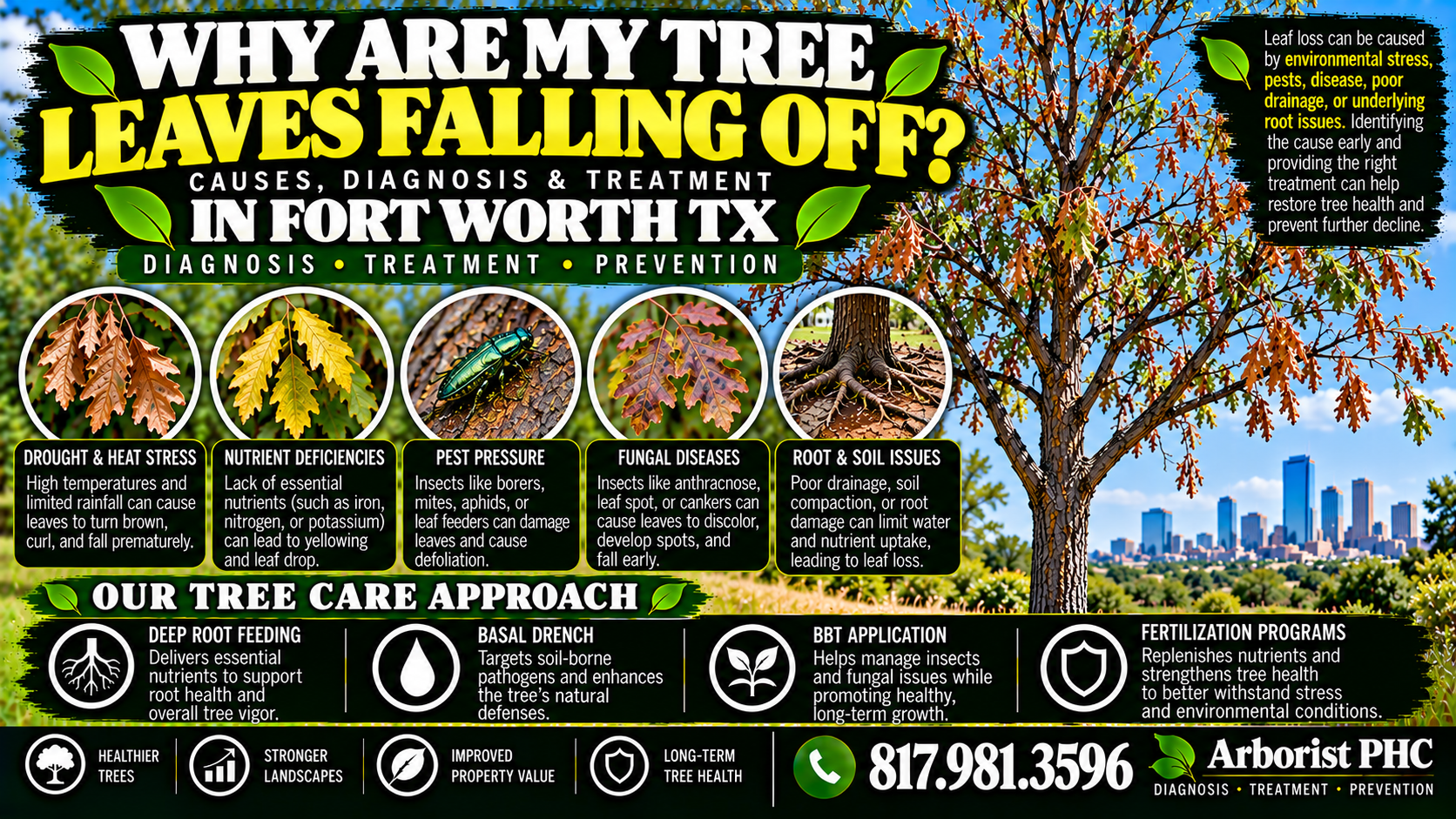
Why Are My Tree Leaves Falling Off? | Causes, Diagnosis & Treatment | Arborist PHC
Why Are My Tree Leaves Falling Off?
Why Is My Tree Losing Its Leaves?
If your tree is dropping leaves unexpectedly, you’re probably asking yourself:
“Is my tree dying?”
While some leaf drop is completely normal during seasonal changes, excessive or premature leaf loss is often one of the earliest signs that your tree is experiencing stress.
At Arborist PHC, we specialize exclusively in Plant Health Care (PHC) and help homeowners identify why trees begin losing leaves before long-term damage occurs.
Leaf drop is not a disease—it is a symptom that something is affecting your tree’s health.
Is Leaf Drop Always a Bad Sign?
Not necessarily.
Many deciduous trees naturally lose their leaves during the fall as they prepare for dormancy.
However, if your tree begins dropping leaves during spring or summer—or loses significantly more leaves than usual—it may indicate an underlying problem that should be investigated.
The earlier the cause is identified, the greater the chance of restoring your tree’s health.
Common Causes of Tree Leaf Drop
Several factors can cause trees to lose leaves earlier than expected.
One of the most common causes of premature leaf loss is prolonged heat and drought.
During periods of extreme temperatures, trees often shed leaves to reduce water loss and conserve energy.
Common symptoms include:
🍂 Yellow leaves
🍂 Brown leaf edges
🍂 Wilting
🍂 Thin canopy
🍂 Premature leaf drop
🍂 Branch tip dieback
🌧 Overwatering & Poor Drainage
Too much water can be just as harmful as too little.
When soils remain saturated, roots cannot receive enough oxygen, resulting in:
🍂 Yellow leaves
🍂 Wilting
🍂 Root decline
🍂 Premature leaf drop
🍂 Slow growth
Healthy roots require both moisture and oxygen.
🍄 Fungal Diseases
Many fungal diseases cause leaves to fall prematurely.
Common diseases include:
Tubakia Leaf Spot
Depending on the disease, homeowners may notice:
🍂 Brown spots
🍂 Black lesions
🍂 Curling leaves
🍂 Early defoliation
🍂 Branch dieback
🌱 Nutrient Deficiencies
Nutrient deficiencies reduce a tree’s ability to produce healthy foliage.
Iron Chlorosis is especially common throughout Texas.
Symptoms often include:
🍂 Yellow leaves
🍂 Green veins
🍂 Thin canopy
🍂 Premature leaf loss
Proper nutrient management can significantly improve overall tree health.
🐛 Insect Activity
Many insects damage leaves or weaken the tree’s vascular system.
Common pests include:
🐛 Scale Insects
🐛 Caterpillars
🐛 Leaf-feeding insects
Many insect infestations occur after environmental stress has weakened the tree.
🚧 Root Damage
Construction activities, trenching, grading, soil compaction, and utility work frequently damage root systems.
Without healthy roots, trees struggle to support the canopy, leading to:
🍂 Leaf drop
🍂 Wilting
🍂 Sparse foliage
🍂 Slow decline
Trees Commonly Affected
We frequently diagnose premature leaf drop on:
🌳 Savannah Post Oaks
🌳 Bradford Pears
🌳 Desert Willows
🌳 Maple Trees
🌳 Newly Planted Trees
Why Proper Diagnosis Is Important
Many different problems can produce the exact same symptom.
Two trees may both be losing leaves while requiring completely different treatments.
Our Certified Arborists evaluate:
✔️ Tree species
✔️ Root health
✔️ Soil conditions
✔️ Irrigation practices
✔️ Nutrient deficiencies
✔️ Disease symptoms
✔️ Insect activity
✔️ Environmental stress
By identifying the underlying cause, we can develop a customized Plant Health Care program designed specifically for your tree.
Our Plant Health Care Solutions
Every treatment recommendation is customized to the individual tree.
🌱 Deep Root Inoculation
Our Deep Root Inoculation program helps:
✔️ Stimulate healthy root development
✔️ Improve nutrient uptake
✔️ Increase drought tolerance
✔️ Strengthen overall tree health
✔️ Promote healthy new foliage
🌳 BBT (Broad Brush Treatment) Program
Our signature BBT (Broad Brush Treatment) combines multiple Plant Health Care techniques into one comprehensive treatment.
The program includes:
✔️ Deep Root Inoculation
✔️ Basal Drench Applications
✔️ Nutrient & Micronutrient Management
✔️ Disease Prevention Support
✔️ Environmental Stress Reduction
✔️ Insect Management Support
This integrated treatment program strengthens trees from the roots upward while improving long-term health and resilience.
💧 Basal Drench Applications
Basal Drench treatments improve systemic uptake through the root flare while helping reduce environmental stress and support healthy root function.
Can My Tree Recover?
In many cases, yes.
Trees have an incredible ability to recover when the underlying cause is identified early and treated properly.
Waiting until large branches begin dying often reduces the likelihood of successful recovery.
Early diagnosis makes all the difference.
Schedule a Tree Health Assessment
If your tree is dropping leaves unexpectedly, don’t ignore the warning signs.
Premature leaf loss is often your tree’s way of telling you that something is wrong.
📞 Call or Text Arborist PHC
📸 Send Photos for a Preliminary Evaluation
Our Certified Arborists will identify the underlying cause of decline and develop a customized Plant Health Care program designed to restore and protect your trees.
Frequently Asked Questions
-
Premature leaf drop during summer is commonly caused by heat stress, drought, nutrient deficiencies, fungal diseases, insect activity, root damage, or poor drainage.
-
Yes. Trees often shed leaves during prolonged drought to conserve water and survive periods of environmental stress.
-
Seasonal leaf drop during fall is normal for deciduous trees. Significant leaf loss during spring or summer usually indicates an underlying issue.
-
Many trees recover successfully when the underlying cause is diagnosed and treated before severe decline occurs.
-
No. Arborist PHC specializes exclusively in Plant Health Care, diagnosis, treatment, and preventive care.