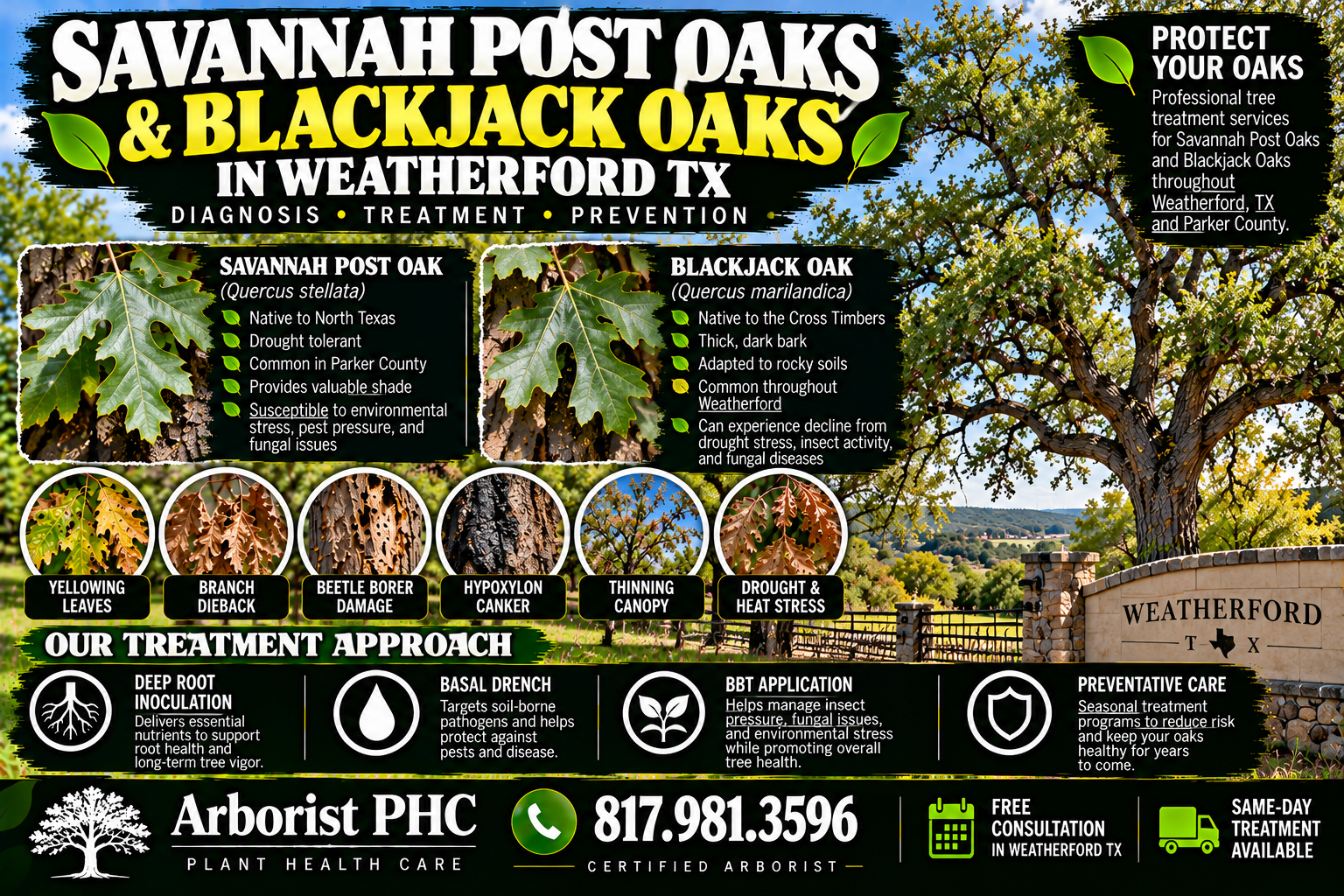
Savannah Post Oak & Blackjack Oak Tree Treatment in Weatherford, TX | Arborist PHC
Professional Oak Tree Health Care | Diagnosis • Treatment • Prevention
Savannah Post Oaks and Blackjack Oaks are important native tree species throughout Weatherford, TX, and Parker County. These trees contribute to the natural beauty of North Texas properties, provide valuable shade, and support the surrounding ecosystem. However, despite their reputation for tolerating challenging soil conditions and periodic drought, both species can experience serious health problems when exposed to prolonged environmental stress, fungal diseases, insect infestations, and root-related damage.
At Arborist PHC, we specialize in professional tree treatment services for Savannah Post Oaks, Blackjack Oaks, and other native oak species throughout Weatherford and surrounding communities.
Our Plant Health Care programs focus on identifying the underlying causes of tree decline, managing treatable conditions, and providing preventative care to support long-term tree health.
Whether your oaks are experiencing thinning canopies, branch dieback, yellowing leaves, pest activity, or sudden decline, our goal is to identify the problem and recommend an appropriate treatment program.
Understanding Savannah Post Oaks and Blackjack Oaks in Weatherford, TX
Savannah Post Oak (Quercus stellata)
Savannah Post Oaks are native oak trees commonly found throughout Parker County and the surrounding Cross Timbers region.
These trees are well adapted to North Texas conditions and often grow in rocky, sandy, or relatively nutrient-poor soils.
Although established Post Oaks can tolerate periods of drought, they are particularly sensitive to significant disturbances involving their root systems and surrounding soil environment.
Common health concerns include:
Rapid Oak Decline symptoms
Hypoxylon Canker
Environmental and drought stress
Root damage from construction
Soil compaction
Beetle borer activity
Nutrient deficiencies
Fungal leaf diseases
Excessive moisture and poor drainage
Branch dieback and canopy thinning
One important consideration is that mature Post Oaks can respond poorly to sudden changes in their environment.
Construction, trenching, changes in soil elevation, excessive irrigation, and disturbances within the root zone can contribute to progressive decline.
Blackjack Oak (Quercus marilandica)
Blackjack Oaks are another native species commonly encountered throughout Weatherford and Parker County.
These trees are recognizable by their thick, dark bark, irregular branching patterns, and distinctive broad leaves.
Blackjack Oaks often grow in dry, rocky, or sandy soils and are naturally adapted to difficult growing environments.
However, they can still experience serious health problems when exposed to prolonged drought, root damage, insect pressure, or disease.
Common concerns include:
Hypoxylon Canker
Branch dieback
Leaf scorch
Beetle borer infestations
Fungal diseases
Root deterioration
Soil compaction
Reduced canopy density
Because Blackjack Oaks naturally have irregular growth patterns, professional evaluation is important when distinguishing normal tree structure from actual decline.
Why Savannah Post Oaks and Blackjack Oaks Decline in Weatherford
One of the most common reasons native oak trees decline in North Texas is the accumulation of environmental stress over time.
A tree may appear relatively healthy for several years before suddenly developing noticeable symptoms.
In many cases, the underlying stress began months or even years before the canopy showed obvious signs of deterioration.
1. Heat and Drought Stress
Weatherford regularly experiences periods of extreme summer temperatures and limited rainfall.
Although mature Post Oaks and Blackjack Oaks are adapted to drought, prolonged moisture deficits can weaken their ability to maintain normal physiological functions.
Common symptoms include:
Browning leaves
Premature leaf drop
Reduced canopy density
Branch tip dieback
Smaller-than-normal foliage
Reduced seasonal growth
Severe or repeated drought can also increase vulnerability to certain opportunistic fungi and insect pests.
2. Hypoxylon Canker
Hypoxylon Canker is a serious fungal disease associated with stressed and weakened hardwood trees, including Post Oaks and Blackjack Oaks.
The disease is commonly associated with fungi in the Biscogniauxia group.
These fungi may remain present in trees without obvious symptoms until environmental stress weakens the host.
Signs can include:
Rapid canopy decline
Branch dieback
Peeling or sloughing bark
Dark fungal growth beneath damaged bark
Gray, brown, or black fungal structures
Exposed dead wood
There is no proven curative fungicide treatment for established Hypoxylon Canker. Management focuses on reducing underlying stress, protecting remaining healthy trees, and evaluating the structural condition of severely affected trees.
3. Rapid Oak Decline
Rapid Oak Decline is a descriptive term used for relatively fast deterioration of oak health. It does not identify one specific disease or pathogen.
In Weatherford, Savannah Post Oaks may experience rapid decline associated with a combination of drought, root damage, soil disturbances, pest activity, and secondary fungal infections.
Symptoms may include:
Sudden canopy thinning
Multiple dead branches
Premature leaf discoloration
Reduced foliage production
Progressive dieback
Declining overall vigor
Because several conditions can produce similar symptoms, proper diagnosis is essential before implementing treatment.
4. Beetle Borer Damage and Insect Pressure
Stressed oak trees may become more vulnerable to wood-boring insects and other pests.
Certain beetle borers are attracted to weakened or declining trees, where their larvae may feed beneath the bark or within woody tissues.
Signs of potential borer activity include:
Small holes in bark
Frass or sawdust-like material
Loose or damaged bark
Galleries beneath the bark
Branch dieback
Increased woodpecker activity
Not all insects found on declining trees are responsible for the original damage. Some colonize trees that are already severely weakened or dying.
Identifying the pest and its role in the decline is important before recommending insecticide treatment.
5. Root Damage and Soil Compaction
The root systems of mature Savannah Post Oaks and Blackjack Oaks can extend well beyond their canopies.
Activities such as trenching, excavation, heavy equipment traffic, grading, and construction can damage important roots.
Soil compaction can also reduce oxygen availability and interfere with water infiltration.
Because root damage may not immediately produce visible canopy symptoms, trees can continue declining long after the original disturbance.
Our Savannah Post Oak and Blackjack Oak Treatment Programs
At Arborist PHC, we develop customized treatment recommendations based on the tree species, visible symptoms, root-zone conditions, and suspected causes of decline.
Our approach may include the following services.
Broad Brush Treatment (BBT) Application
Our Broad Brush Treatment program is designed to address multiple plant health concerns through a customized combination of appropriate treatment products and application methods.
Depending on the diagnosis, the program may include:
Targeted insect management
Fungicide applications for treatable diseases
Nutritional support
Micronutrient supplementation
Root-zone support
Seasonal preventative care
BBT applications are customized for each property. Products are selected according to the condition being managed, tree species, and applicable label directions.
The purpose is to address identifiable problems and support tree health rather than simply treating visible symptoms.
Deep Root Inoculation
Deep Root Inoculation involves applying selected materials into the tree's root zone.
Depending on the diagnosis and soil conditions, this method may be used to deliver appropriate nutrients, soil-supporting products, or labeled systemic treatments.
Potential objectives include:
Addressing identified nutrient deficiencies
Supporting root-zone conditions
Improving access to appropriate nutritional inputs
Supporting recovery from certain environmental stresses
Because mature Post Oaks and Blackjack Oaks are sensitive to root disturbances and soil changes, treatment must be carefully selected.
Excessive fertilization or unnecessary root-zone injections can create additional stress. Soil testing may be recommended when nutrient deficiencies or soil chemistry problems are suspected.
Basal Drench Applications
Basal drench treatments involve applying approved products to the lower trunk or root-flare area, depending on the product's labeled application method.
This technique may be recommended for certain insect or disease management programs when the target condition and product label support its use.
Basal drenches are not a universal treatment for oak decline, and they cannot reverse extensive root death or advanced fungal decay.
Preventative Oak Tree Care
Preventative treatment focuses on identifying potential problems before they become severe.
Our programs may include:
Seasonal tree health evaluations
Monitoring for insect pressure
Disease symptom assessments
Root-zone inspections
Water management recommendations
Targeted nutritional support
Follow-up reassessments
Healthy trees do not automatically require pesticide or fertilizer applications. Preventative treatments are recommended when there is a specific, identifiable benefit.
Can Declining Savannah Post Oaks and Blackjack Oaks Recover?
Recovery depends on several important factors, including the cause of decline, severity of root damage, amount of living canopy, and overall condition of the tree.
Trees experiencing moderate drought stress, manageable pest infestations, or correctable nutrient deficiencies may respond positively when the underlying problems are addressed.
However, trees with extensive root death, advanced Hypoxylon Canker, severe vascular damage, or significant structural deterioration may have limited recovery potential.
At Arborist PHC, our goal is to provide realistic treatment recommendations based on the condition of each tree.
No treatment can guarantee that a severely declining oak will survive. Early detection and appropriate care provide a better opportunity to manage problems before they become irreversible.
Preventative Treatment for Healthy Oaks in Weatherford, TX
Homeowners often assume that a tree only needs professional care when it begins showing obvious signs of decline.
However, evaluating mature native oaks before significant symptoms develop can be especially beneficial on properties experiencing:
Recent construction
Changes in irrigation
Extended drought
Soil disturbances
Nearby tree decline
Pest infestations
Drainage changes
When one Post Oak or Blackjack Oak begins declining, evaluating surrounding trees may help identify shared environmental conditions or pest problems.
Not every case of oak decline is contagious. However, nearby trees may be exposed to the same drought, soil disturbances, drainage problems, or insect populations.
Tree Treatment After Construction in Weatherford
Construction-related damage is a major concern for mature native oaks.
Savannah Post Oaks and Blackjack Oaks are often preserved during residential development, but their root systems may be disturbed by excavation, grading, utility installation, and heavy machinery.
Even when the trunk and canopy remain untouched, damage beneath the soil can compromise tree health.
Our evaluations focus on identifying signs of root disturbance, changes in soil conditions, and progressive canopy stress.
When appropriate, we recommend corrective cultural practices, monitoring, and targeted Plant Health Care applications to help manage remaining tree health concerns.
Free Savannah Post Oak and Blackjack Oak Consultation in Weatherford, TX
Arborist PHC offers complimentary on-site tree health consultations for homeowners and property owners throughout Weatherford and surrounding Parker County communities.
During the evaluation, we inspect accessible trees for visible signs of:
Fungal disease
Insect infestations
Root-related stress
Environmental damage
Nutrient-related symptoms
Canopy deterioration
After the assessment, we explain our findings and discuss whether treatment is appropriate.
Same-Day Tree Treatment Available
When treatment is recommended and approved, Arborist PHC can often complete the application during the same visit, depending on the required materials and scheduling availability.
This provides homeowners with the convenience of having their trees evaluated and treated without necessarily scheduling a separate appointment.
There is no obligation to proceed with treatment following the complimentary consultation.
Frequently Asked Questions
Why are my Savannah Post Oaks suddenly dying?
Sudden decline may be associated with prolonged drought, root damage, construction stress, severe fungal infections, or insect activity. Multiple factors may be involved, so an on-site evaluation is recommended.
Can Hypoxylon Canker be treated?
There is no proven curative fungicide for established Hypoxylon Canker. Management focuses on reducing stress, evaluating remaining tree health, and assessing the safety of affected trees.
Are Blackjack Oaks naturally drought tolerant?
Yes. Blackjack Oaks are adapted to relatively dry and nutrient-poor soils. However, prolonged drought and repeated environmental stress can still contribute to decline.
Should I fertilize my declining Post Oak?
Not automatically. Fertilization should be based on identified nutritional needs. Unnecessary fertilizer applications may be ineffective or potentially harmful to stressed native oaks.
Can insecticide treatment help protect my oaks?
Targeted insecticide applications may help manage certain damaging pests when the insect is correctly identified and treatment is appropriate. Insecticides cannot reverse existing structural damage or cure advanced fungal disease.
Can treatment be performed the same day?
Yes. When the recommended treatment is suitable for same-day application and scheduling allows, we can often complete it immediately following the consultation.
Do you offer free tree evaluations?
Yes. Arborist PHC offers complimentary on-site tree health consultations in Weatherford, TX, with no obligation to purchase treatment.
Schedule Savannah Post Oak and Blackjack Oak Treatment in Weatherford, TX
If your Savannah Post Oaks or Blackjack Oaks are experiencing branch dieback, thinning canopies, leaf discoloration, insect activity, or signs of environmental stress, early evaluation can help determine the most appropriate next steps.
At Arborist PHC, we specialize in professional Plant Health Care services for mature native oaks throughout Weatherford, Parker County, and surrounding North Texas communities.
Our services include tree disease diagnosis, targeted treatment applications, pest management, root-zone care, nutritional support, and preventative tree health programs.
ARBORIST PHC — PLANT HEALTH CARE
CERTIFIED ARBORIST
Diagnosis • Treatment • Prevention
Free On-Site Consultations | Same-Day Treatment Availability
Call or Text: 817.981.3596
Serving Weatherford, Aledo, Hudson Oaks, Willow Park, Brock, and surrounding Parker County communities.