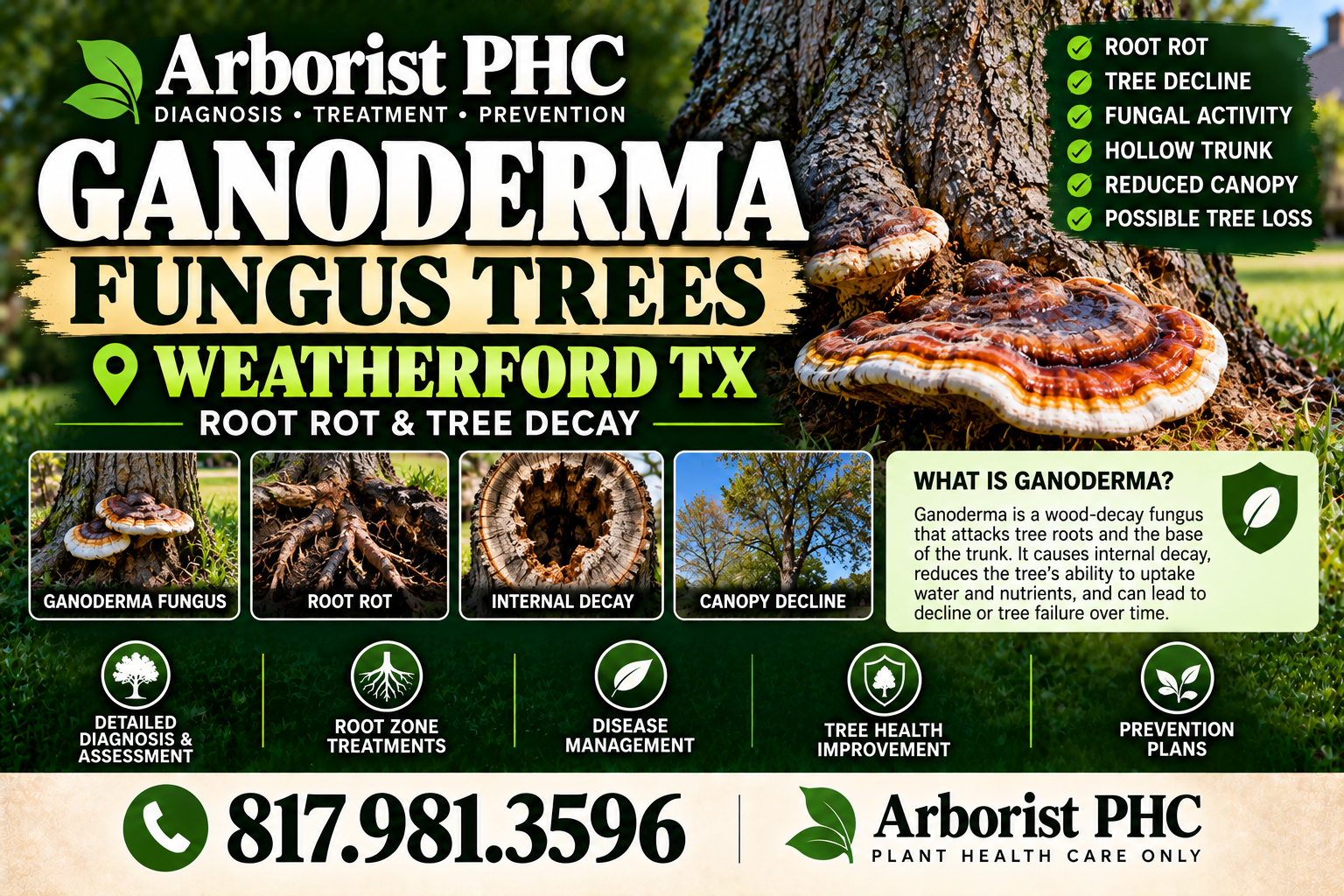
Ganoderma Fungus on Trees in Weatherford, TX | Root Rot & Tree Decay | Arborist PHC
Ganoderma Fungus on Trees in Weatherford, TX - Serving Weatherford & North Texas
Understanding Ganoderma Root Rot in North Texas Trees
Ganoderma fungus is a serious wood decay organism commonly found on stressed or declining trees throughout Weatherford and surrounding North Texas communities.
At Arborist PHC, we specialize in evaluating tree decline, structural risk, and environmental stress factors associated with fungal activity.
Proper diagnosis is critical when evaluating trees affected by Ganoderma.
What Is Ganoderma Fungus?
Ganoderma is a fungal decay organism that attacks:
Root systems
Root flare tissue
Lower trunk wood
Over time, the fungus causes internal wood decay and structural weakening.
Ganoderma is often associated with:
👉 Advanced stress
👉 Root decline
👉 Internal decay progression
The fungus feeds on weakened wood tissue and compromises the tree’s structural integrity.
Signs of Ganoderma on Trees
Common symptoms include:
Shelf-like fungal conks near the base of the tree
White or reddish-brown fungal growth
Declining canopy density
Dead or thinning limbs
Bark deterioration near the trunk flare
Internal decay and weakening
In many cases, visible fungal structures indicate that decay is already present internally.
Why Trees in Weatherford Develop Ganoderma
Several environmental conditions increase the likelihood of fungal decay, including:
Soil compaction
Overwatering or poor drainage
Root stress
Drought injury
Mechanical damage
Long-term environmental decline
Trees under prolonged stress become significantly more vulnerable to decay organisms.
The Connection Between Stress & Decay
Ganoderma is commonly considered a secondary stress-related fungus.
Healthy trees naturally compartmentalize damage and resist decay more effectively.
However, when trees experience:
Root damage
Environmental stress
Nutrient deficiencies
Previous pest or disease pressure
their ability to defend against fungal invasion decreases significantly.
Why Ganoderma Is a Structural Concern
Unlike surface-level fungal issues, Ganoderma affects the internal wood structure of the tree.
This can lead to:
Root instability
Structural weakness
Increased failure potential
As decay progresses, the risk of structural failure may increase—especially during storms, wind events, or saturated soil conditions.
Our Evaluation Approach
At Arborist PHC, we focus on:
👉 Identifying stress factors
👉 Evaluating structural concerns
👉 Determining overall tree condition
Our evaluations may include:
Root flare inspection
Canopy assessment
Soil condition evaluation
Visual decay indicators
Risk assessment observations
Every tree responds differently depending on species, age, and severity of decay.
Plant Health Care Support for Stressed Trees (Watch Our Process)
Although internal decay cannot be reversed, plant health care treatments may help reduce additional stress and improve overall vitality in trees showing early or moderate decline.
Deep Root Feeding (Soil Injection)
Improves nutrient uptake and root function
Supports overall vigor and stress tolerance
Root Zone Support
Helps improve soil conditions and oxygen movement
Reduces compaction-related stress
Broad-Spectrum Plant Health Care (BBT)
Addresses multiple environmental stress factors simultaneously
Includes nutrients, micronutrients, and systemic support
Why Early Evaluation Matters
Trees affected by Ganoderma may continue declining over time.
Early evaluation helps:
Identify structural concerns
Determine severity of decay
Reduce additional environmental stress
Develop monitoring recommendations
Proper assessment is critical for making informed management decisions.
Preventative Tree Health Care
The best defense against decay fungi is maintaining strong overall tree health.
Preventative care may include:
Soil health improvement
Proper watering practices
Root zone support
Stress reduction programs
Routine monitoring and evaluation
Healthy trees are more capable of resisting environmental decline.
Service Areas Near Weatherford
We proudly serve:
Hudson Oaks
Willow Park
Surrounding Parker County communities
Request a Tree Health Assessment in Weatherford, TX (Click Here To Submit A Form)
If your trees are showing signs of fungal growth, canopy decline, or structural stress, early evaluation is important.
📞 Call or Text to Schedule
📸 Send photos for a preliminary review
We’re here to help you identify the cause of decline and provide science-based guidance for long-term tree health management.
Frequently Asked Questions
-
Ganoderma can weaken the internal wood structure and may increase structural risk over time.
-
Internal wood decay cannot be reversed, but overall tree stress may sometimes be reduced through plant health care support.
-
It commonly appears as shelf-like fungal conks near the base or root flare of the tree.
-
Every situation is different and depends on species, structural condition, and severity of decay.
-
No—Arborist PHC focuses strictly on plant health care, diagnosis, and treatment recommendations.