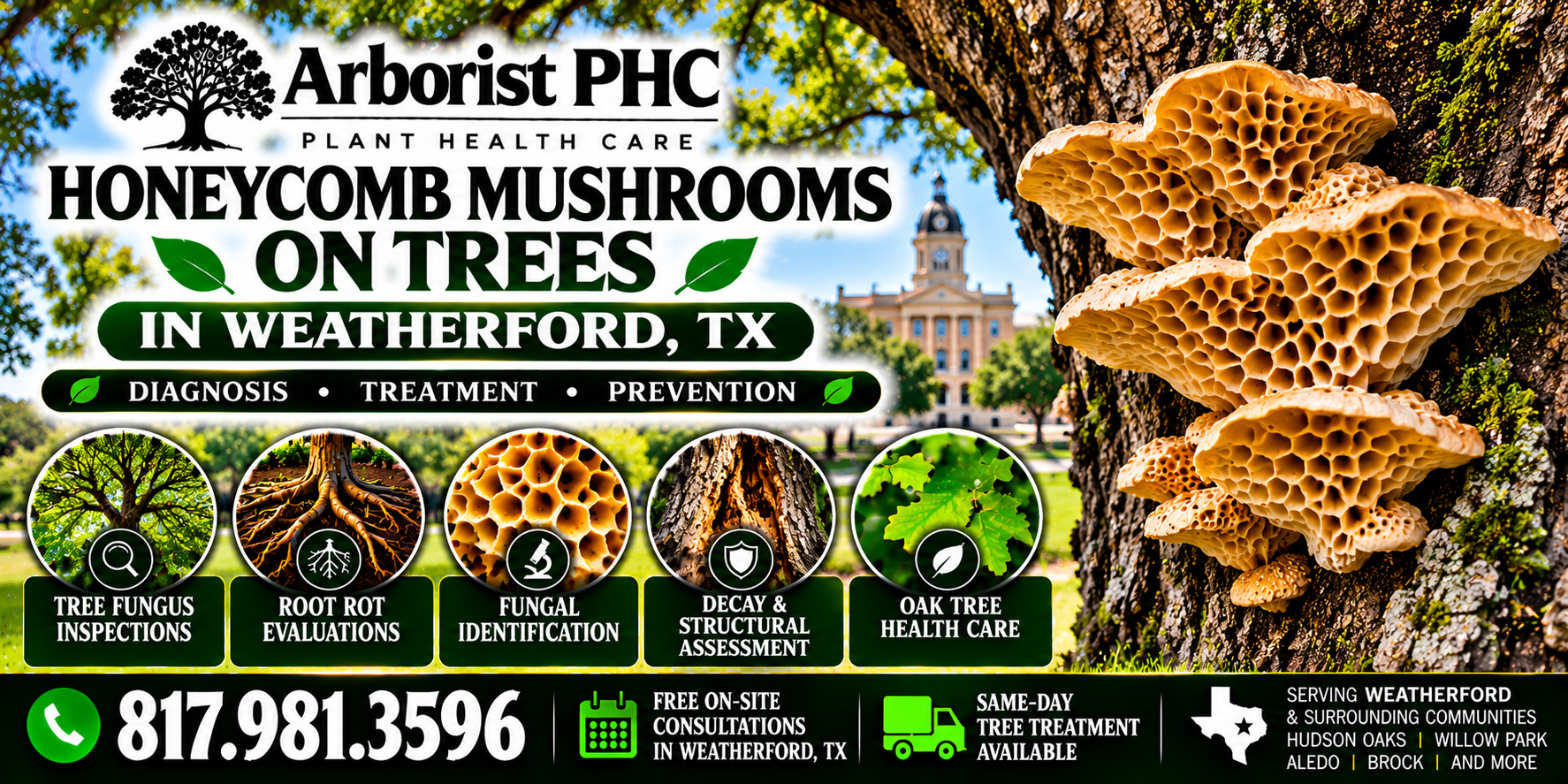
Honeycomb Mushrooms on Trees in Weatherford, TX | Tree Fungus Diagnosis & Treatment
Tree Fungus Inspections • Oak Tree Disease Diagnosis • Root Rot Evaluations • Fungal Decay Management • Professional Plant Health Care
FREE On-Site Tree Consultations | Same-Day Tree Treatment Available When Appropriate
Honeycomb Mushrooms Growing on Your Trees in Weatherford, Texas?
Have you recently noticed unusual mushrooms growing around the base of your oak tree, along exposed roots, or directly from the trunk?
Do the mushrooms have a honeycomb-like appearance, with small holes, honey-colored caps, or a textured underside?
If you're noticing honeycomb mushrooms on trees in Weatherford, TX, it may be time to have your tree professionally evaluated.
At Arborist PHC, we specialize in diagnosing tree health problems, evaluating fungal activity, and developing customized Plant Health Care programs for trees throughout Weatherford and Parker County.
Although mushrooms are a natural part of the environment, certain fungi can indicate decaying wood, compromised roots, or underlying health problems.
However, not every mushroom growing near a tree is harmful.
Some fungi naturally decompose dead wood, while others can infect living roots and contribute to serious tree decline.
The key is identifying the fungus and understanding its relationship with the tree.
ARBORIST PHC — DIAGNOSIS • TREATMENT • PREVENTION
Call or Text: 817.981.3596 | 682.220.8191
Schedule your FREE on-site tree health consultation in Weatherford, TX.
What Are Honeycomb Mushrooms on Trees?
Understanding Honeycomb-Like Fungal Growth
The term "honeycomb mushroom" can describe several different fungi, rather than one specific tree disease.
Some mushrooms have a honeycomb-shaped surface, while others have numerous visible pores beneath their caps.
These structures are involved in producing or releasing fungal spores.
One example is the hexagonal-pored polypore, Neofavolus alveolaris, formerly classified as Favolus alveolaris.
This fungus produces a distinctive honeycomb-like pattern of large, angular pores beneath its fruiting body.
It commonly grows on dead hardwood branches and decaying wood.
Because this species primarily decomposes dead material, its presence does not automatically mean a living tree is infected.
However, similar-looking mushrooms may belong to entirely different fungal groups.
Other possibilities include honey mushrooms associated with Armillaria species, bracket fungi, and wood-decay fungi.
Accurate identification is essential before determining whether treatment is necessary.
Why Are Mushrooms Growing on My Oak Tree?
Understanding Fungal Activity in Mature Trees
Mushrooms are the visible reproductive structures of certain fungi.
The main fungal organism may be growing inside wood, beneath bark, or throughout organic material in the soil.
When environmental conditions are favorable, the fungus may produce visible mushrooms or bracket-like structures.
Common contributing conditions include:
Decaying roots or buried wood
Dead branches or damaged trunk tissue
Excessive soil moisture
Poor drainage
Root-system injuries
Construction-related damage
Previous mechanical injuries
Naturally decomposing organic material
The presence of mushrooms does not always indicate an active infection.
However, mushrooms growing directly from a living tree's trunk, root flare, or major structural roots deserve closer examination.
These locations may indicate that wood-decay fungi are colonizing tissues important to the tree's stability.
Honey Fungus vs. Honeycomb Fungus: What's the Difference?
Two Different Types of Fungal Growth
Homeowners sometimes confuse honeycomb-like mushrooms with honey fungus.
Although the names sound similar, they are not the same thing.
Honeycomb-Like Polypore Fungi
Certain polypore fungi produce fruiting bodies with large, angular pores resembling a honeycomb.
For example, Neofavolus alveolaris commonly grows on dead hardwood material.
Its presence on a dead branch is different from finding a decay fungus emerging from the base of a mature living tree.
Honey Fungus (Armillaria Species)
Honey fungus refers to several fungi in the genus Armillaria.
Some species cause Armillaria root disease, which can infect roots and lower trunk tissues.
Potential symptoms include:
Yellowing or thinning foliage
Progressive canopy decline
Root deterioration
White fungal growth beneath affected bark
Dark, root-like fungal structures known as rhizomorphs
Clusters of honey-colored mushrooms near the tree base
Not every honey-colored mushroom is Armillaria, and laboratory identification may be necessary.
Are Honeycomb Mushrooms Dangerous to Oak Trees?
Understanding the Difference Between Fungal Presence and Fungal Disease
The risk depends on the fungus, the location of the growth, and the condition of the tree.
Mushrooms growing from dead branches may simply indicate natural decomposition.
However, fungal fruiting bodies emerging from the base of a mature oak may warrant investigation for root or butt decay.
Potential concerns include:
Root Decay: Certain fungi break down root tissues, potentially reducing root function and anchorage.
Butt Rot: Decay affecting the lower trunk can compromise important structural wood.
Internal Wood Decay: Some fungi progressively decompose wood inside the trunk or branches.
Reduced Structural Stability: Extensive decay may increase the likelihood of branch or whole-tree failure.
Progressive Tree Decline: Some fungal pathogens damage living tissues and contribute to declining tree health.
A tree may continue producing green foliage even while significant internal decay is developing.
For this reason, evaluating structural condition is just as important as examining canopy appearance.
Honeycomb Mushrooms on Live Oak Trees in Weatherford
Evaluating Mature Live Oaks
Live Oaks (Quercus virginiana) are common throughout Weatherford and surrounding Parker County communities.
These trees are valued for their large canopies, shade, and long lifespan.
When mushrooms develop around the base of a Live Oak, possible explanations include decomposing organic matter, dead roots, or wood-decay fungi.
Our evaluations consider:
The location of fungal growth
Root flare condition
Trunk injuries
Canopy density
Soil moisture
Drainage conditions
Evidence of internal decay
Overall tree stability
Not every Live Oak with mushrooms requires fungicide treatment.
Proper identification and evaluation help determine the most appropriate next steps.
Honeycomb Mushrooms on Bur Oak Trees
Fungal Growth Around Mature Bur Oaks
Bur Oaks (Quercus macrocarpa) are impressive shade trees known for their broad canopies and large leaves.
Although Bur Oaks can tolerate a range of growing conditions, they may experience fungal decay when roots or trunk tissues are injured or compromised.
Mushrooms emerging near the base of a Bur Oak should be evaluated to determine whether they are growing from buried dead wood or the tree's structural roots.
Depending on the findings, recommendations may include:
Fungal identification
Root flare evaluation
Drainage correction
Soil moisture management
Root-zone protection
Structural risk assessment
Targeted disease treatment when supported by the diagnosis
Removing visible mushrooms does not eliminate fungal growth already established inside infected or decaying wood.
Post Oak & Blackjack Oak Fungal Problems in Parker County
Weatherford and surrounding Parker County properties contain native Post Oaks (Quercus stellata) and Blackjack Oaks (Quercus marilandica).
These species are particularly important within the Cross Timbers landscape.
Mature native oaks may experience significant stress from:
Prolonged drought
Soil compaction
Construction activity
Root damage
Changes in drainage
Excessive irrigation
Environmental disturbances
Some stressed trees may develop opportunistic fungal problems.
One important condition affecting declining hardwoods is Hypoxylon Canker, associated with fungi in the Biscogniauxiagroup.
Hypoxylon Canker is different from the honeycomb-like mushroom fungi described above.
Correctly distinguishing between fungal diseases is essential because their management strategies differ significantly.
Signs of Fungal Decay in Trees
When Should You Contact an Arborist?
Mushrooms are not always the only warning sign of decay.
Other symptoms may include:
Mushrooms emerging directly from the trunk
Fungal brackets growing along the root flare
Soft or deteriorating wood
Hollow-sounding trunk sections
Bark separation
Cracks near the base
Dead or decaying structural roots
Sudden canopy thinning
Branch dieback
Changes in tree lean
Soil lifting around the root plate
Some of these symptoms may indicate structural concerns requiring prompt evaluation.
If a mature tree has significant basal decay, new leaning, or visible root-plate movement, keep people and vehicles away from the potential fall zone until the tree can be assessed by a qualified tree-risk professional.
Tree Fungus Treatment in Weatherford, TX
Can Fungicide Eliminate Honeycomb Mushrooms?
Treatment depends on the specific fungus and the extent of the problem.
Not every fungal organism can be controlled with fungicides.
For example, fungi that have extensively decomposed structural wood cannot be eliminated simply by applying a fungicide to the trunk or root zone.
Likewise, no chemical treatment can restore wood that has already decayed.
At Arborist PHC, we focus on identifying the fungal organism and determining whether an appropriate treatment is available.
A management plan may include:
1. Professional Diagnosis
Identifying the fungus and evaluating its relationship with the tree.
2. Root-Zone Evaluation
Examining soil moisture, drainage, root injuries, and environmental conditions.
3. Targeted Fungicide Applications
Using appropriately labeled products when the identified disease is responsive to treatment.
4. Environmental Stress Management
Addressing irrigation problems, soil compaction, and avoidable root disturbances.
5. Monitoring & Follow-Up
Evaluating changes in canopy health, fungal activity, and overall tree condition.
6. Structural Evaluation
Recommending additional tree-risk assessment when fungal decay may compromise stability.
The goal is to address treatable conditions while recognizing that advanced wood decay may require other management decisions.
Broad Brush Treatment (BBT) Programs in Weatherford
Customized Plant Health Care for Stressed Trees
At Arborist PHC, our Broad Brush Treatment (BBT) program is a customized approach to managing identified tree health concerns.
Depending on the diagnosis, the program may include:
Targeted disease management
Insect and pest management
Nutritional support when needed
Root-zone treatments
Seasonal preventative care
Follow-up evaluations
A BBT program may help address certain secondary problems affecting a stressed tree.
However, it is not a cure for established internal wood decay or severe structural root deterioration.
We recommend treatments based on the condition of the tree and the problems identified during inspection.
Root Rot & Excessive Soil Moisture in Weatherford
Why Drainage Matters
Root rot can develop when susceptible trees are exposed to certain pathogens and unfavorable root-zone conditions.
Excessively wet soils can reduce oxygen availability and contribute to root dysfunction.
Some root diseases, including those caused by certain Phytophthora species, may be favored by poorly drained conditions.
Potential symptoms include:
Yellowing foliage
Wilting
Reduced growth
Canopy thinning
Root deterioration
Progressive decline
Treatment may require irrigation adjustments, drainage improvements, and disease-specific management.
Because root diseases can resemble drought stress and other conditions, proper diagnosis is important.
Should You Remove Mushrooms From Your Tree?
Removing visible mushrooms may reduce their immediate presence, but it generally does not eliminate the underlying fungus.
The fungal organism may remain within wood, roots, or surrounding organic material.
If mushrooms are growing from the trunk or root flare, photographing them before removal can help with identification.
Photographs should show the mushroom's upper surface, underside, attachment point, and surrounding tree.
Avoid digging into structural roots or cutting into the trunk to investigate fungal growth.
These actions may cause additional damage.
Preventative Tree Health Care in Weatherford, TX
Protecting Mature Trees From Environmental Stress
Preventative Plant Health Care focuses on reducing avoidable stress and identifying developing problems early.
Our recommendations may include:
Seasonal tree inspections
Proper irrigation practices
Root-zone protection
Mulch management
Drainage evaluations
Disease monitoring
Pest identification
Nutritional assessments
Targeted treatment applications when appropriate
Maintaining favorable growing conditions can help support overall tree health, although it cannot guarantee protection from every fungal disease.
Tree Fungus Inspections for Ranches & Acreage Properties
Weatherford and surrounding Parker County communities feature numerous ranches, wooded properties, and large residential landscapes.
These properties may contain dozens of mature Post Oaks, Live Oaks, Blackjack Oaks, and other hardwood trees.
Fungal problems can develop in individual trees or across areas affected by similar environmental conditions.
At Arborist PHC, we provide evaluations for individual trees and multiple-tree properties.
We can help identify trees requiring further investigation and prioritize management based on health concerns and potential structural risks.
Why Choose Arborist PHC for Tree Fungus Evaluations?
Specialized Plant Health Care: Our focus is diagnosing, treating, and helping prevent tree health problems.
Free On-Site Consultations: We provide complimentary initial tree health evaluations.
Fungal Disease Evaluations: We assess symptoms and recommend appropriate identification and management options.
Customized Treatment Programs: Recommendations are based on tree species, condition, and diagnosis.
Mature Oak Tree Care: We evaluate Live Oaks, Red Oaks, Post Oaks, Blackjack Oaks, and Bur Oaks.
Same-Day Treatment Availability: Appropriate treatments may be completed during the initial visit when scheduling allows.
Local Service: We serve Weatherford, Hudson Oaks, Willow Park, Aledo, Brock, Poolville, and surrounding Parker County communities.
Frequently Asked Questions About Honeycomb Mushrooms on Trees
What causes honeycomb mushrooms to grow on trees?
Different fungi produce honeycomb-like structures. Some grow on dead wood, while others may be associated with root or trunk decay. Identification is necessary to determine the cause.
Are honeycomb mushrooms a sign that my tree is dying?
Not necessarily. Some fungi decompose dead wood without infecting living tissue. However, mushrooms growing directly from structural roots or the lower trunk may indicate decay that warrants professional evaluation.
Can fungicide kill mushrooms growing on an oak tree?
Some fungal diseases can be managed with properly selected fungicides, but many wood-decay fungi cannot be cured with chemical applications. Fungicides also cannot restore decayed wood.
Should I remove mushrooms from the base of my tree?
Removing mushrooms does not usually eliminate the underlying fungus. Photographing them before removal can help with identification.
Can a tree survive with fungal decay?
Some trees remain alive for years despite localized decay. Survival and structural stability depend on the extent and location of the damage.
Do you treat fungal diseases in Weatherford, TX?
Yes. Arborist PHC provides tree disease evaluations and targeted treatment recommendations for appropriate fungal conditions.
Do you offer free tree fungus inspections?
We offer complimentary initial on-site tree health consultations. Specialized diagnostic testing or advanced structural assessments may require additional services.
Schedule a Tree Fungus Inspection in Weatherford, TX
If you've discovered honeycomb mushrooms growing on your oak tree in Weatherford, Texas, don't automatically assume the tree is dying—but don't ignore potentially serious signs of decay.
Identifying the fungus and evaluating the tree's condition are the first steps toward determining whether treatment or additional management is necessary.
At Arborist PHC, we provide professional tree health consultations, fungal disease evaluations, and customized Plant Health Care recommendations.
ARBORIST PHC | PLANT HEALTH CARE
DIAGNOSIS • TREATMENT • PREVENTION
FREE ON-SITE TREE CONSULTATIONS
SAME-DAY TREE TREATMENT AVAILABLE WHEN APPROPRIATE
CALL OR TEXT: 817.981.3596
Serving Weatherford, Hudson Oaks, Willow Park, Aledo, Brock, Poolville, Springtown, Azle, and surrounding Parker County communities.