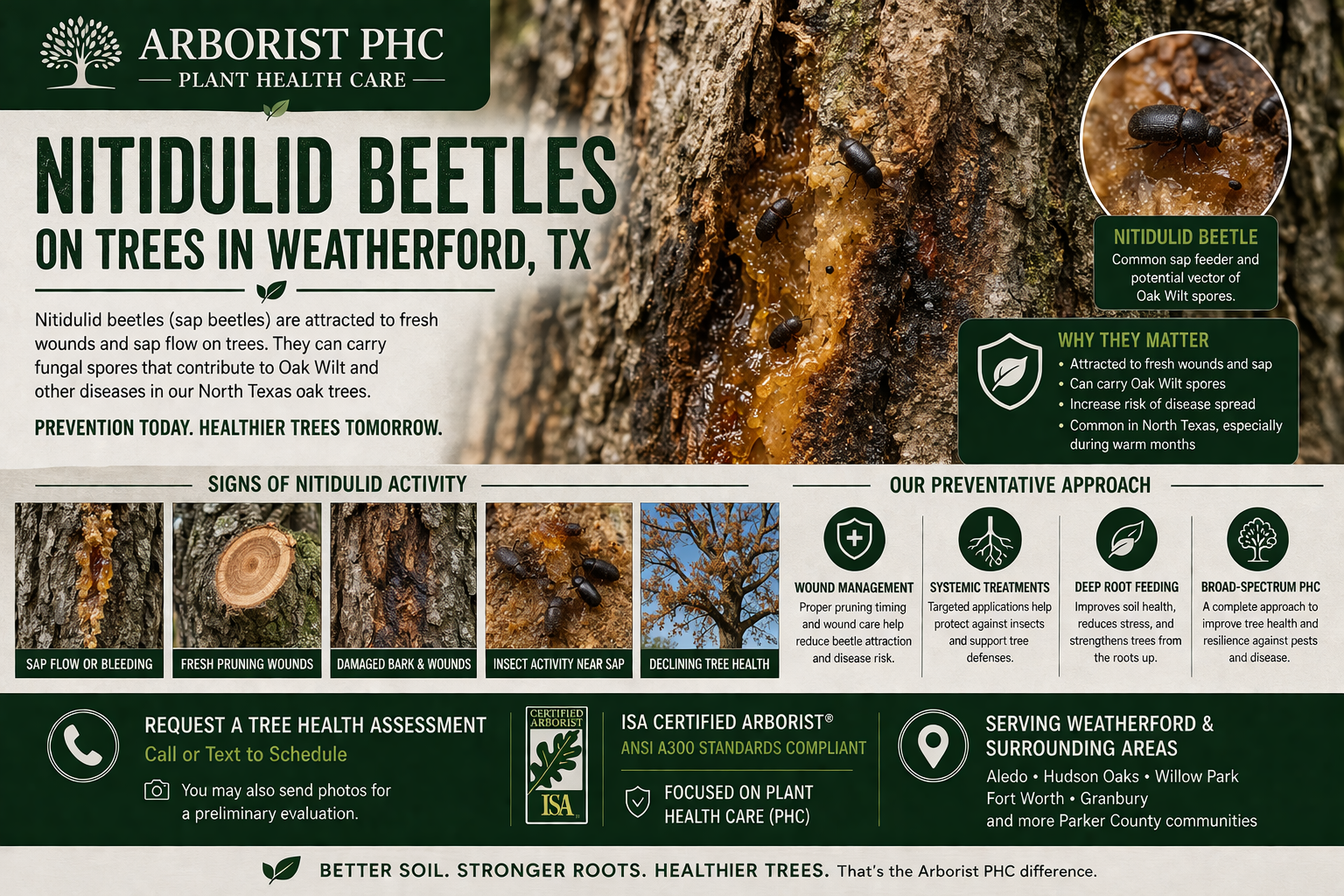
Nitidulid Beetle Activity on Trees in Weatherford, TX | Oak Wilt Vector Management | Arborist PHC
ISA Certified Arborist® | ANSI A300 Compliant | Serving Weatherford & North Texas
Nitidulid Beetle Activity on Trees in Weatherford, TX
Understanding Sap Beetles and Their Role in Tree Health
Nitidulid beetles, commonly referred to as sap beetles, are a significant concern in Weatherford and across North Texas due to their role in spreading Oak Wilt and targeting stressed trees.
At Arborist PHC, we focus on identifying insect activity, evaluating associated risks, and implementing plant health care strategies to reduce exposure and protect trees.
Our approach follows ISA arboriculture principles and ANSI A300 standards, emphasizing proper diagnosis and preventative care.
What Are Nitidulid Beetles?
Nitidulid beetles are small insects attracted to:
Fresh pruning wounds
Damaged bark
Sap flow from stressed trees
They feed on plant sap and organic material and can carry fungal spores, including those associated with Oak Wilt transmission.
Why Nitidulid Beetles Matter in Weatherford, TX
These beetles are particularly important because they can:
Transfer fungal spores from infected trees
Introduce pathogens into fresh wounds
Increase the risk of Oak Wilt infection
In areas with high oak populations, such as Weatherford, this creates a serious risk for Live Oaks and Red Oaks.
Signs of Nitidulid Beetle Activity
While the beetles themselves are small and often not seen, indicators may include:
Sap bleeding or fresh wounds on trees
Increased insect presence around damaged bark
Attraction to recently pruned trees
Secondary stress symptoms in nearby trees
Their presence is often tied to tree stress or improper pruning timing.
The Connection to Oak Wilt
Nitidulid beetles are known vectors of Oak Wilt.
They are attracted to:
👉 Fresh cuts or wounds on trees
👉 Fungal mats on infected Red Oaks
When beetles move between trees, they can carry fungal spores, increasing the likelihood of infection.
This is why proper timing and treatment are critical.
Our Preventative Approach (Watch Our Process)
Managing Nitidulid beetle risk is largely about prevention and tree health.
Wound Management & Protection
Avoid pruning during high-risk periods
Seal or treat fresh wounds when necessary
Reduce exposure to beetle activity
Basal Drench & Systemic Applications
Helps protect against secondary insect pressure
Supports overall tree defense systems
Deep Root Feeding (Soil Injection)
Improves tree vigor and stress tolerance
Reduces susceptibility to insect attraction
Broad-Spectrum Plant Health Care (BBT)
Addresses multiple stress factors
Strengthens tree resilience and recovery
Why Tree Stress Attracts Beetles
Nitidulid beetles are most active around stressed or damaged trees.
Common stress factors in Weatherford include:
Drought and extreme heat
Heavy clay soils
Root damage or compaction
Disease presence
Reducing stress is one of the most effective ways to limit beetle activity.
Our Diagnosis-First Approach
Not all insect activity poses the same level of risk.
We evaluate:
Tree species and condition
Presence of wounds or damage
Environmental stress factors
Proximity to infected trees
This allows us to determine whether intervention is necessary and what level of treatment is appropriate.
Service Areas Near Weatherford
We proudly serve:
Hudson Oaks
Willow Park
Surrounding Parker County communities
Request a Tree Health Assessment in Weatherford, TX (Click Here To Submit A Form)
If you’re concerned about insect activity or potential Oak Wilt exposure, early evaluation is critical.
📞 Call or Text to Schedule
📸 Send photos for a preliminary review
We’re here to help you protect your trees and reduce risk through proper diagnosis and preventative care.
Frequently Asked Questions
-
Not directly—but they can contribute to disease spread, especially Oak Wilt.
-
They are most active during warmer months and are attracted to fresh wounds.
-
Pruning should be done carefully and at the correct time to reduce risk. Improper timing can increase beetle attraction.
-
Preventative measures can significantly reduce risk, especially when combined with proper tree care practices.
-
No—Arborist PHC specializes strictly in plant health care, diagnosis, and treatment programs.